MGA 2400 Scrap Buyer, Importer and Exporter in India
Mipra Steel trades MGA 2400 vane scrap and revert from Mumbai, kept apart from IN-939 and the MGA blade alloys.
Sell MGA 2400 Scrap
Selling MGA 2400 vane segments or revert? Tell us the segment count and weight, the turbine model and row, whether the parts are coated or stripped, and where they are. Readings taken on ground metal that show chromium and tungsten are the quickest way to settle IN-939 questions. We review incoming enquiries and respond with relevant next steps.
Buy MGA 2400 Scrap
If you melt vane alloys and want MGA 2400, let us know your tonnage, whether coated ex-service segments are acceptable or only revert, the chromium and tungsten readings you need to see, and your discharge port. Lots are named as MGA 2400 only where the readings support it.
What Is MGA 2400, and Why Is It So Easy to Confuse with IN-939?
A turbine vane does not spin, but it sits directly in the hottest, dirtiest gas stream coming out of the combustor. Vane alloys are therefore built with more chromium and cobalt for hot-corrosion and oxidation resistance, and less gamma prime than blade alloys. MGA 2400 follows that pattern. Mitsubishi Heavy Industries developed it with Mitsubishi Steel Manufacturing, and published MHI work records it in service in the 1,500°C class M501G turbine from January 1997, with use in the M501G and M701G.
Look at its analysis next to IN-939 and the problem is obvious. Cobalt (19%), titanium (3.7%), aluminium (1.9%), tantalum (1.4%) and niobium (1%) are effectively identical. Only two numbers differ: MGA 2400 has about 19% chromium against IN-939's 22.4%, and about 6% tungsten against roughly 2%. Those two gaps are big enough for a handheld XRF on clean metal, but a vane read through its coating, or a lot nobody has read at all, can easily be called IN-939.
That matters to the buyer at the other end. A melter making a vane alloy to a chromium window, or one who values the extra tungsten, needs to know which of the two is going into the furnace. Four extra points of tungsten also make MGA 2400 the heavier refractory carrier of the pair. There is no molybdenum in the nominal chemistry, which gives one more clue when a lot looks mixed.
MGA is a Mitsubishi designation, and the name appears as MGA 2400, MGA2400 or occasionally as a misprint in older documents. Its blade-alloy siblings are compared on the MGA alloy scrap page.
MGA 2400 belongs to the MGA family, part of superalloy scrap.
Where MGA 2400 Scrap Is Released
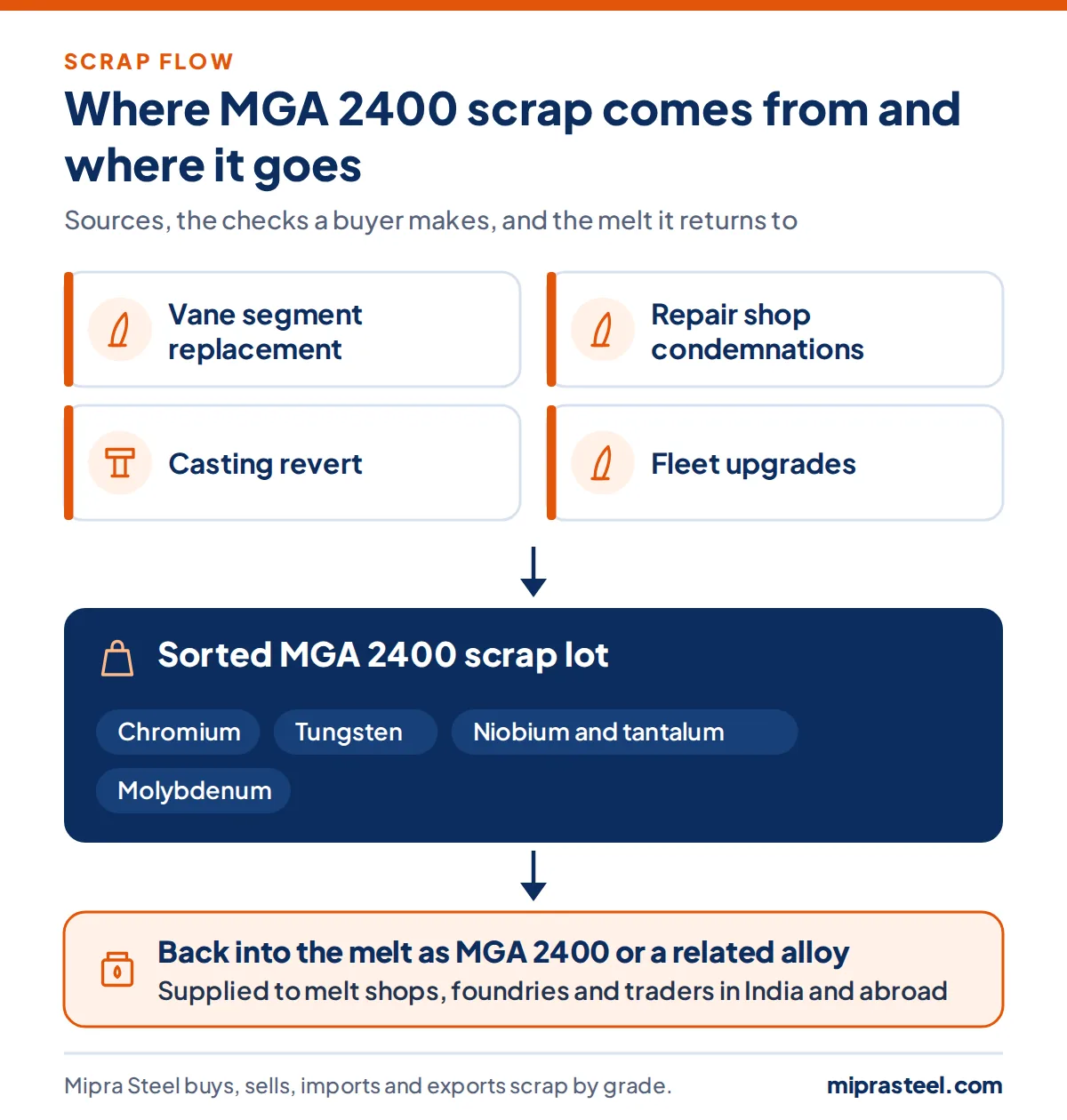
Because MGA 2400 is a vane alloy for large Mitsubishi frames, its scrap follows those machines' maintenance cycles and the foundries that cast their vanes.
Vane Segment Replacement
Nozzle or vane segments changed at combustion and hot-gas-path inspections. They usually carry thermal barrier or metallic coatings and may show burning, cracking or weld repairs.
Repair Shop Condemnations
Vane segments that have been through repair cycles and are judged no longer repairable.
Casting Revert
Gates, risers and rejected vane castings from conventionally cast production, normally documented by heat.
Fleet Upgrades
When a power station upgrades a unit, earlier vane rows may be released in reasonable condition. See power generation scrap.
MGA 2400 Scrap Specification Chart
| Grade | MGA 2400 |
|---|---|
| UNS | Not assigned (proprietary Mitsubishi Heavy Industries alloy) |
| W.Nr. / EN | Not assigned |
| Identified by | Mitsubishi specification, turbine part records and analysis |
| Also known as | MGA2400 |
| Alloy type | Cast nickel superalloy (gas turbine vane alloy) |
| Density | Not published |
| Magnetic | Non-magnetic. |
| HS code (customs heading) | 7503.00 (nickel waste and scrap) |
MGA 2400 Chemical Composition
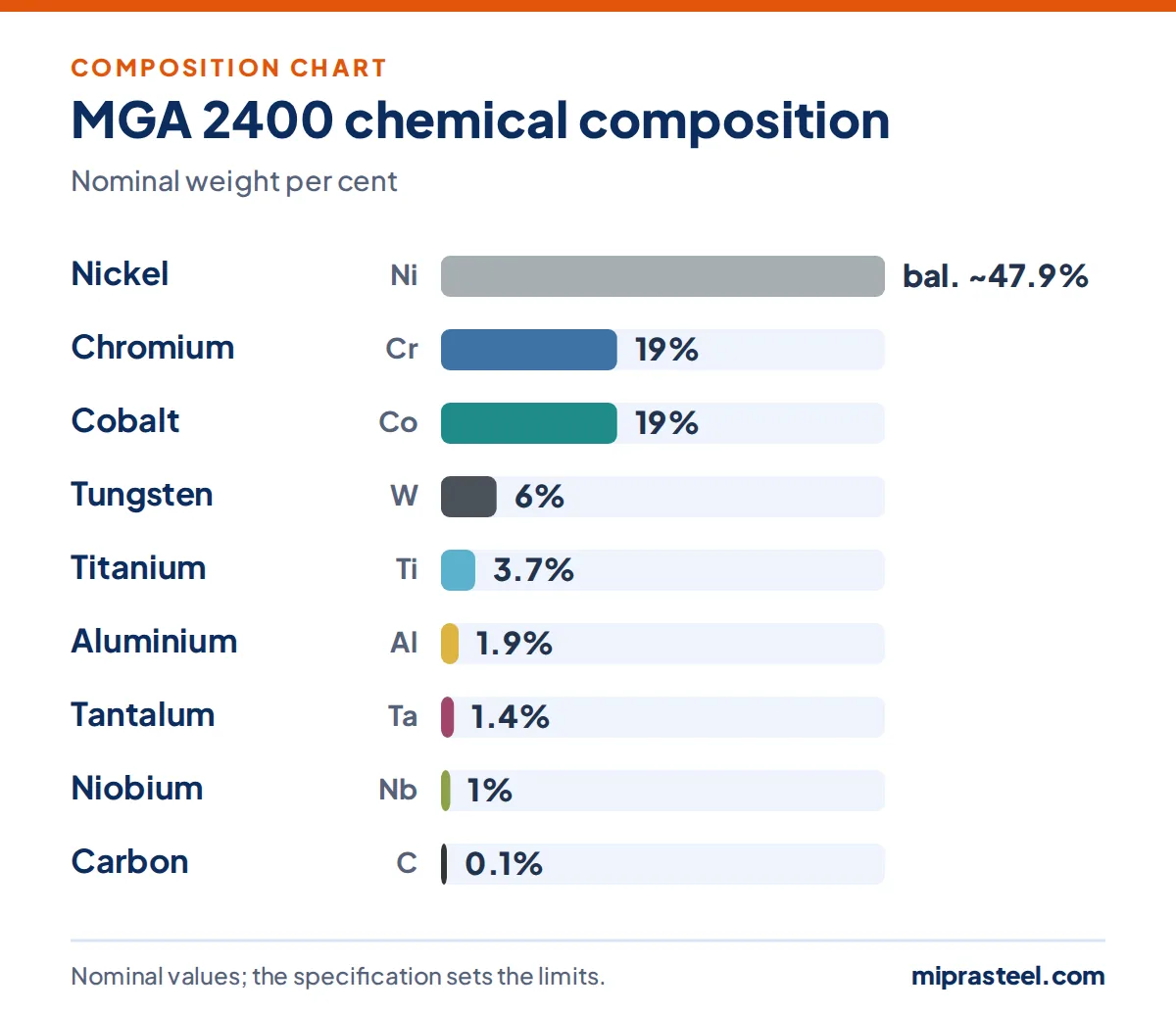
Nominal composition in weight per cent, used to describe and identify the grade. The governing specification sets the limits for each product.
| Element | Symbol | Nominal wt% | |
|---|---|---|---|
| Nickel | Ni | Balance (about 47.9) | |
| Chromium | Cr | 19 | |
| Cobalt | Co | 19 | |
| Tungsten | W | 6 | |
| Titanium | Ti | 3.7 | |
| Aluminium (aluminum) | Al | 1.9 | |
| Tantalum | Ta | 1.4 | |
| Niobium | Nb | 1 | |
| Carbon | C | 0.1 |
MGA 2400 Equivalent Grades and Other Names
| Designation | Value |
|---|---|
| Trade name | MGA 2400 |
| UNS | Not assigned (proprietary Mitsubishi Heavy Industries alloy) |
| W.Nr. / EN | Not assigned |
| Other names in the trade | MGA2400 |
Look up any designation in the grade name converter or the equivalent grade chart.
MGA 2400 Standards and Specifications
Mitsubishi Heavy Industries specification.
MGA 2400 Applications
- Industrial gas turbine vanes
Source industries: power generation.
How MGA 2400 Scrap Is Identified
The working question for MGA 2400 is almost always "is this MGA 2400 or IN-939?", followed by "is anything else mixed in?"
| Check | What it shows for MGA 2400 |
|---|---|
| Chromium | About 19% points to MGA 2400. IN-939 and GTD-222 read about 22 to 22.5%. |
| Tungsten | About 6% for MGA 2400, against about 2% for IN-939 and GTD-222. This is the clearest single split. |
| Niobium and tantalum | About 1% and 1.4%. Their presence places a piece in the vane group, not with blade alloys such as MGA 1400. |
| Molybdenum | Should be absent. A molybdenum reading suggests a different alloy or a mixed package. |
| Coating and ceramic | Ceramic thermal barrier coat and bond coat must be ground off a test spot first; they distort chromium, aluminium and cobalt figures. |
| Repairs and attachments | Weld-repaired areas may be a different filler alloy. Read the parent metal away from repairs. See how XRF readings are taken on alloys. |
Grades Most Often Confused with MGA 2400
- IN-939: same cobalt, titanium, aluminium, tantalum and niobium, but about 22.4% chromium and 2% tungsten.
- GTD-222: another vane alloy with 22.5% chromium and 19% cobalt, but lower titanium (2.3%) and tungsten (2%).
- MGA 1400: the blade alloy from the same turbines: 14% chromium, 10% cobalt, 4.7% tantalum and no niobium.
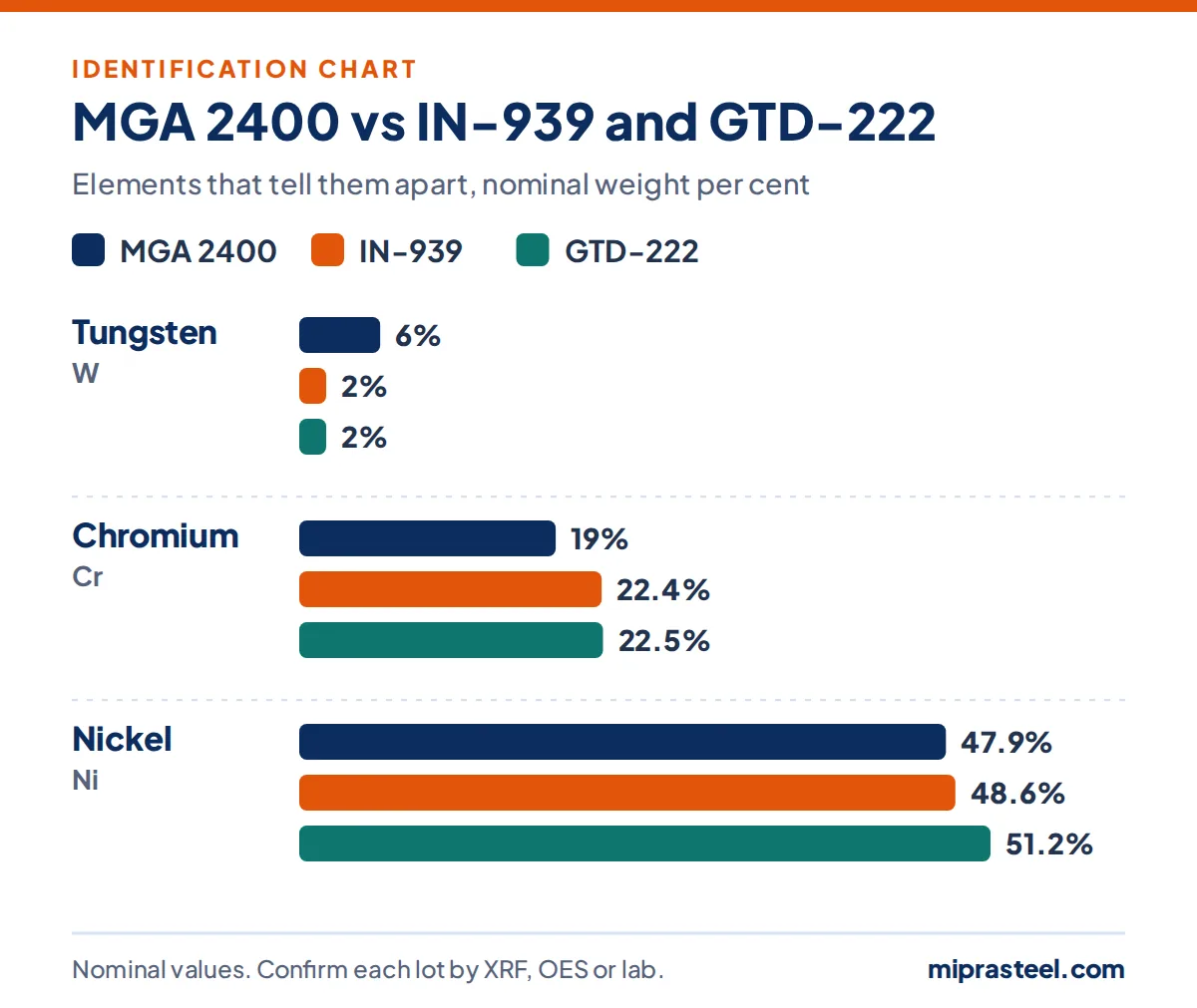
Nominal values for MGA 2400 against its closest grades on this site.
Preparing MGA 2400 Scrap for Sale
- Grind a small test spot on each segment and record chromium and tungsten.
- Move anything reading about 22% chromium and 2% tungsten into a separate IN-939 package.
- Remove seals, pins and attached sheet-metal parts from segments.
- Keep foundry revert, stripped segments and coated segments apart.
- List turbine model and row on the packing sheet where known.
MGA 2400 Scrap Price per Kg: What Decides It
What MGA 2400 scrap fetches per kg depends on a short list of grade-specific factors.
- Cobalt at about 19%, a large share of the contained value for a vane alloy.
- Tungsten at about 6%, with smaller tantalum and niobium contents.
- Correct naming against IN-939 and GTD-222, supported by readings on each segment.
- How much of the weight is ceramic coating, bond coat and oxide on ex-service segments.
- Weld repairs, braze and attached seals or hardware, which a buyer either deducts for or asks to be removed.
- Foundry revert over service scrap, because it is uncoated and traceable by heat.
Cobalt and tungsten prices move separately from nickel, so any offer carries a date. The reasoning is explained in nickel alloy scrap value.
MGA 2400 Scrap Import and Export
Importing MGA 2400 Scrap into India
Mitsubishi G-class and F-class frames run in East Asia, the Gulf and elsewhere, and vane rows leave those fleets at scheduled outages. Indian buyers bring MGA 2400 in through traders and overhaul channels. Shipments are inspected in the country of origin and come with their pre-shipment inspection certificate together with invoice, packing list and bill of lading, landing at Nhava Sheva, Mundra or Chennai. Insist that MGA 2400 and IN-939 segments are packed and listed separately. See India import rules for nickel alloy scrap.
Exporting MGA 2400 Scrap from India
MGA 2400 leaving India is listed by grade on invoice and packing list, weighed, and packed in crates or drums inside containers loaded at Nhava Sheva or Mundra. Natural buyers are vane-alloy melters and revert traders in Japan, South Korea and Europe. Our Dubai and South Korea offices keep us close to Gulf power stations and East Asian melters. See alloy scrap export documents.
Customs heading: 7503.00 (nickel waste and scrap). The HS code is the international tariff heading the scrap is declared under; national tariff lines add further digits, so confirm the full line with your customs broker.
Other MGA Scrap Grades
Related Reading
MGA 2400 Scrap FAQ
How do I tell MGA 2400 from IN-939?
Check chromium and tungsten on clean metal. MGA 2400 reads about 19% chromium and 6% tungsten; IN-939 reads about 22.4% chromium and 2% tungsten. Everything else, including cobalt, titanium, tantalum and niobium, is practically the same.
Is MGA 2400 a blade or a vane alloy?
A vane alloy. Mitsubishi uses MGA 2400 for the stationary vanes of heavy-duty gas turbines, while MGA 1400 and MGA 1400 DS are its rotating blade alloys. Vanes and blades from one outage should be packed separately.
Which turbines use MGA 2400 vanes?
Published Mitsubishi work states that MGA 2400 vanes have been in service in the 1,500°C class M501G since January 1997, and that the alloy is used in the M501G and M701G. Other models may also use it; part records confirm this for a given lot.
Why does the 6% tungsten in MGA 2400 matter to buyers?
It is about three times the tungsten in IN-939, so a melter targeting one alloy gets the wrong tungsten if the other is mixed in. It also adds refractory value, which is one reason correctly named lots are worth more than mixed vane scrap.
Can coated MGA 2400 vane segments be sold as they are?
Yes. Coated segments are traded regularly, but buyers allow for ceramic and bond coat weight and for any weld repairs. Stripped segments and foundry revert are easier to describe and need fewer deductions.
What is the customs classification for MGA 2400 scrap?
MGA 2400 is a nickel-base alloy, so its scrap is normally entered under HS 7503.00 (nickel waste and scrap). National subheadings differ, and a customs broker should confirm the complete code for each shipment.
How do I offer MGA 2400 segments to Mipra Steel?
Send segment count, weight, turbine model, coating condition and location, with photographs and any chromium and tungsten readings. Part rows and full sets can both be discussed.
What is MGA 2400 made of?
Nominally 47.9% nickel, 19% chromium, 19% cobalt, 6% tungsten, 3.7% titanium, 1.9% aluminium, 1.4% tantalum, 1% niobium, 0.1% carbon. Specification ranges vary by product form and standard.
Published by Mipra Steel, Khetwadi, Mumbai · Updated