Udimet 500 Scrap Buyer, Importer and Exporter in India
Mipra Steel buys Udimet 500 blades, vanes, discs and revert from turbine service work and casting houses, and supplies sorted U-500 lots to superalloy melters and traders.
Sell Udimet 500 Scrap
Selling U-500 blades or vanes? Tell us the engine or turbine type they came from, the number of pieces or the weight, and the city. Photos of roots, platforms and any part numbers help most. If you have readings, include cobalt, chromium, titanium, aluminium and molybdenum, and say whether the parts are coated. We review incoming enquiries and respond with relevant next steps.
Buy Udimet 500 Scrap
Superalloy melters and revert processors who can use cobalt-bearing gamma-prime scrap can source U-500 from us. Say how much you need, whether you take coated ex-service parts or only clean revert, your limits on tungsten, tantalum and niobium, and which port you ship to. We describe lots as Udimet 500, UNS N07500, with supporting readings or overhaul records where available.
What Is Udimet 500, and Why Does Its Scrap Still Appear?
Udimet 500 belongs to the first generation of turbine blade superalloys. It pairs high cobalt and chromium with equal, fairly generous amounts of titanium and aluminium, which gives a large volume of the strengthening phase while keeping enough chromium to resist hot corrosion. It was produced as forged bar and as investment castings, so the same chemistry turns up as wrought blades and discs and as cast vanes.
Newer alloys displaced it from new engine designs long ago. The reason U-500 still reaches the scrap market is the long life of the machines it went into. Older industrial gas turbines, mechanical-drive units on pipelines and platforms, and legacy aero engines kept in service or used as spares stocks continue to shed blades, vanes and discs at each overhaul. When a fleet type is finally retired, its spares and rejected parts come out together.
That history makes U-500 lots small and scattered. A typical parcel is a few hundred kilograms of blades from one overhaul, a drum of rejected castings, or a pallet of discs, rather than a regular flow. Because it often travels with other blade alloys from the same engine, keeping it apart from neighbours with similar cobalt and chromium, such as Nimonic C-263 and IN-939, is the main task. The superalloy scrap page explains how such mixed parcels are usually split.
Udimet is a Special Metals brand name; this page uses it only to say which alloy a scrap lot contains.
Udimet 500 belongs to the superalloy family.
Where Udimet 500 Scrap Comes From
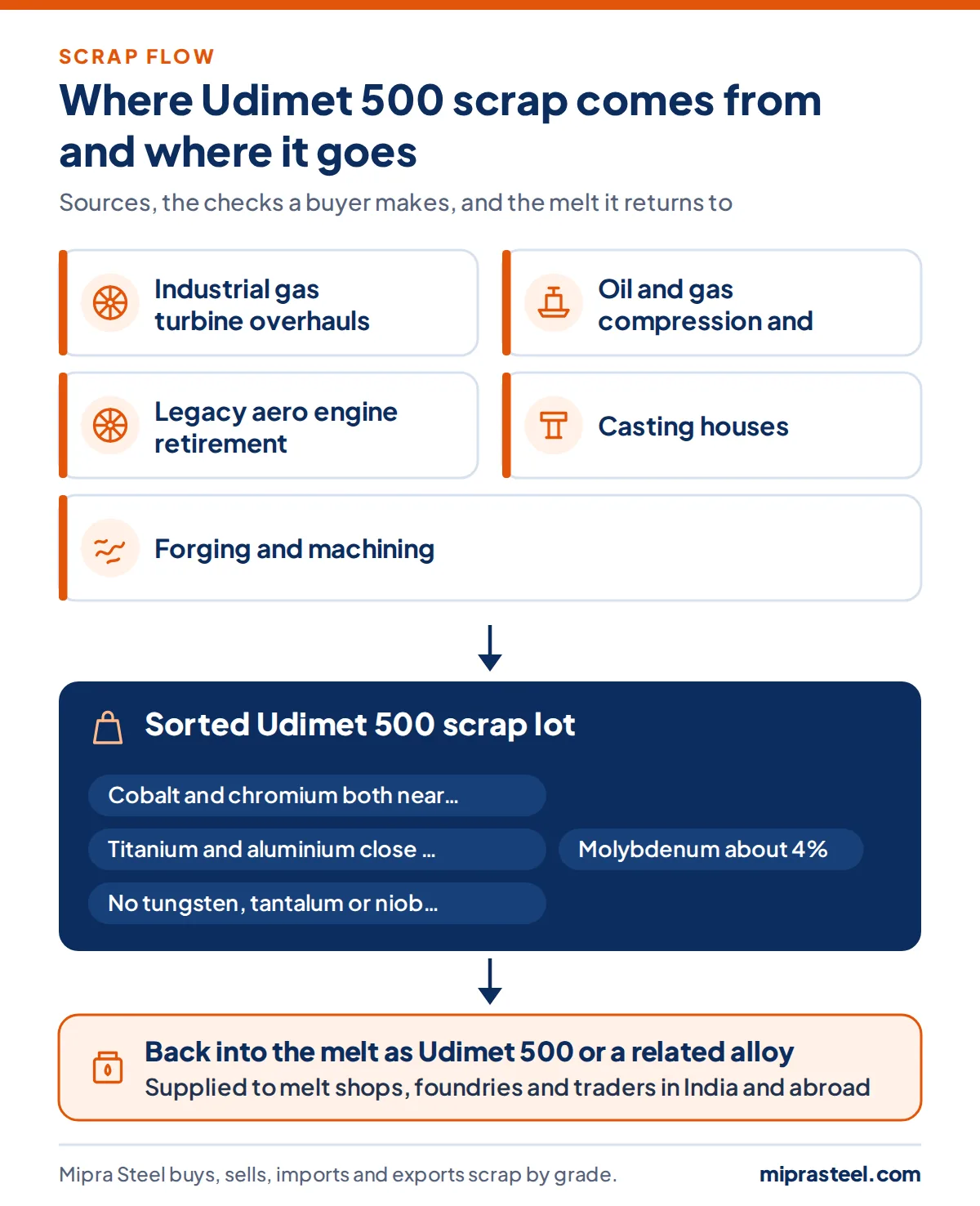
Almost all U-500 scrap is ex-service or overhaul material. These are the usual origins.
Industrial Gas Turbine Overhauls
Blades and vanes replaced at hot-gas-path inspections on older frame and mechanical-drive units. See power generation scrap.
Oil and Gas Compression and Pumping Stations
Aero-derivative and small industrial turbines on pipelines and platforms. See oil and gas scrap.
Legacy Aero Engine Retirement
Blades, vanes and discs from engine types being withdrawn, including unused spares.
Casting Houses
Rejected investment castings, gates and risers from remaining U-500 production to AMS 5384.
Forging and Machining
Bar crops and turnings from parts made to AMS 5751.
Udimet 500 Scrap Specification Chart
| Grade | Udimet 500 |
|---|---|
| UNS | N07500 |
| W.Nr. / EN | Not assigned; specified by UNS N07500 |
| Also known as | U-500, Alloy 500 (superalloy) |
| Alloy type | Precipitation-hardened (γ′) nickel superalloy |
| Density | 8.02 g/cm³ (0.29 lb/in³) |
| Magnetic | Non-magnetic. |
| HS code (customs heading) | 7503.00 (nickel waste and scrap) |
Udimet 500 Chemical Composition
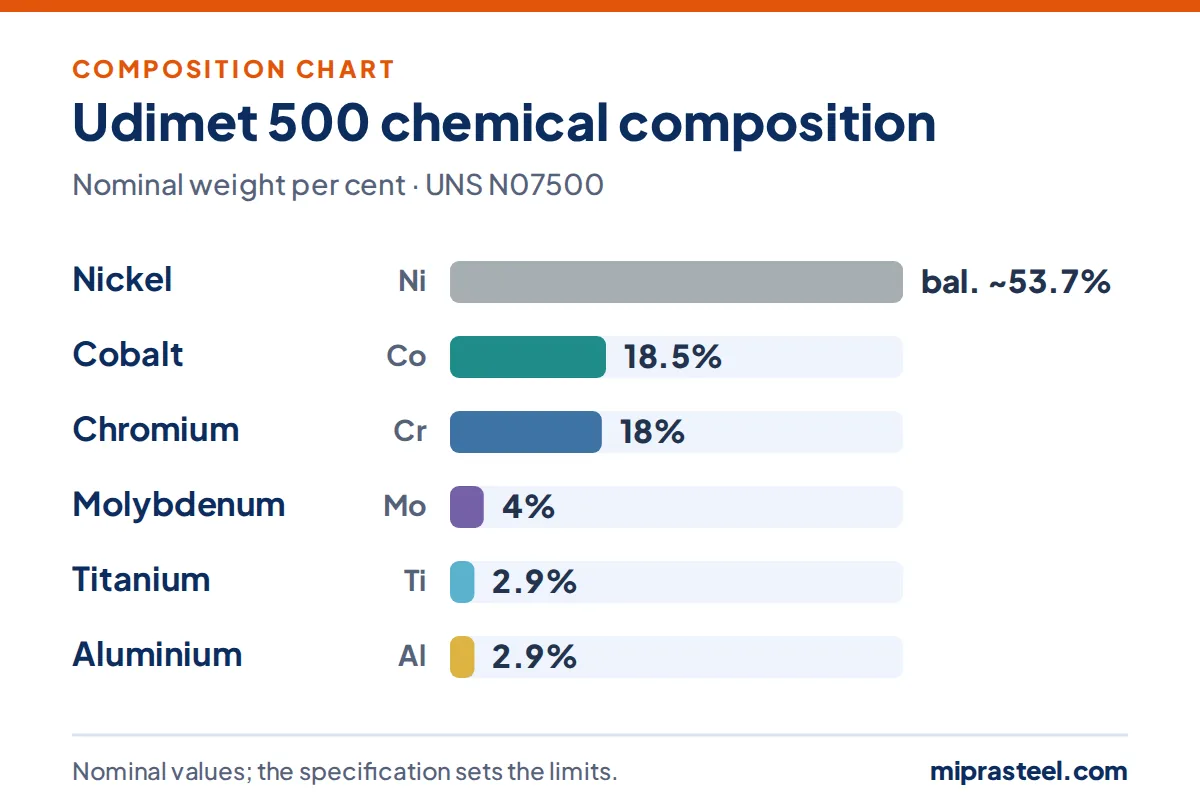
Nominal composition in weight per cent, used to describe and identify the grade. The governing specification sets the limits for each product.
| Element | Symbol | Nominal wt% | |
|---|---|---|---|
| Nickel | Ni | Balance (about 53.7) | |
| Cobalt | Co | 18.5 | |
| Chromium | Cr | 18 | |
| Molybdenum | Mo | 4 | |
| Titanium | Ti | 2.9 | |
| Aluminium (aluminum) | Al | 2.9 |
Udimet 500 Equivalent Grades and Other Names
| Designation | Value |
|---|---|
| Trade name | Udimet 500 |
| UNS | N07500 |
| W.Nr. / EN | Not assigned; specified by UNS N07500 |
| Other names in the trade | U-500, Alloy 500 (superalloy) |
Look up any designation in the grade name converter or the equivalent grade chart.
Udimet 500 Standards and Specifications
Udimet 500 Applications
- Turbine blades and vanes in legacy engines
- Discs and hot-section parts
Source industries: aerospace, power generation.
How Udimet 500 Scrap Is Identified
U-500 has no unusual element of its own; it is identified by the balance of six. Check each of these against the nominal analysis.
| Check | What it shows for Udimet 500 |
|---|---|
| Cobalt and chromium both near 18% | The core of the fingerprint. Cobalt near 15% with chromium near 15% leans towards René 77 instead. |
| Titanium and aluminium close to 3% each | Roughly equal titanium and aluminium is typical. Aluminium needs OES or a light-element XRF. XRF, OES or a lab? explains the choice. |
| Molybdenum about 4% | Lower than C-263 (about 6%) and well below Inconel 617 or Haynes 282. |
| No tungsten, tantalum or niobium | Any of these suggests a different blade alloy, for example IN-939, which carries all three. |
| Coatings | Ex-service blades and vanes are often aluminide or overlay coated. Clean back a patch on the fir-tree root or platform before taking a reading. |
| Part numbers and engine records | Overhaul paperwork naming the engine type and part number is often the fastest way to confirm U-500 on blades. |
Grades Most Often Confused with Udimet 500
- René 77: sits close but reads about 15% cobalt, 14.6% chromium and 4.3% aluminium.
- Nimonic C-263: has about 20% each of cobalt and chromium but only 0.45% aluminium and about 6% molybdenum.
- IN-939: has similar cobalt but about 22% chromium plus tungsten, tantalum and niobium.
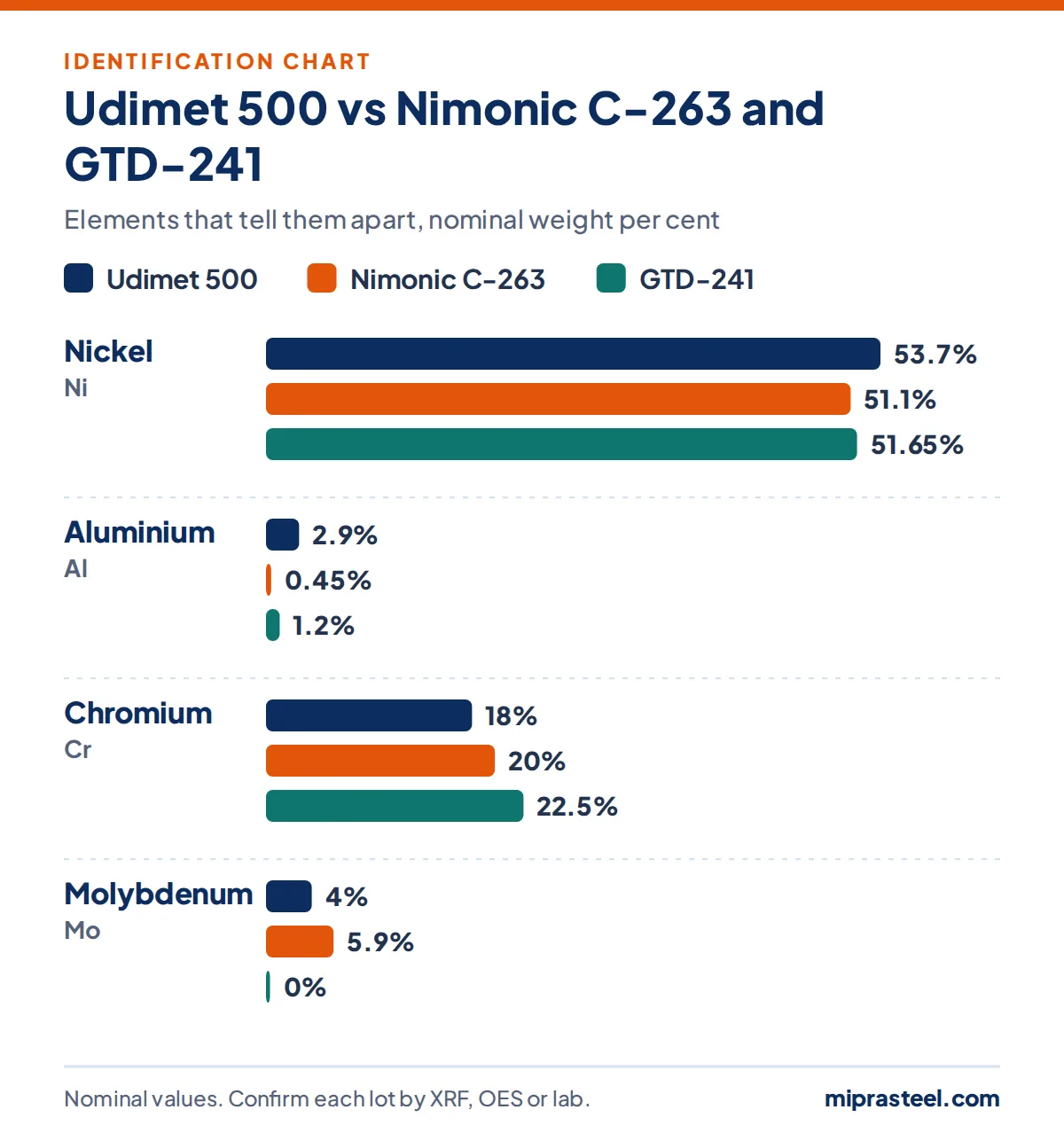
Nominal values for Udimet 500 against its closest grades on this site.
Preparing Udimet 500 Scrap for Sale
- Pull dampers, pins, lock plates and seals off blades before weighing.
- Separate cast vanes from forged blades and disc pieces.
- Keep U-500 away from IN-939, René 77 and C-263 parts from the same overhaul.
- Box coated parts as their own line and note the coating if known.
- Copy the engine type and part numbers onto the packing list.
Udimet 500 Scrap Price per Kg: What Decides It
Udimet 500 scrap is priced as a cobalt-bearing superalloy, so an offer per kg reflects nickel and cobalt together, then adjusts for how certain and how clean the parcel is.
- Cobalt at about 18.5%, a major part of the value next to nickel at about 54%.
- Molybdenum at about 4%, a smaller credit.
- Grade certainty: blades confirmed by reading or by engine and part records, against an unsorted bin of mixed turbine parts.
- Coatings and service oxide on blades and vanes, which reduce yield and add tramp elements.
- Attached hardware: blade dampers, pins, seals and brazed shrouds of other alloys must come off.
- Cast versus wrought: castings and revert with gating are judged differently from clean forged blades and disc pieces.
Nickel and cobalt each have a daily market, so a U-500 offer is tied to its date. See how nickel alloy scrap is valued and, for blades, selling turbine blade scrap.
Udimet 500 Scrap Import and Export
Importing Udimet 500 Scrap into India
U-500 parcels arise wherever older turbines are still overhauled: the Gulf, Europe, North America and parts of Asia. Small parcels are often consolidated before shipping to India. Paperwork is the standard set for metal scrap (inspection certificate issued before loading, invoice, packing list, bill of lading), and cargo typically lands at Nhava Sheva or Mundra. Describing it as "Udimet 500 nickel superalloy scrap, UNS N07500" and attaching readings keeps it from being lumped in with mixed turbine scrap. Read importing nickel alloy scrap into India.
Exporting Udimet 500 Scrap from India
Turbine overhauls in India release U-500 in small lots that suit overseas superalloy recyclers once several parcels are combined. Once combined, a lot is weighed, boxed or drummed, and named on the invoice and packing list as Udimet 500, N07500. Superalloy revert buyers in Europe, Japan and South Korea are the natural destinations; our Korea and Dubai offices help with East Asian and Gulf parcels. See export documents.
Customs heading: 7503.00 (nickel waste and scrap). The HS code is the international tariff heading the scrap is declared under; national tariff lines add further digits, so confirm the full line with your customs broker.
Related Reading
Udimet 500 Scrap FAQ
Is Udimet 500 still used?
Mostly in existing equipment. U-500 was an early turbine blade alloy and newer grades replaced it in new designs, but older industrial gas turbines and legacy engines still run with U-500 blades, vanes and discs. That is why its scrap appears in small parcels from overhauls rather than in large regular volumes.
What is the difference between Udimet 500 and René 77?
Both are cobalt-bearing gamma-prime alloys, but U-500 reads about 18.5% cobalt, 18% chromium and 2.9% aluminium, while René 77 reads about 15% cobalt, 14.6% chromium and 4.3% aluminium. A reading of all three elements is needed to separate them reliably.
Is U500 the same as Alloy 500 or Monel 500?
U500 and "Alloy 500" in superalloy trade mean Udimet 500, UNS N07500. "Monel 500" is a different alloy entirely, the nickel-copper Monel K-500 (UNS N05500). Mixing up the names is a common error on scrap offers, so check copper: U-500 has none, Monel K-500 has about 30%.
Can coated Udimet 500 blades be sold?
Yes. Most ex-service blades and vanes carry a protective coating and some oxide. They are sold as coated or ex-service U-500 and valued on their yield, separately from clean revert. Remove any attached parts made of other alloys first.
How do I sell a small parcel of U-500 to Mipra Steel?
Send the piece count or weight, the engine type, photographs and any readings. Mipra Steel buys and sells U-500 in small and larger parcels and can discuss combining material where that makes sense. We look at each enquiry and come back with what happens next.
Which HS code applies to Udimet 500 scrap?
Nickel is the largest element, at about 54%, which typically places U-500 scrap in heading 7503.00 for nickel waste rather than the cobalt heading. A customs broker should confirm the national digits.
What is Udimet 500 made of?
Nominally 53.7% nickel, 18.5% cobalt, 18% chromium, 4% molybdenum, 2.9% titanium, 2.9% aluminium. Specification ranges vary by product form and standard.
Published by Mipra Steel, Khetwadi, Mumbai · Updated