GTD-222 Scrap Buyer, Importer and Exporter in India
Mipra Steel trades GTD-222 nozzle scrap and foundry revert from Khetwadi, Mumbai, working with power plants, repair shops, foundries and traders in India, the Gulf and East Asia.
Sell GTD-222 Scrap
Releasing condemned nozzle segments or foundry revert? Tell us the approximate weight, how many segments, whether they are engine-run or new castings, and where the lot sits. Photographs of part numbers, any outage paperwork and handheld readings on bare metal make a clear description possible. We review incoming enquiries and respond with relevant next steps.
Buy GTD-222 Scrap
Vacuum melters and revert traders sourcing GTD-222 should state the tonnage, whether engine-run segments or foundry revert are acceptable, the coating and repair condition they can take, and the delivery port. Lots are described by grade and by the evidence behind it, so the buyer knows whether the description rests on paperwork, analysis or both.
What Is GTD-222, and Why Does Its Scrap Need Careful Sorting?
GTD-222 was developed by GE for the stationary vanes, called nozzles, that sit between the rotating stages of a land-based gas turbine. Earlier nozzles of this kind were often cast in a cobalt alloy, FSX-414. GTD-222 replaced it with a nickel base that could be precipitation-hardened for creep strength while still accepting weld repair, because nozzles are routinely pulled at an inspection, repaired and refitted several times before they are finally condemned.
That repair cycle shapes what the scrap looks like. A condemned GTD-222 segment has usually seen high-temperature service, at least one round of blending and welding, and sometimes a coating. When it reaches a scrap buyer, the useful question is not only "is this 222?" but also "what else has been added to it over its life?"
Chemically, the alloy is a high-chromium, high-cobalt material: about 51% nickel, 22.5% chromium and 19% cobalt, with modest titanium, aluminium, tungsten, tantalum and niobium. The 19% cobalt matters commercially, because a superalloy melter buying GTD-222 revert is buying cobalt as well as nickel.
The trap is that several other vane alloys sit very close to it. IN-939 has the same chromium-cobalt base with more titanium, and the later nozzle alloys GTD-241 and GTD-262 were derived from GTD-222 itself. A lot of mixed nozzle segments can read as plausibly "222" on a quick scan and still be a blend of three or four alloys. Keeping lots tied to part numbers and casting records is how a seller protects the description.
GTD-222 belongs to the GTD family, part of superalloy scrap.
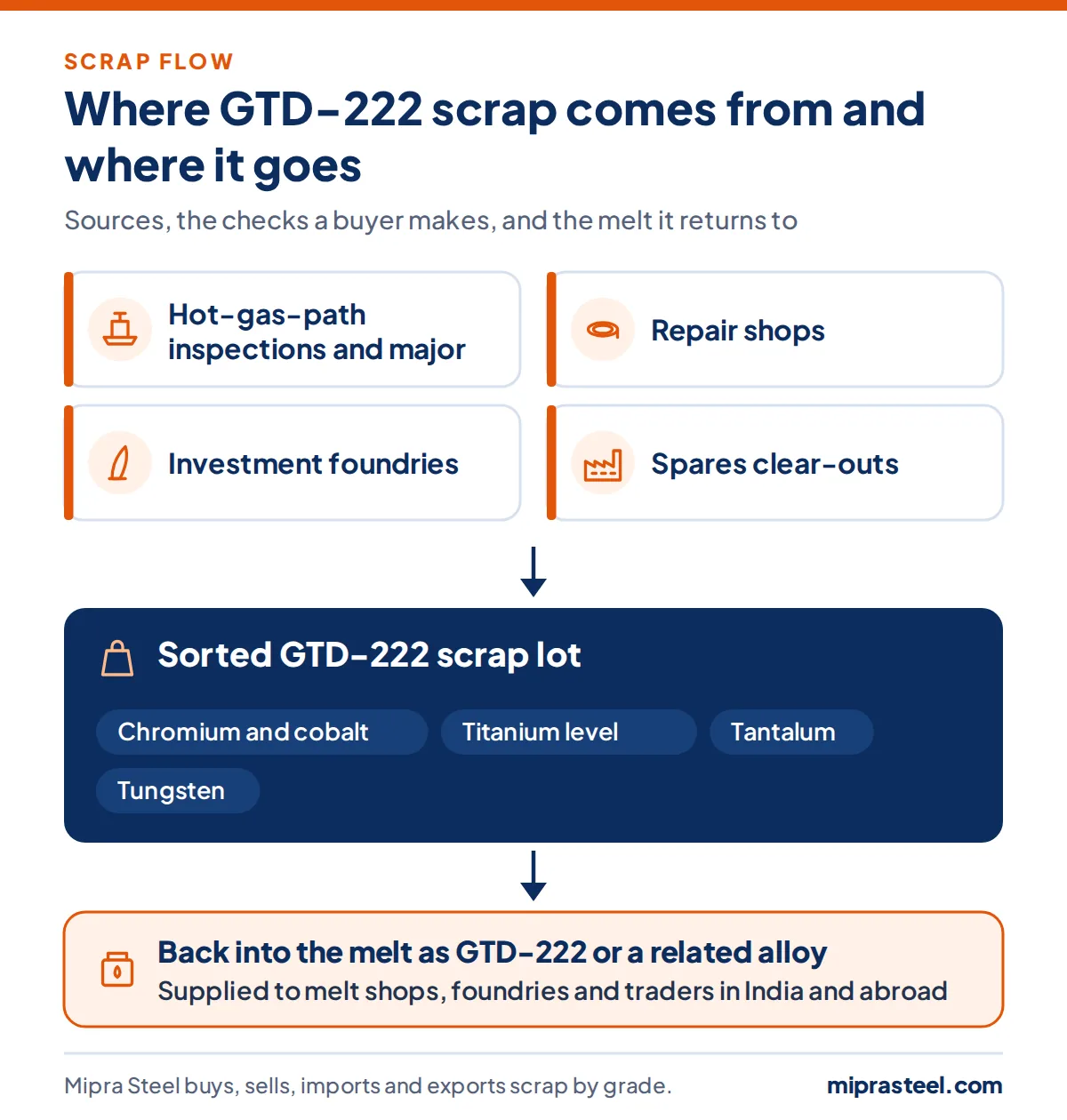
Where GTD-222 Nozzle Scrap Turns Up
GTD-222 scrap is almost always linked to heavy-duty gas turbine maintenance or to the foundries that cast nozzle segments.
Hot-Gas-Path Inspections and Major Overhauls
Second- and third-stage nozzle segments that have run out of repair margin are condemned and released for scrap. Combined-cycle plants and utility power stations generate this material on planned outage schedules. See power generation scrap.
Repair Shops
Segments that fail incoming inspection at a repair vendor, along with cut-out sections and weld-repair coupons, end up as solid scrap.
Investment Foundries
Gates, risers, sprues and rejected castings from nozzle production are foundry revert. It has not seen service, so it is usually the cleanest form of GTD-222.
Spares Clear-Outs
Plants and traders occasionally release new or refurbished segments that no longer fit any unit they run.
GTD-222 Scrap Specification Chart
| Grade | GTD-222 |
|---|---|
| UNS | Not assigned (proprietary GE alloy) |
| W.Nr. / EN | Not assigned |
| Identified by | GE Power specification, part records and analysis |
| Also known as | GTD 222 |
| Alloy type | Cast γ′ superalloy |
| Density | Not published |
| Magnetic | Non-magnetic. |
| HS code (customs heading) | 7503.00 (nickel waste and scrap) |
GTD-222 Chemical Composition
Nominal composition in weight per cent, used to describe and identify the grade. The governing specification sets the limits for each product.
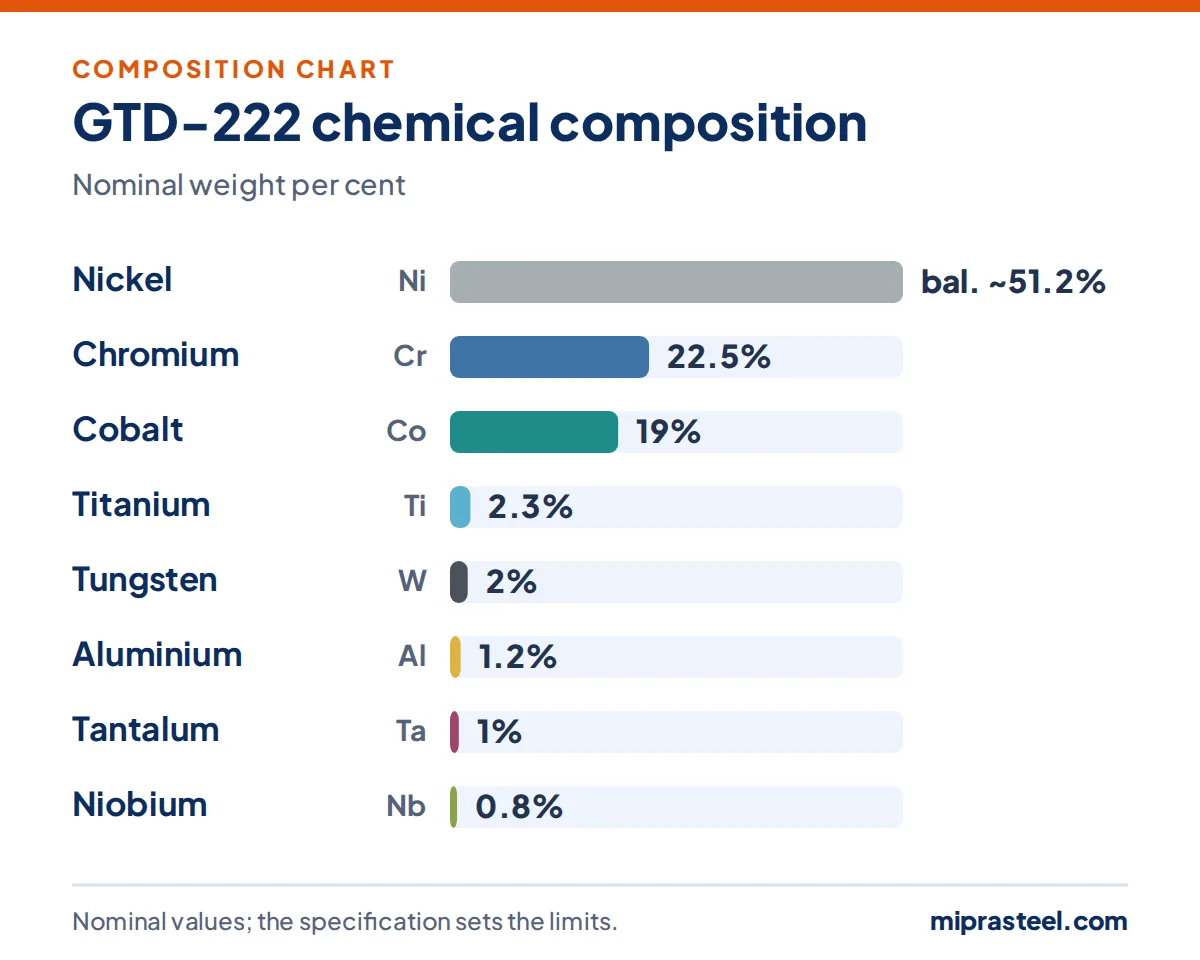
| Element | Symbol | Nominal wt% | |
|---|---|---|---|
| Nickel | Ni | Balance (about 51.2) | |
| Chromium | Cr | 22.5 | |
| Cobalt | Co | 19 | |
| Titanium | Ti | 2.3 | |
| Tungsten | W | 2 | |
| Aluminium (aluminum) | Al | 1.2 | |
| Tantalum | Ta | 1 | |
| Niobium | Nb | 0.8 |
GTD-222 Equivalent Grades and Other Names
| Designation | Value |
|---|---|
| Trade name | GTD-222 |
| UNS | Not assigned (proprietary GE alloy) |
| W.Nr. / EN | Not assigned |
| Other names in the trade | GTD 222 |
Look up any designation in the grade name converter or the equivalent grade chart.
GTD-222 Standards and Specifications
Supplied to turbine OEM specifications.
GTD-222 Applications
- Second- and third-stage turbine nozzles (vanes)
Source industries: power generation.
How GTD-222 Scrap Is Identified
A handheld XRF confirms the family quickly; separating GTD-222 from its close relatives takes more care and, for some pairs, a spark OES reading.
| Check | What it shows for GTD-222 |
|---|---|
| Chromium and cobalt | Around 22.5% chromium with about 19% cobalt places a piece in the GTD-222 / IN-939 / GTD-241 group. A 14% chromium reading points to a bucket alloy such as GTD-111 instead. |
| Titanium level | About 2.3% titanium fits GTD-222. Readings near 3.7% suggest IN-939 or MGA 2400. |
| Tantalum | Roughly 1% tantalum is the marker that separates GTD-222 from GTD-241 and GTD-262, which have none. |
| Tungsten | About 2% tungsten. A reading near 6% with 19% chromium means MGA 2400. |
| Coatings and weld repairs | Scan on bare metal at more than one spot. Coatings, braze and weld filler from earlier repairs can distort a surface reading. |
| Part numbers and casting records | Stamped part numbers, outage reports or foundry certificates are the strongest evidence that a lot is GTD-222. |
Grades Most Often Confused with GTD-222
- IN-939: shares about 22.4% chromium and 19% cobalt but carries about 3.7% titanium against 2.3%, and slightly more tantalum and aluminium.
- GTD-241: is the same base with tantalum removed and niobium raised to about 1.35% (GTD-222 has about 0.8%).
- MGA 2400: is a vane alloy with about 19% chromium and 6% tungsten, against 22.5% and 2% in GTD-222.
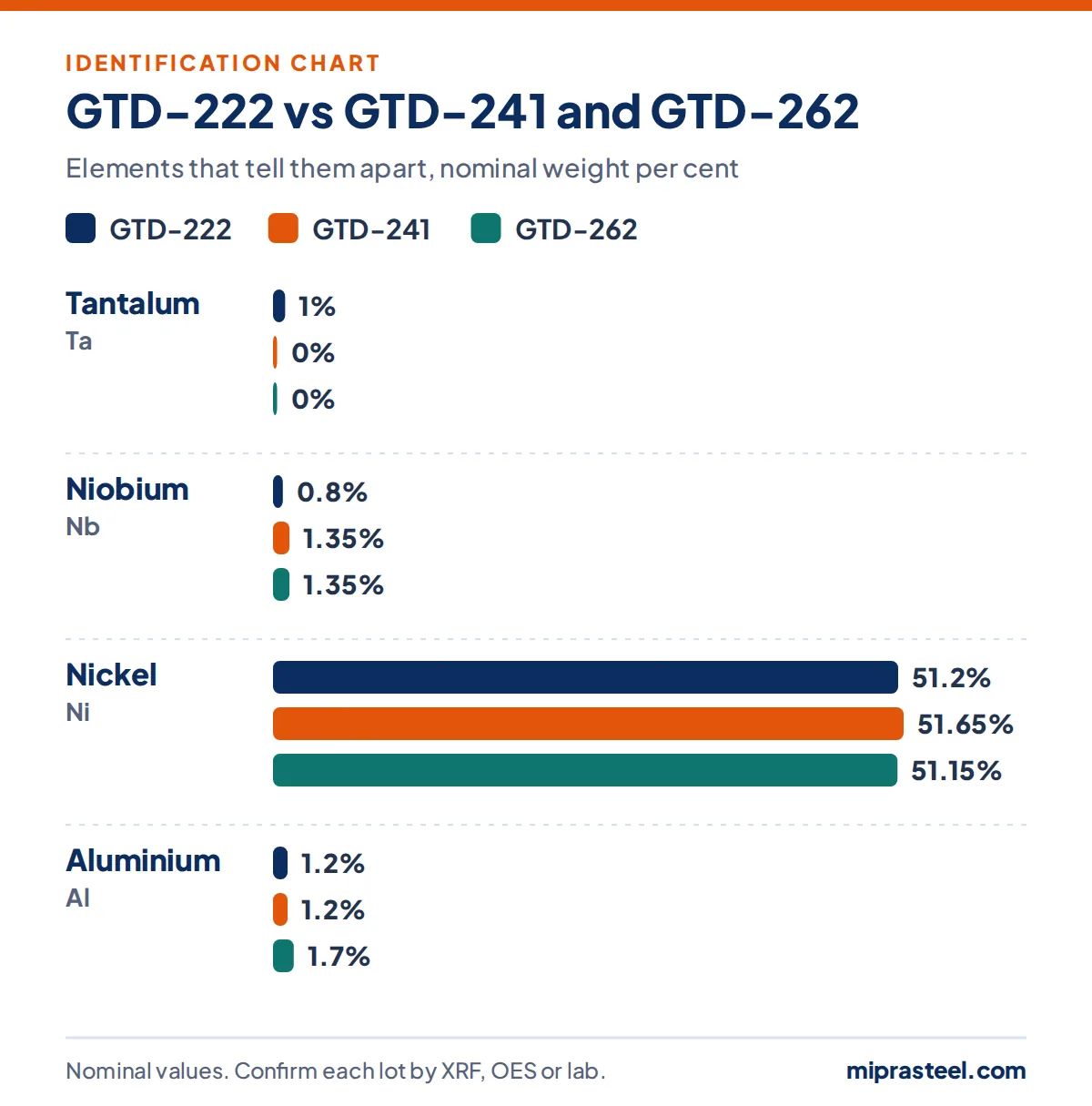
Nominal values for GTD-222 against its closest grades on this site.
Preparing GTD-222 Scrap for Sale
- Keep GTD-222 segments in their own lot, apart from IN-939, GTD-241, GTD-262 and any bucket alloys.
- Remove inserts, seals, pins and bolted hardware that are not cast GTD-222.
- Group engine-run segments separately from unused foundry revert.
- Record part numbers and keep outage or foundry paperwork with the lot.
- Take handheld readings on ground, bare metal rather than on coated or repaired surfaces.
GTD-222 Scrap Price per Kg: What Decides It
GTD-222 scrap is valued as superalloy revert, so its contained cobalt counts alongside nickel, and the confidence in the description counts almost as much as the metal.
- The nickel, around half the weight, and the 19% cobalt: two metals whose market prices change every day.
- Tantalum at about 1%: small by weight, but it is one reason a melter wants 222 kept separate rather than blended with tantalum-free nozzle alloys.
- Proof of grade: segments tied to part numbers or foundry paperwork are described as GTD-222; anonymous mixed nozzles are offered as general vane revert.
- Service condition: unused foundry revert is cleaner than engine-run segments that carry coatings, oxide and weld repairs.
- Foreign material: inserts, seals, pins and attached hardware of other alloys must be stripped or the lot is discounted.
- Quantity and logistics: a full, single-grade lot near a port is easier to place than small parcels collected inland.
Because two exchange-traded metals sit underneath it, a GTD-222 offer is only good for the day it is made. Our guide to how nickel alloy scrap is valued explains the arithmetic, and superalloy revert recycling covers where the material goes next.
GTD-222 Scrap Import and Export
Importing GTD-222 Scrap into India
Most GTD-222 scrap originates where heavy-duty turbines run in large numbers: the Gulf, East Asia and Europe. Bringing it into India follows the normal route for metal scrap: the cargo is checked at origin, and the inspection agency's certificate joins the bill of lading, invoice and packing list in the shipping set. Naming the material GTD-222 nozzle scrap, nickel-base, and attaching readings keeps the customs entry and the sale contract saying the same thing. Nhava Sheva and Mundra handle most arrivals for western India. Our page on bringing nickel alloy scrap into India has the detail.
Exporting GTD-222 Scrap from India
GTD-222 segments also come out of Indian gas-fired stations and repair vendors after outages. An outbound lot names the grade and segment count on its paperwork, is weighed net, and goes in crates, drums or bags stowed in a container. Superalloy melters abroad generally ask for analysis before they confirm a description. Mipra Steel keeps offices in Dubai and South Korea, near turbine operators and revert buyers, and we also serve Saudi Arabia. The alloy scrap export paperwork guide lists what is needed.
Customs heading: 7503.00 (nickel waste and scrap). The HS code is the international tariff heading the scrap is declared under; national tariff lines add further digits, so confirm the full line with your customs broker.
Other GTD Scrap Grades
Related Reading
GTD-222 Scrap FAQ
Is GTD-222 the same as IN-939?
No, though they are close. Both carry about 22% chromium and 19% cobalt, but IN-939 has about 3.7% titanium while GTD-222 has about 2.3%. Many melters treat them as separate revert grades, so a mixed lot of the two is usually described and valued as general vane revert rather than as either alloy.
Why did GE replace FSX-414 nozzles with GTD-222?
FSX-414 is a cobalt-base vane alloy. GTD-222 was introduced as a nickel-base alternative for later-stage nozzles that could be strengthened by precipitation hardening while remaining weldable for repair. For scrap traders the practical result is that older units may yield cobalt-base FSX-414 nozzles and newer ones GTD-222, and the two must never share a lot.
Can a handheld analyser tell GTD-222 from GTD-241?
Often, yes, if it reads tantalum reliably. GTD-222 carries about 1% tantalum and about 0.8% niobium; GTD-241 has no tantalum and about 1.35% niobium. Coated or repaired surfaces can blur these small differences, so readings should be taken on ground metal and backed by part numbers.
Do weld repairs and coatings reduce the value of GTD-222 scrap?
They can. Repair welds may use a filler of a different chemistry, and coatings add aluminium and other elements at the surface. Neither stops the scrap from being sold, but a buyer will price in the uncertainty unless the repair history and coating are disclosed.
How do I sell GTD-222 nozzle segments to Mipra Steel?
Send the weight, segment count, location and clear photographs, ideally showing part numbers. Say whether the segments are engine-run or new castings and attach any readings or outage reports. Those details let us describe the lot accurately before any offer is discussed.
Which customs heading applies to GTD-222 scrap shipments?
Nickel is the base metal, so shipments typically go under heading 7503.00 (nickel waste and scrap) rather than the cobalt heading, despite the 19% cobalt. National tariffs extend that heading with extra digits; your customs broker should confirm the exact line for the destination.
Is GTD-222 scrap magnetic?
No. GTD-222 is non-magnetic, so a magnet will not separate it from other nickel superalloys. It will, however, flag steel fixtures or carbon-steel hardware that should be removed from a nozzle lot before it is weighed.
What is GTD-222 made of?
Nominally 51.2% nickel, 22.5% chromium, 19% cobalt, 2.3% titanium, 2% tungsten, 1.2% aluminium, 1% tantalum, 0.8% niobium. Specification ranges vary by product form and standard.
Published by Mipra Steel, Khetwadi, Mumbai · Updated