Ni-Resist Type 2 Scrap Buyer, Importer and Exporter in India
Mipra Steel, Mumbai, trades Ni-Resist Type 2 scrap as a copper-free grade in its own right, collecting castings from process plants and foundries and offering screened lots to iron foundries and traders.
Sell Ni-Resist Type 2 Scrap
Selling Type 2 pump or valve castings? Tell us which plant and duty they came from, roughly how much there is, where it is stored, and send photographs. Readings showing nickel and copper on each casting are especially useful, because copper-free status is what buyers check first. We review incoming enquiries and respond with relevant next steps.
Buy Ni-Resist Type 2 Scrap
Foundries recasting copper-free Ni-Resist can ask us for Type 2 scrap with per-piece readings. Give the tonnage, your copper limit, any piece-size constraint and the port of delivery. Tell us if you also accept ductile D-2, so lots can be offered to match.
Why Was Ni-Resist Type 2 Developed, and How Does That Shape Its Scrap Value?
Type 2 is the answer to a narrow problem. Type 1 Ni-Resist resists corrosion well, but its 6.5% copper can dissolve into some products, discolouring soap, tainting food and contaminating rayon and plastics. Metallurgists removed the copper and raised the nickel to about 20% to keep the iron fully austenitic. The result serves pumps and valves in caustic soda, alkali, soap, food and synthetic-fibre plants, where hot alkaline liquors attack plain cast iron.
For scrap, two things follow. First, Type 2 carries more nickel per tonne than Type 1, roughly 200 kg against 155 kg, so the nickel content is the heart of its value. Second, its copper-free status is a property buyers rely on. A foundry recasting Type 2 needs copper below 0.5% in the finished iron, and one bin of Type 1 castings can make a whole melt unusable for that purpose. A Type 2 lot that has been proven copper-free on every piece is worth far more than one that might contain Type 1.
Type 2 also has a ductile twin. Ni-Resist D-2 carries similar nickel and chromium, but its graphite is spheroidal rather than flake, and it is the grade used for exhaust manifolds and turbocharger housings. The two are often mixed up in the trade, which is why buyers ask what the castings actually were. See the Ni-Resist family page for all three flake types side by side.
Ni-Resist Type 2 belongs to the Ni-Resist family, part of exotic alloy scrap.
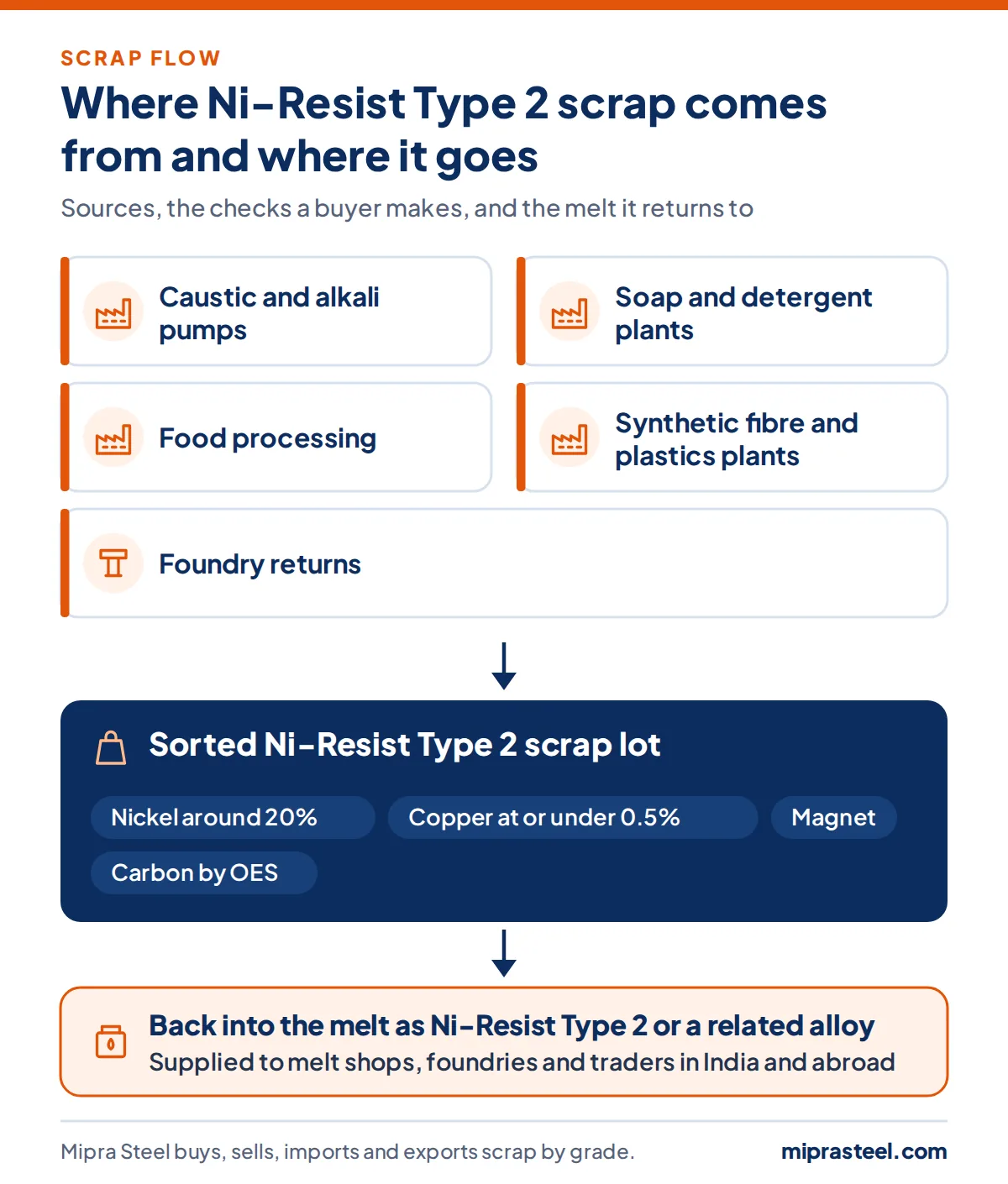
Typical Sources of Ni-Resist Type 2 Scrap
Type 2 is found in plants handling alkalis and products that copper would spoil, which keeps its sources quite specific.
Caustic and Alkali Pumps
Casings and impellers from caustic soda transfer and alkali process pumps, replaced when worn. See chemical processing scrap.
Soap and Detergent Plants
Pump bodies and valves from saponification and liquor handling lines.
Food Processing
Pumps and valve castings from equipment where copper pickup would affect taste or colour.
Synthetic Fibre and Plastics Plants
Valve and pump castings from rayon and polymer process lines.
Foundry Returns
Runners, risers and rejected Type 2 castings, normally of documented chemistry.
Ni-Resist Type 2 Scrap Specification Chart
| Grade | Ni-Resist Type 2 |
|---|---|
| UNS | F41002 |
| W.Nr. / EN | EN-GJLA-XNiCr20-2 |
| Also known as | Ni-Resist 2 |
| Alloy type | Austenitic flake-graphite cast iron |
| Density | 7.3 g/cm³ (0.264 lb/in³) |
| Magnetic | Non-magnetic. |
| HS code (customs heading) | 7204.10 (cast iron waste and scrap) |
Ni-Resist Type 2 Chemical Composition
Nominal composition in weight per cent, used to describe and identify the grade. The governing specification sets the limits for each product.
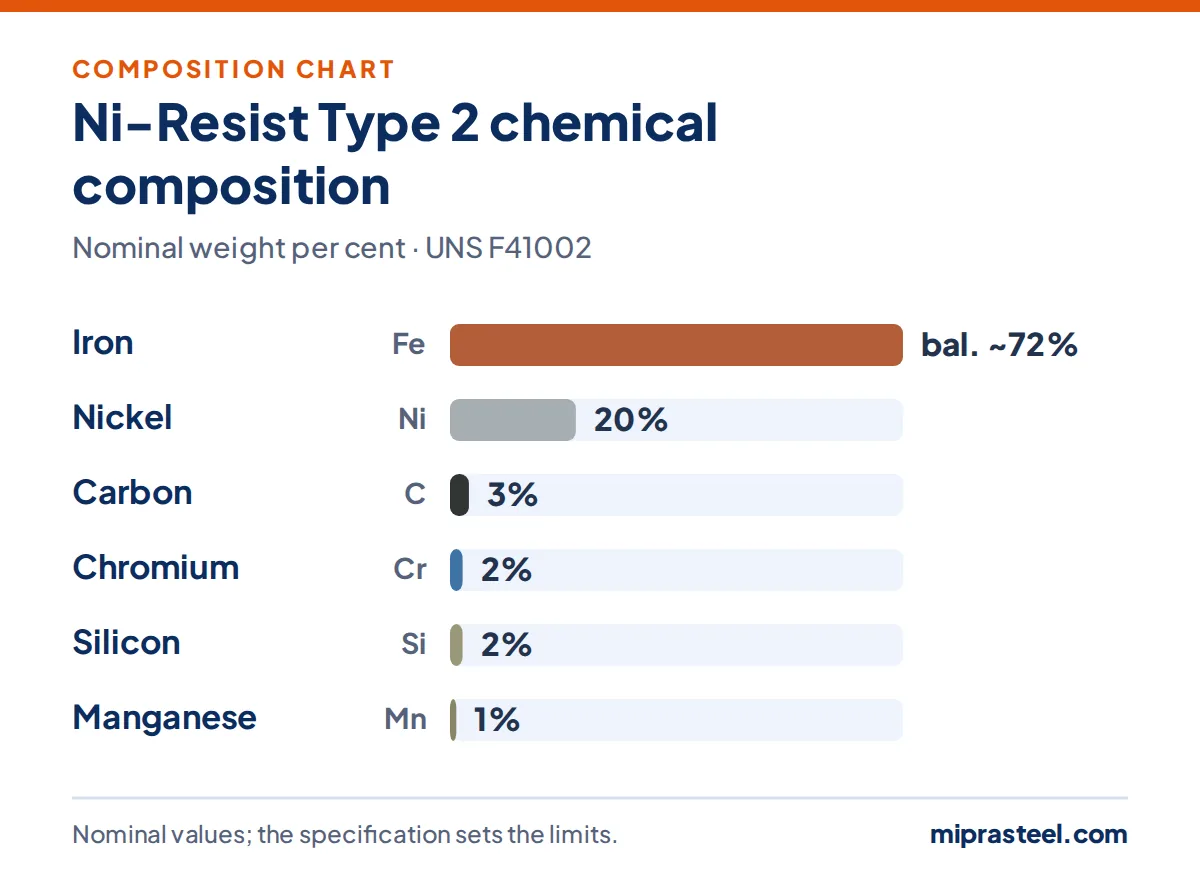
| Element | Symbol | Nominal wt% | |
|---|---|---|---|
| Iron | Fe | Balance (about 72) | |
| Nickel | Ni | 20 | |
| Carbon | C | 3 | |
| Chromium | Cr | 2 | |
| Silicon | Si | 2 | |
| Manganese | Mn | 1 |
Ni-Resist Type 2 Equivalent Grades and Other Names
| Designation | Value |
|---|---|
| Trade name | Ni-Resist Type 2 |
| UNS | F41002 |
| W.Nr. / EN | EN-GJLA-XNiCr20-2 |
| Key specification | ASTM A436 Type 2 |
| Other names in the trade | Ni-Resist 2 |
Look up any designation in the grade name converter or the equivalent grade chart.
Ni-Resist Type 2 Standards and Specifications
| Product form | Standard | ASME equivalent |
|---|---|---|
| Austenitic grey iron castings | ASTM A436 | No ASME edition |
| Austenitic cast iron (Europe) | EN 13835 | No ASME edition |
Ni-Resist Type 2 Applications
- Caustic and alkali pumps
- Food and soap processing equipment
- Valve and pump castings
Source industries: chemical processing, marine and shipbuilding.
How Ni-Resist Type 2 Scrap Is Identified
Type 2 is confirmed by what is missing as much as by what is present: high nickel, no copper, and the carbon of a cast iron.
| Check | What it shows for Ni-Resist Type 2 |
|---|---|
| Nickel around 20% | An XRF reading of about 18% to 22% nickel with iron as the balance fits Type 2. |
| Copper at or under 0.5% | Any reading above that points to Type 1 or to contamination, and the piece should leave the lot. |
| Magnet | Non-magnetic, like Type 1. This separates it from plain grey iron casings but not from other austenitic irons. |
| Carbon by OES | Spark OES confirms cast iron carbon levels, which rules out wrought austenitic alloys with similar nickel. See XRF vs OES vs lab. |
| Flake or spheroidal graphite | A polished section under a microscope, or the casting's origin, shows whether the iron is flake Type 2 or ductile D-2. Exhaust and turbocharger parts are almost always ductile grades. |
| Plant and pump records | Pump data sheets for caustic or food duty often state ASTM A436 Type 2. |
Grades Most Often Confused with Ni-Resist Type 2
- Ni-Resist Type 1: has lower nickel, about 15.5%, plus about 6.5% copper.
- Ni-Resist D-2: has similar nickel and chromium but spheroidal graphite, and comes mostly from exhaust manifolds and turbocharger housings.
- Ni-Resist Type 5: has about 35% nickel, almost no chromium, and can be magnetic.

Nominal values for Ni-Resist Type 2 against its closest grades on this site.
Preparing Ni-Resist Type 2 Scrap for Sale
- Wash caustic, soap and food residues off every casting.
- Read copper on each piece and reject anything over 0.5%.
- Keep exhaust manifolds and turbocharger housings out of a flake Type 2 lot.
- Remove stainless shafts, sleeves and seal hardware.
- Label castings by plant and duty when you can.
- Store indoors or covered so residues do not run and corrode the castings.
Ni-Resist Type 2 Scrap Price per Kg: What Decides It
Type 2 is valued as a nickel-bearing cast iron whose usefulness depends on staying free of copper.
- Nickel at about 20%: the main driver, higher than Type 1.
- Proven copper-free status: readings on each casting showing copper at or under 0.5% let a foundry use the lot for Type 2 without dilution.
- Separation from ductile D-2: flake and spheroidal irons are kept apart where the buyer melts for one specific type.
- Product residues: caustic, soap and food deposits must be washed off; caustic residue is also a handling hazard.
- Foreign parts: stainless shafts, sleeves and seal components in alkali pumps are removed before weighing.
- Lot consistency: castings from one plant and one duty are easier to describe than mixed pump yard lots.
Nickel prices move daily, so any figure is tied to a date and to the lot as described. Estimate contained nickel with the contained metal calculator.
Ni-Resist Type 2 Scrap Import and Export
Importing Ni-Resist Type 2 Scrap into India
Process plants in Europe, the Gulf and East Asia replace caustic and food-duty pumps on fixed maintenance cycles, and that is where most imported Type 2 comes from. Metal scrap shipped to India normally travels with a pre-shipment inspection certificate as well as the commercial invoice, packing list and bill of lading. As an austenitic cast iron, Ni-Resist is typically classified under HS 7204.10 for cast iron waste and scrap; check the national tariff line with your customs broker. Describing the cargo as "Ni-Resist Type 2, ASTM A436, UNS F41002, copper 0.5% max" makes the purpose of the lot clear at Nhava Sheva, Mundra or Chennai.
Exporting Ni-Resist Type 2 Scrap from India
India has a large caustic soda, soap and food processing base, so worn Type 2 pumps and valves are generated here regularly. Export lots are described by type, ASTM grade and UNS number on the invoice and packing list, weighed, and shipped palletised or loose in containers from Nhava Sheva or Mundra. Buyers in Italy, Spain and Japan are among the markets we serve, and our UAE office supports Gulf enquiries.
Customs heading: 7204.10 (cast iron waste and scrap). The HS code is the international tariff heading the scrap is declared under; national tariff lines add further digits, so confirm the full line with your customs broker.
Other Ni-Resist Scrap Grades
Related Reading
Ni-Resist Type 2 Scrap FAQ
What is the difference between Ni-Resist Type 2 and Ni-Resist D-2?
The graphite shape. Type 2 is a flake-graphite iron used for pumps and valves; D-2 is spheroidal-graphite (ductile) iron with similar nickel and chromium, used for exhaust manifolds and turbocharger housings. XRF reads them almost the same, so the source of the castings or a metallographic check separates them.
Why is Ni-Resist Type 2 made without copper?
Copper from the casting can contaminate products such as soap, food, rayon and plastics. Type 2 replaces the copper of Type 1 with more nickel, about 20%, so it keeps its corrosion resistance without that risk. Scrap buyers expect the same copper-free chemistry in a Type 2 lot.
Is Ni-Resist Type 2 scrap worth more than Type 1?
Usually it carries more nickel, about 20% against 15.5%, which counts in its favour. Type 1 offsets some of that gap with its copper, and actual value depends on demand from foundries for each type and on how clean and well documented each lot is.
Which tariff heading applies to Ni-Resist Type 2 scrap?
It is generally declared as cast iron waste and scrap under HS 7204.10, even though it contains about 20% nickel. Nickel scrap headings do not apply because the material is iron-base cast iron. Confirm the national line with your broker.
Are old caustic soda pumps made of Ni-Resist Type 2?
Many are, since Type 2 handles hot alkaline liquors better than plain cast iron. Others use stainless or high-nickel alloys, so check the pump data sheet or take an XRF reading before describing the castings as Type 2.
How can I offer Type 2 castings to Mipra Steel?
Send photographs, an estimated weight, the location and the plant duty the castings served, with any nickel and copper readings. Mention whether shafts or seals are still attached. We will come back on how the lot can be described and traded.
What is Ni-Resist Type 2 made of?
Nominally 72% iron, 20% nickel, 3% carbon, 2% chromium, 2% silicon, 1% manganese. Specification ranges vary by product form and standard.
Published by Mipra Steel, Khetwadi, Mumbai · Updated