Titanium Grade 7 Scrap Buyer, Importer and Exporter in India
Mipra Steel trades palladium-bearing titanium as a separate grade from Khetwadi, Mumbai, buying from plants, fabricators and traders and supplying described Grade 7 lots.
Sell Titanium Grade 7 Scrap
If you are selling Grade 7 from a plant rebuild, tell us what the equipment was, what it has been cut into, the weight and where it is. Send photos, any palladium readings and the original mill certificates or drawings showing R52400. If tubes are still in tubesheets, say what the tubesheet material is. We review incoming enquiries and respond with relevant next steps.
Buy Titanium Grade 7 Scrap
Melters and traders who need palladium-bearing titanium can send their tonnage, accepted forms, palladium documentation requirements and destination. Lots are described as Titanium Grade 7, UNS R52400, with whatever readings and certificates came from the seller. Small, traceable lots are normal for this grade.
Why Is Titanium Grade 7 Scrap Kept Separate from Grade 2?
Plain titanium resists oxidising chemicals very well but can corrode in hot reducing acids and in tight crevices under hot chloride brine. A small palladium addition changes that. At around 0.15%, palladium shifts the metal's surface behaviour enough that Grade 7 survives dilute hydrochloric and sulfuric acid duty, wet chlorine and hot brine where Grade 2 would struggle. Mechanically it is still Grade 2, with the same strength and the same fabrication methods.
For scrap, that tiny addition is the whole story. Palladium is a precious metal, and a melt shop making Grade 7 needs palladium-bearing feed. Grade 7 scrap that is sold as plain CP titanium gives that value away, and Grade 7 mixed into a Grade 2 lot does not help the Grade 2 buyer either. Sellers who know they have Ti-Pd material should say so on the first enquiry.
Grade 7 is a niche material. It turns up where a plant engineer has paid extra for crevice and reducing-acid resistance: chlorine and brine lines, brine heaters, acid coolers, gasketed flange faces and vessel linings. That makes most Grade 7 scrap traceable to a specific plant and a specific rebuild, which helps when the lot needs to be described.
Titanium Grade 7 belongs to the Titanium family, part of exotic alloy scrap.
Where Grade 7 Titanium Scrap Turns Up
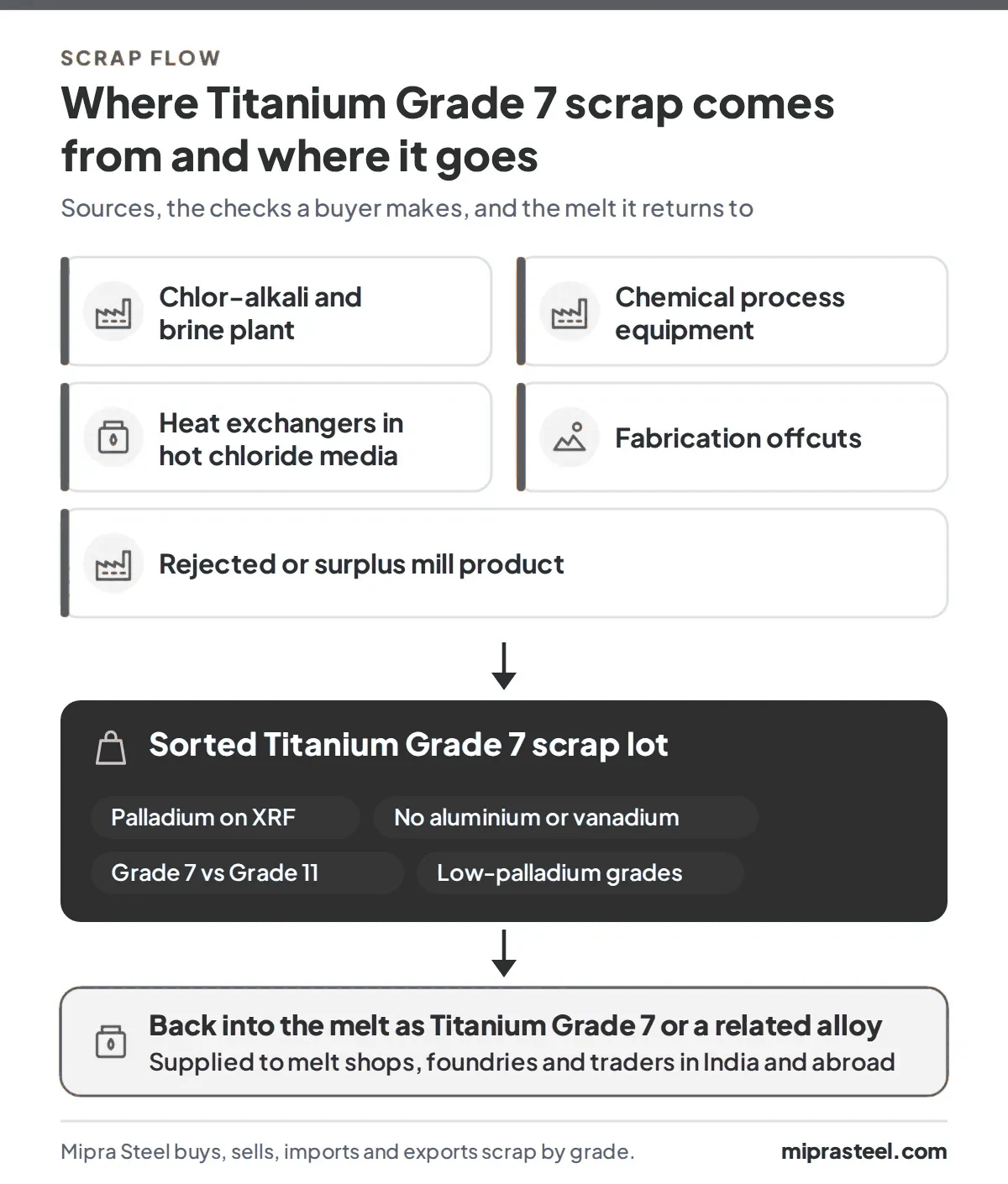
Expect Grade 7 at turnarounds and rebuilds of plants handling acids and chlorides, rarely from machining.
Chlor-Alkali and Brine Plant
Brine heater tubes, wet-chlorine handling equipment and gasketed flange parts released when units are rebuilt.
Chemical Process Equipment
Reactor and vessel linings, agitators and exchanger parts from units in reducing-acid service. See chemical processing scrap.
Heat Exchangers in Hot Chloride Media
Tube bundles to ASTM B338, tubesheets and channel parts. Tubes are often seal-welded into a different tubesheet material, which must be cut out.
Fabrication Offcuts
Plate and sheet trim to ASTM B265 left after making Grade 7 vessels and linings, usually clean and traceable.
Rejected or Surplus Mill Product
Over-ordered Grade 7 plate, tube and fittings to ASTM B363, often still carrying mill markings.
Titanium Grade 7 Scrap Specification Chart
| Grade | Titanium Grade 7 |
|---|---|
| UNS | R52400 |
| W.Nr. / EN | 3.7235 |
| Also known as | Ti-0.15Pd |
| Alloy type | Commercially pure titanium with palladium |
| Density | 4.51 g/cm³ (0.163 lb/in³) |
| Magnetic | Non-magnetic. |
| HS code (customs heading) | 8108.30 (titanium waste and scrap) |
Titanium Grade 7 Chemical Composition
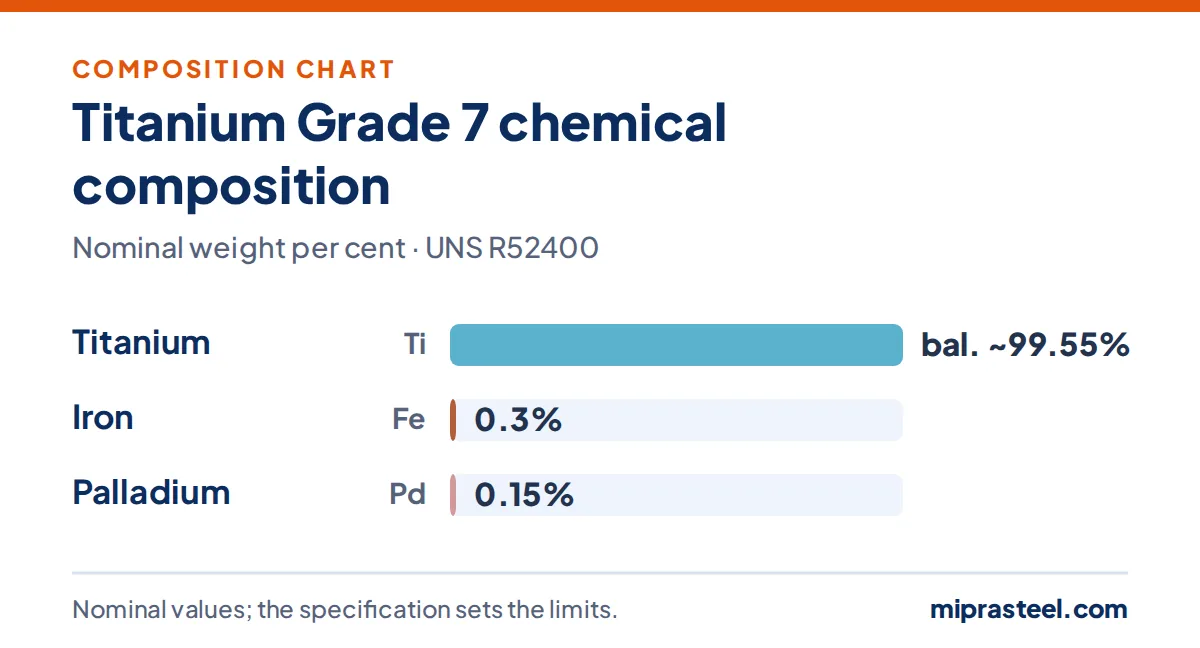
Nominal composition in weight per cent, used to describe and identify the grade. The governing specification sets the limits for each product.
| Element | Symbol | Nominal wt% | |
|---|---|---|---|
| Titanium | Ti | Balance (about 99.6) | |
| Iron | Fe | 0.3 | |
| Palladium | Pd | 0.15 |
Titanium Grade 7 Equivalent Grades and Other Names
| Designation | Value |
|---|---|
| Trade name | Titanium Grade 7 |
| UNS | R52400 |
| W.Nr. / EN | 3.7235 |
| Other names in the trade | Ti-0.15Pd |
Look up any designation in the grade name converter or the equivalent grade chart.
Titanium Grade 7 Standards and Specifications
Titanium Grade 7 Applications
- Chemical process equipment in reducing acids
- Brine and chlorine service
- Heat exchangers in hot chloride media
Source industries: chemical processing.
How Titanium Grade 7 Scrap Is Identified
All the CP titanium grades look the same, so Grade 7 is identified by its palladium and by its paperwork.
| Check | What it shows for Titanium Grade 7 |
|---|---|
| Palladium on XRF | A reading of about 0.12% to 0.25% palladium, with the Pd K-alpha line near 21 keV, marks a Ti-Pd grade. Use a long enough count time for a trace element. |
| No aluminium or vanadium | A clean titanium spectrum with no alloying rules out Grade 5 and Grade 9. |
| Grade 7 vs Grade 11 | Both carry the same palladium range. Grade 11 sits on the softer Grade 1 base, so mill certificates or hardness decide which one it is. |
| Low-palladium grades | A palladium reading well under 0.1% suggests Grade 16 or 17 (about 0.04% to 0.08%), which must not be sold as Grade 7. |
| Certificates and stamps | Plate and tube are often stamped "Gr 7" or R52400 with a heat number. Mill certificates make the description secure. |
Grades Most Often Confused with Titanium Grade 7
- Titanium Grade 2: is identical in look and strength, but shows no palladium on XRF.
- Titanium Grade 11: has the same 0.12% to 0.25% palladium on a Grade 1 base with lower oxygen and iron limits.
- Grade 16 (Ti-0.05Pd): is a lower-cost Grade 2 variant with only 0.04% to 0.08% palladium.
Nominal values for Titanium Grade 7 against its closest grades on this site.
Preparing Titanium Grade 7 Scrap for Sale
- Check every titanium piece from an acid or brine unit for palladium before it goes in a bag.
- Keep Grade 7, Grade 11, Grade 16 and plain Grade 2 in separate, labelled lots.
- Cut tubes free of tubesheets and remove steel, copper-alloy and gasket material.
- Rinse off process residues and dry the material before packing.
- File drawings, data sheets or certificates that name R52400 with the lot.
Titanium Grade 7 Scrap Price per Kg: What Decides It
A Grade 7 offer is built on titanium value plus recognition of the palladium, and that recognition depends on proof.
- Palladium confirmed: readings on every piece, or certificates, let the lot be priced as Grade 7 rather than CP titanium.
- Separation from Grade 2 and Grade 16: a mixed CP lot is priced at the lowest grade the buyer cannot rule out.
- Attached dissimilar metals: tubesheets, steel shells, copper-alloy parts or gasket residue must be removed or deducted.
- Condition: heavy scale, chemical deposits or residual process media need cleaning and are reflected in the offer.
- Form and size: clean plate and tube trim handle better than crushed equipment or mixed fabrications.
- Titanium and palladium markets on the day, and the lot size and location.
No fixed titanium Grade 7 scrap price per kg exists; each offer is dated and depends on how confidently the lot can be described. See Grade 2 vs Grade 7 for the grade differences in detail.
Titanium Grade 7 Scrap Import and Export
Importing Titanium Grade 7 Scrap into India
Grade 7 scrap comes into India in modest lots from chemical and chlor-alkali plant rebuilds in the Gulf, Europe and East Asia. It is typically declared as titanium waste and scrap under HS 8108.30, with the full tariff line confirmed by the customs broker. Each consignment carries a pre-shipment inspection certificate, commercial invoice, packing list and bill of lading. Describing it as Titanium Grade 7 with palladium readings attached avoids it being treated as generic titanium at either end. More in importing alloy scrap into India.
Exporting Titanium Grade 7 Scrap from India
Rebuilds at Indian chlor-alkali and chemical plants release Grade 7 alongside Grade 2. Exported lots are described by grade and UNS number on the invoice and packing list, weighed, and shipped in bags or crates inside containers from Nhava Sheva or Mundra. Buyers in Japan and South Korea are reached through our Korea office, and Gulf buyers through Dubai. See export paperwork for alloy scrap.
Customs heading: 8108.30 (titanium waste and scrap). The HS code is the international tariff heading the scrap is declared under; national tariff lines add further digits, so confirm the full line with your customs broker.
Comparisons
Other Titanium Scrap Grades
Related Reading
Titanium Grade 7 Scrap FAQ
Why is palladium added to titanium Grade 7?
Palladium improves titanium's resistance to reducing acids and to crevice corrosion in hot chloride solutions. A small amount, about 0.15%, lets Grade 7 work in services such as dilute hydrochloric acid and hot brine where plain Grade 2 can corrode.
Is titanium Grade 7 scrap worth more than Grade 2 scrap?
Generally yes, because Grade 7 contains palladium and a melt shop making Ti-Pd grades needs that input. The premium only holds if the palladium is shown by readings or certificates and the lot is not mixed with plain titanium.
Can a handheld XRF find the palladium in Grade 7?
Usually, yes. Palladium at 0.12% to 0.25% gives a measurable peak near 21 keV on a handheld XRF with an adequate count time. Very low readings may indicate Grade 16 or 17 instead, so the number matters, not just its presence.
What is the difference between Grade 7 and Grade 11 titanium scrap?
Both have the same palladium range. Grade 7 is built on Grade 2 and Grade 11 on the softer, lower-oxygen Grade 1. XRF cannot separate them reliably, so certificates or hardness testing are used.
Which customs heading covers titanium-palladium scrap?
It is typically declared under HS 8108.30, the heading for titanium waste and scrap, even though it contains palladium. Confirm the national tariff line with your customs broker for the import or export country.
We have Grade 7 heat exchanger tubes from a plant shutdown. How do we sell them?
Send Mipra Steel the tube count or weight, whether they are still in the tubesheet, the tubesheet material, location and photos. Certificates or the exchanger data sheet showing Grade 7 are very helpful.
What is Titanium Grade 7 made of?
Nominally 99.6% titanium, 0.3% iron, 0.15% palladium. Specification ranges vary by product form and standard.
Published by Mipra Steel, Khetwadi, Mumbai · Updated