
How Are the Six René Alloys Told Apart in a Scrap Lot?
René is a set of designations rather than one chemistry, and the six grades on this site span roughly four decades of turbine blade design. The simplest way to sort them is by generation and casting route. The older equiaxed alloys, René 77 and René 80, rely on chromium near 14% and plenty of titanium; 77 carries 15% cobalt and no tungsten, while 80 has about 5% titanium with 4% each of molybdenum and tungsten. The hafnium-bearing pair, René 108 and René 125, drop chromium to under 9% and add tungsten, tantalum and about 1.5% hafnium; 108 is cast directionally solidified for blades. The single-crystal pair, René N5 and René N500, go further again: about 6.5% tantalum, over 6% aluminium, around 7% chromium, and in N5 about 3% rhenium.
That spread is why a "René lot" with no grade is close to meaningless to a revert melter. Each melter charges revert into a specific alloy, so what matters is whether the chemistry in the drum matches the chemistry of the heat. Rhenium is the sharpest divide: N5 must never share a container with N500 or any other rhenium-free grade, because the rhenium is paid for only when it arrives undiluted and is unwanted where the specification has none. Next comes hafnium and tantalum: René 108 or 125 tipped into René 80 adds elements the 80 melt was not designed to carry.
René 80 has an extra layer. Trade lists show "René 80 low Zr" or "LZR". No published specification uses those names. Traders use them for René 80 returns segregated because their zirconium is low, with an analysis to show it, aimed at heats where the melter caps zirconium. Without a supporting heat certificate or OES result, a lot is treated as ordinary René 80. The whole approach to sorting and returning cast revert is set out in how superalloy revert is recycled.
René Scrap Grades We Buy and Sell
René Chemical Composition
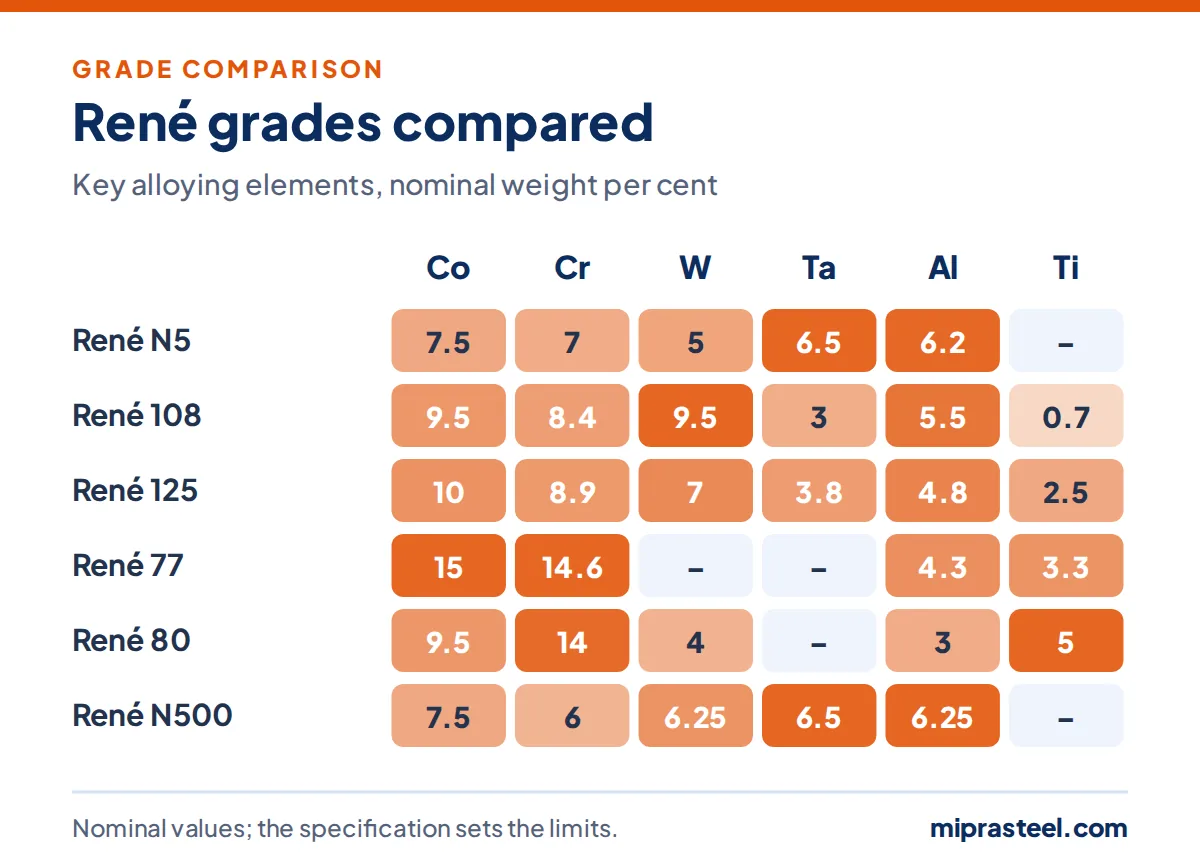
| Grade | Ni | Co | Cr | W | Ta | Al | Ti | Mo | Re | Hf |
|---|---|---|---|---|---|---|---|---|---|---|
| René N5 | 63.2 | 7.5 | 7 | 5 | 6.5 | 6.2 | – | 1.5 | 3 | 0.15 |
| René 108 | 61.4 | 9.5 | 8.4 | 9.5 | 3 | 5.5 | 0.7 | 0.5 | – | 1.5 |
| René 125 | 59.5 | 10 | 8.9 | 7 | 3.8 | 4.8 | 2.5 | 2 | – | 1.5 |
| René 77 | 58.6 | 15 | 14.6 | – | – | 4.3 | 3.3 | 4.2 | – | – |
| René 80 | 60.5 | 9.5 | 14 | 4 | – | 3 | 5 | 4 | – | – |
| René N500 | 65.9 | 7.5 | 6 | 6.3 | 6.5 | 6.3 | – | 1.5 | – | 0.15 |
Nominal weight per cent. Specification ranges vary by product form and standard.
How to Tell René Grades Apart
A clean reading of six or seven elements separates the René grades, except where rhenium or zirconium is the question. Those two call for OES or a laboratory, as explained in choosing between XRF, OES and lab work.
| Check | What it shows for René |
|---|---|
| Chromium level | About 14% to 15% chromium points to René 77 or René 80; under 9% points to 108, 125, N5 or N500. |
| Titanium and tungsten | About 5% titanium with 4% tungsten is René 80. 3.3% titanium with no tungsten and 15% cobalt is René 77. |
| Hafnium | About 1.5% hafnium marks 108 or 125. 108 shows 9.5% tungsten and under 1% titanium; 125 shows 7% tungsten and about 2.5% titanium. |
| Tantalum and aluminium | Around 6.5% tantalum with over 6% aluminium means a single-crystal grade, N5 or N500. |
| Rhenium | N5 carries about 3%, N500 none. Rhenium lines overlap tungsten and tantalum on XRF, so a lab analysis or OEM documentation is normally used. |
| Grain structure | Single-crystal blades show no grain boundaries after etching; DS blades show long columnar grains; equiaxed parts show small grains. |
| Coating | Ex-service blades carry aluminide or MCrAlY coatings. Read a ground root, not the airfoil, and declare the coating. |
Grades Most Often Confused with René
- GTD-111: close to René 80 in chromium, cobalt and titanium, but carries about 2.8% tantalum and only 1.5% molybdenum.
- PWA 1484: another 3% rhenium single-crystal alloy; it has about 8.7% tantalum and 5% chromium against 6.5% and 7% in N5.
- MAR-M 247: shares hafnium and tantalum with René 108, with 10% each of tungsten and cobalt; the two are often cast in the same foundries.
Rhenium Flags N5
About 3% rhenium. Its X-ray lines overlap tungsten and tantalum, so laboratory analysis is normally used to confirm it.
Titanium Flags René 80
About 5% titanium with 4% each of molybdenum and tungsten.
Hafnium Points to 108 and 125
Both carry about 1.5% hafnium. 108 has more tungsten (9.5%); 125 has more titanium (2.5%).
Where René Scrap Comes From
The generation of an engine or turbine usually tells you which René grade to expect, and the source also tells you how much documentation the lot will carry.
Aero Engine Overhaul
High-pressure turbine blades and vanes from newer engines are where single-crystal N5 turns up; older engines release René 80, 77 and 125 parts. See aerospace scrap.
Industrial Gas Turbines
René 80 buckets and vanes, René 108 directionally solidified blades and some N5 and N500 hardware come out of land-based turbine outages. See power generation scrap.
Investment-Casting Foundries
Feeders, runners and scrapped castings left over when blades and vanes are poured. This revert is uncoated and tied to a heat, which buyers value.
Single-Crystal Casting Rejects
Blades that fail inspection for stray grains, recrystallisation or dimensional faults. They are new metal with no service exposure, often still carrying ceramic core.
Wheel and Rotor Scrap
Integral turbine wheels and rotors, mainly René 77, from smaller engines and auxiliary units. See selling turbine blade scrap.
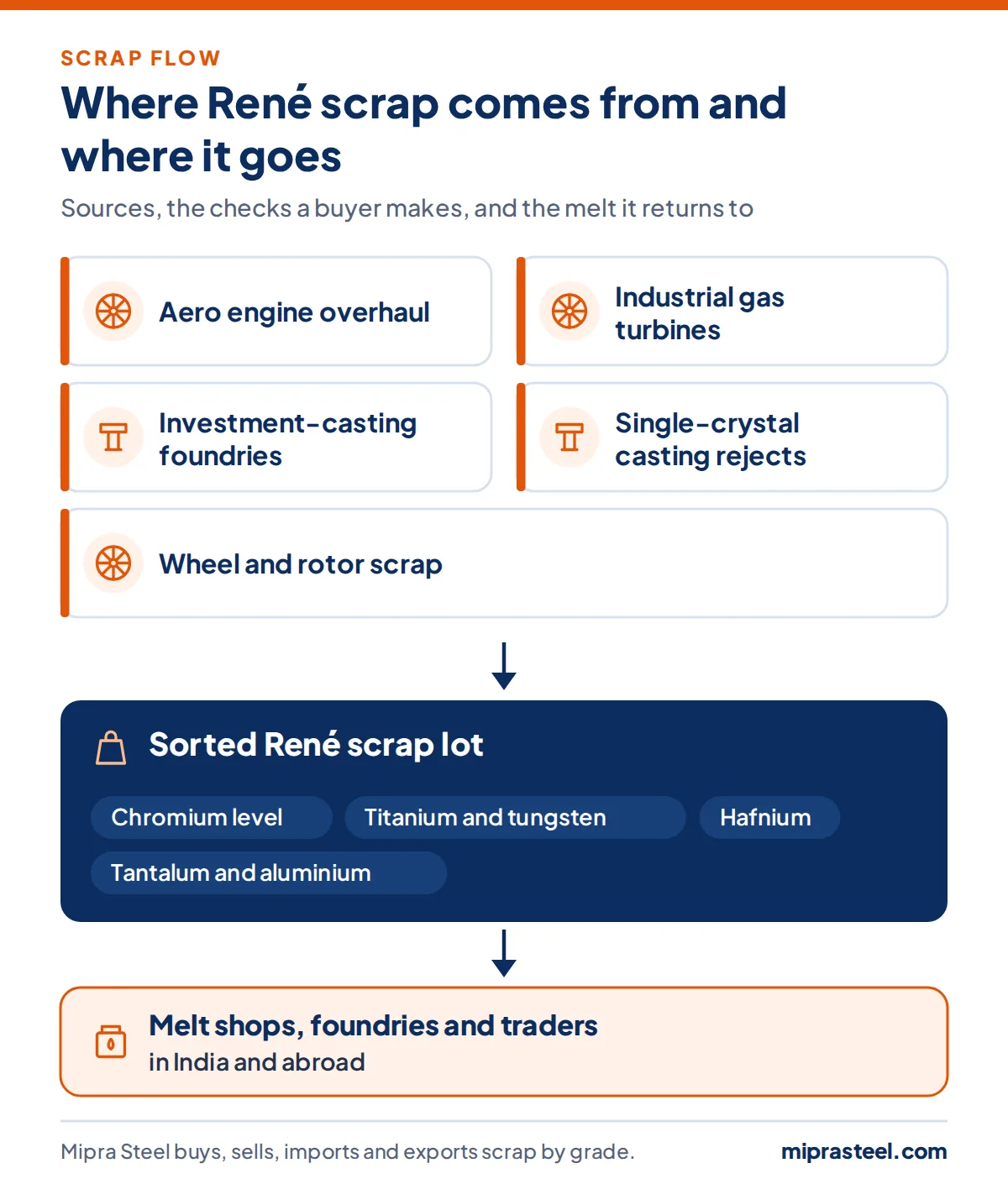
Source industries: aerospace, power generation.
René Alloy Scrap Buyer, Importer and Exporter in India
Mipra Steel trades René revert and ex-service parts grade by grade from Mumbai, keeping rhenium-bearing N5, documented low Zr René 80 and each of the other alloys in their own lots.
Sell René Scrap
Holding René scrap? Give us each alloy name, the basis for it (reading, certificate, part record), and the weight of each. Say whether the material is foundry revert, cast rejects or ex-service parts, whether it is coated, and whether blades still contain ceramic core. For N5, send any analysis or OEM paperwork showing rhenium; for René 80 offered as low Zr, send the zirconium result. Photos of roots and markings are useful too. We review incoming enquiries and respond with relevant next steps.
Buy René Scrap
Melt shops and traders looking for René revert should state the grade, whether they need revert, rejects or service parts, any coating limits, the quantity and the delivery port. Buyers of René 80 low Zr should say what zirconium documentation they need, and buyers of N5 how rhenium should be confirmed. Lots are described by grade and origin, with the supporting papers listed.
Preparing René Scrap for Sale
- Keep René N5 in sealed, labelled containers away from every rhenium-free grade.
- Separate the hafnium grades, 108 and 125, from René 77 and René 80.
- Store René 80 described as low Zr in its own drums, each tagged with the zirconium result.
- Split foundry revert from ex-service blades, and coated from stripped.
- Note whether blades still contain ceramic core and remove pins and shims.
- Record the engine or turbine model and stage on each container where known.
René Scrap Price per Kg: What Decides It
The spread in value across the René family is wider than in most families on this site, because one grade carries rhenium and the others do not.
- Rhenium: René N5 is assessed as rhenium-bearing revert, which puts it in a different bracket from every other grade in the family.
- Tantalum, tungsten and hafnium content, which lift N500, 108 and 125 above the older high-titanium grades.
- Single-grade certainty. A lot proved as one alloy can go back into that alloy; a mixed René lot goes to whoever can tolerate the blend.
- Origin: foundry revert with heat records is usually preferred to engine-run blades, which carry coatings, oxidation and repair welds.
- For René 80, documented low zirconium, which suits melts that need zirconium controlled.
- Ceramic core, coatings and attachments, which a buyer allows for in yield.
- Nickel, cobalt, tantalum, tungsten and rhenium markets on the day.
The broader logic of offers, from metal content to yield, is on our nickel alloy scrap value guide.
René Scrap Import and Export
Importing René Scrap into India
René scrap comes into India from aero engine overhaul centres and land turbine fleets in the Gulf, Europe, Japan, South Korea and Australia, and from investment-casting foundries abroad. Each shipment needs its pre-shipment inspection certificate along with the bill of lading, invoice and packing list, and clears at Nhava Sheva, Mundra or Chennai. The packing list should name each alloy separately and state whether blades are coated. Where a lot is sold as N5 or as René 80 low Zr, attach the analysis that justifies the name. Our guide to bringing nickel alloy scrap into India covers the rest.
Exporting René Scrap from India
Indian airline maintenance work and power stations with GE-design turbines release René blades and vanes that find their main buyers among specialist revert melters overseas. For export, each alloy and its origin are named on the invoice and packing list, and the weighed lot goes out in drums or crates. Melters in Japan and South Korea, and traders in Saudi Arabia, usually want readings and part records with the shipment. Our Dubai and South Korea offices keep us close to both regions; paperwork is covered under alloy scrap export documents.
Customs heading: 7503.00 (nickel waste and scrap). The HS code is the international tariff heading the scrap is declared under; national tariff lines add further digits, so confirm the full line with your customs broker.
Related Reading
René Alloy Scrap FAQ
Is "Rene" the same as "René" when searching for scrap?
Yes. Both spellings refer to the same GE-designated superalloys; the accent is often dropped on invoices, packing lists and search engines. What matters in a lot description is the grade that follows the name, such as René 80 or René N5, because the family covers very different chemistries.
Why is René N5 scrap handled differently from the rest of the family?
Because it carries about 3% rhenium, a scarce element that superalloy melters pay for separately. N5 kept on its own can go back into rhenium-bearing alloys; mixed with other René grades, the rhenium is diluted and the lot loses that use. Its confirmation usually needs lab analysis or OEM records.
What does "low Zr" mean on a René 80 lot?
It is shorthand used between traders and melters, with no specification behind it. A seller uses it for René 80 returns whose zirconium has been measured and found low, offered to buyers whose heats limit zirconium. No number defines it, so the label stands or falls on the OES result or heat certificate that comes with the drums.
Can René 108 and René 125 be packed together?
Better not. Both carry about 1.5% hafnium, but 108 has more tungsten and less titanium than 125, and each melt is charged to its own chemistry. If the two cannot be separated on a reading, declare the lot as a mix of the two so the buyer can decide.
Are retired René turbine blades worth more than foundry revert?
Usually not. Ex-service blades carry coatings, oxidation, repair welds and sometimes core, so a melter expects lower yield and more checking. Clean foundry revert with heat records tends to be preferred, although a well-documented set of stripped blades can compare closely.
Which HS code applies to René alloy scrap?
HS 7503.00, the heading for nickel waste and scrap, is the one typically used, because every René grade is nickel-base; rhenium-bearing N5 is no exception. Each country extends the heading with its own digits, so have your customs broker confirm the full line.
How do I start selling René blades or revert to Mipra Steel?
Use the sell scrap page or the enquiry form to share alloy names, weights, origin, coating state, photos and any analyses. Sellers in India and abroad can both offer lots; we buy, sell, import and export René scrap.
Should directionally solidified René blades be declared separately from equiaxed ones?
Yes. René 108 is cast DS, while René 80 and 77 parts are usually equiaxed, and single-crystal N5 and N500 have no grain boundaries at all. Telling the buyer the casting route alongside the alloy name helps them match the material to their own melt and avoids questions after delivery.
Published by Mipra Steel, Khetwadi, Mumbai · Updated