What Counts as Tungsten Carbide Scrap, and How Are Lots Graded?
Hardmetal is made by mixing tungsten carbide powder with cobalt powder, pressing the mix to shape and sintering it until the cobalt melts and cements the hard grains together. The result is the cutting edge of most modern machining, the button on a rock drill and the bore of a wire-drawing die. Every one of those parts wears out, breaks or gets rejected at inspection, and that is where the scrap comes from.
The trade does not grade carbide by an alloy designation. A buyer sorts it by what it looks like and how much non-carbide material travels with it. Solid hard pieces sit in one class: uncoated inserts, solid round tools, rods and blanks. Coated inserts are usually a separate line, because the thin titanium nitride, titanium aluminium nitride or alumina layer has to be dealt with by the recycler. Mining buttons and road-planing teeth form another class, and brazed tools, where a small carbide tip sits on a steel body, are valued on the carbide they carry rather than their gross weight. Grinding sludge and powder are soft scrap and go to chemical recovery.
Cobalt content matters as well. Most cutting grades sit between about 6 and 12% cobalt, while some wear and mining grades run higher. Grades meant for cutting steel often add titanium, tantalum or niobium carbides, and a few corrosion-resistant grades use a nickel binder instead of cobalt. None of this is visible, so buyers lean on XRF readings and on knowing where a lot came from.
Carbide is not a nickel alloy and not ferro tungsten. It belongs with the other exotic materials Mipra Steel trades, alongside pure tungsten and cobalt metal.
How to Recognise Tungsten Carbide
Carbide is easy to spot once you know that a small piece weighs far more than it should. Telling clean solid carbide from material that will downgrade a lot takes a few more checks.
| Check | What it shows for Tungsten carbide |
|---|---|
| Weight in the hand | Cemented carbide is around 14 to 15 g/cm³, nearly double steel. A rod that feels like lead in a steel-sized body is almost certainly carbide. |
| XRF reading | Shows tungsten and cobalt, plus titanium, tantalum or niobium in steel-cutting grades, and nickel where a nickel binder was used. |
| Coating | Gold, black or purple surfaces on inserts point to coatings. Coated and uncoated inserts are usually kept in separate bags. |
| Steel content | A magnet pulls strongly on steel shanks and casings but only weakly on cobalt-bonded carbide. Strong pull on a "carbide" lot means attached steel. |
| Brazed joints | Copper or silver-coloured braze lines show tipped tools. They are counted as tipped material, not solid carbide. |
| Foreign tips | PCD and CBN tipped inserts look like carbide but carry superhard tips. They are pulled out because they follow a different recovery route. |
Grades Most Often Confused with Tungsten Carbide
- High-speed steel tools: look the same as solid drills and taps but weigh roughly 8 g/cm³ and are strongly magnetic, about half the density of carbide.
- Cermet and ceramic inserts: are shaped like carbide inserts but are much lighter, and XRF shows little or no tungsten.
- Tungsten heavy alloy: is heavier still, around 17 to 18.5 g/cm³, and reads as tungsten with nickel and iron rather than tungsten with cobalt.
Density Is the Quick Check
Cemented carbide is around 14–15 g/cm³, nearly twice as dense as steel. A heavy small piece is usually carbide.
Separate Brazed-Tip Tools
Steel shanks with brazed carbide tips are valued lower than solid carbide.
Cobalt Makes It Slightly Magnetic
The cobalt binder makes most carbide weakly magnetic. That separates it from ceramics and cermets, not from steel.
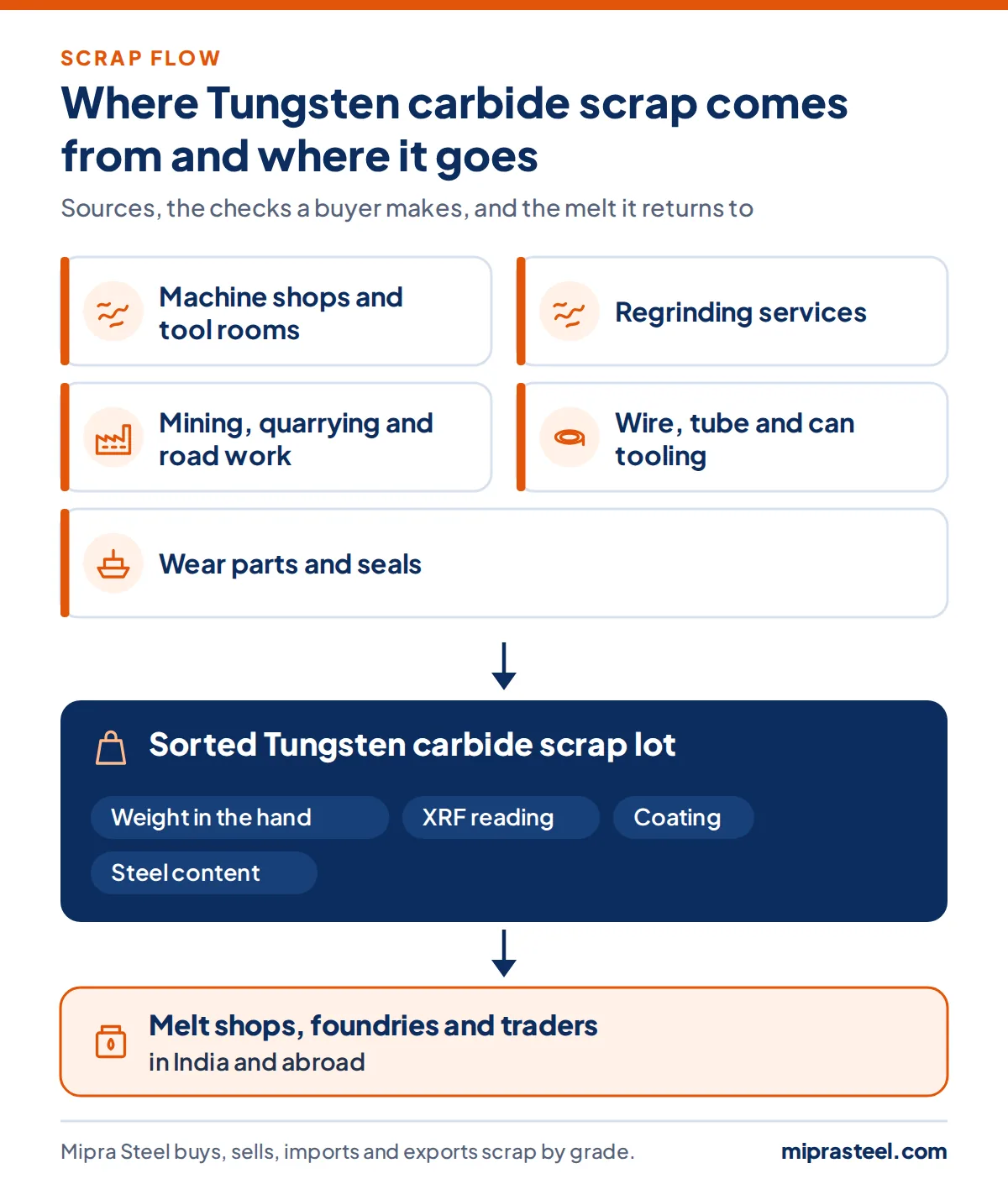
Where Tungsten Carbide Scrap Comes From
Carbide is used up slowly, a fraction of a millimetre of edge at a time, so most of it reaches the scrap market as whole tools that have reached the end of their regrind life.
Machine Shops and Tool Rooms
Indexable inserts with worn or chipped edges, broken solid drills and end mills, and taps that cannot be resharpened. Auto component and die-making shops fill bins steadily.
Regrinding Services
Tools are reground several times until the diameter or flute length runs out. Regrinders collect the final round of spent solid carbide and also produce grinding sludge.
Mining, Quarrying and Road Work
Button bits, drill bit inserts, picks and milling teeth. The carbide is often pressed or brazed into steel, so it is either knocked out or sold as tipped material.
Wire, Tube and Can Tooling
Drawing dies, ironing rings and punches. Dies usually arrive in steel casings that must be removed before the carbide is graded as solid.
Wear Parts and Seals
Nozzles, seal rings, valve trim and wear plates from pumps, sandblasting and process plant. Some of these use nickel binder grades and should be identified.
Tungsten Carbide Scrap Buyer, Importer and Exporter in India
Mipra Steel buys carbide scrap from machine shops, regrinders and traders in India and abroad, and supplies described lots of hard and soft carbide to recyclers and traders.
Sell Tungsten Carbide Scrap
Selling carbide inserts, rods or worn solid tools? Tell us the approximate weight and split the lot into uncoated, coated, solid round tools, tipped tools and buttons if you can. Photographs of a handful of pieces on a scale, any XRF readings and the city where the material sits help us understand it. We review incoming enquiries and respond with relevant next steps.
Buy Tungsten Carbide Scrap
Recyclers and powder makers sourcing carbide scrap can send the class they need (solid, uncoated inserts, coated inserts, buttons, sludge), the monthly or one-off quantity, the delivery port and the tungsten or cobalt range they accept. We describe each lot by form and cleanliness, so the class you receive matches the class you asked for.
Preparing Tungsten Carbide Scrap for Sale
- Pull out HSS tools, ceramic and cermet inserts, and any PCD or CBN tipped tools.
- Keep uncoated inserts, coated inserts, solid round tools and buttons in separate containers.
- Knock out or cut off steel holders, casings and shanks where you can; bag tipped tools apart.
- Dry inserts collected from coolant and keep sludge in closed drums.
- Pack in strong drums: carbide is heavy enough to split ordinary bags.
Tungsten Carbide Scrap Price per Kg: What Decides It
Carbide scrap is priced from the tungsten and cobalt a lot can return to the recycler, then adjusted for how much work the lot needs before it can be processed.
- Form: solid hard pieces (rods, blanks, uncoated inserts) are worth more than tipped or mixed material because nearly every kilogram is carbide.
- Coatings: coated inserts sell as their own grade and usually below uncoated ones.
- Cobalt level: higher-cobalt wear and mining grades carry more cobalt per kilogram, which can move the offer either way depending on the cobalt market.
- Attached steel and braze: shanks, casings and braze reduce the carbide yield and are deducted or the lot is regraded.
- Mixed carbides and binders: titanium, tantalum or nickel bearing material suits some recyclers less than straight WC-Co.
- Oil, moisture and dirt: inserts collected wet from machine sumps lose weight once dried and cleaned.
- Soft scrap: sludge and powder are valued on assayed tungsten content and sit well below hard scrap.
Tungsten and cobalt prices both change with the market, so a carbide scrap price per kg is only meaningful with a date and a lot description. Read our tungsten carbide scrap guide for how hard and soft scrap differ.
Tungsten Carbide Scrap Import and Export
Importing Tungsten Carbide Scrap into India
Sorted carbide scrap can be brought into India from the Gulf, Europe and East Asia, where large machining and drilling sectors generate it. Like other imported metal scrap it is inspected before shipment, and the shipper provides a pre-shipment inspection certificate, commercial invoice, packing list and bill of lading. Carbide is dense, so a small number of drums can make up a full legal container weight; packing in sturdy steel drums on pallets is normal. A clear class description on the invoice (for example "uncoated carbide inserts") avoids disputes when the lot is checked at Nhava Sheva or Chennai.
Exporting Tungsten Carbide Scrap from India
India has a large machining base serving the automotive, engineering and die-making sectors, and spent inserts and solid tools collect in every industrial cluster. Exported carbide lots are described by class on the invoice and packing list, weighed, and shipped in drums inside containers from Nhava Sheva or Mundra. Recyclers in Japan, South Korea and Europe take sorted hard scrap. Our South Korea and UAE offices sit close to buyers in East Asia and the Gulf. See export documents for alloy scrap.
Customs heading: 8101.97 (tungsten waste and scrap). The HS code is the international tariff heading the scrap is declared under; national tariff lines add further digits, so confirm the full line with your customs broker.
Related Reading
Types of Carbide Scrap
| Type | Examples | Notes |
|---|---|---|
| Solid hard scrap | Indexable inserts, solid end mills, drills, rods | The most sought-after form: high carbide content, easy to verify |
| Wear parts and dies | Wire-drawing dies, nozzles, rolls, wear plates | Remove steel casings and mountings |
| Mining and construction tips | Button bits, road-planing teeth | Often brazed or pressed into steel; separate if possible |
| Brazed-tip tools | Saw tips, brazed boring tools | Mostly steel by weight; valued on carbide content |
| Soft scrap | Grinding sludge, powders | Fine, oily and oxidised; processed by chemical routes and valued far lower |
How Carbide Is Recycled
Hard carbide scrap is recycled either by the zinc process, which breaks the cobalt binder so the carbide can be milled back into powder, or by chemical processing that recovers tungsten and cobalt as new compounds. Both routes depend on clean, sorted scrap, which is why coated, brazed and mixed material is separated before sale.
Tungsten Carbide Scrap FAQ
How much is tungsten carbide scrap worth?
It depends on the form and the day. Solid hard carbide such as rods and uncoated inserts commands more than coated inserts, tipped tools or sludge, and every offer follows tungsten and cobalt prices at the time. We do not publish a fixed rate; send the weight, class and photographs for a dated offer.
How do I tell carbide from high-speed steel?
Weigh it. Carbide is about 14 to 15 g/cm³ and high-speed steel about 8 g/cm³, so a carbide drill feels close to twice as heavy as an HSS drill of the same size. HSS is also strongly magnetic, while cobalt-bonded carbide is only weakly attracted.
Are coated carbide inserts bought separately?
Yes, usually. Coatings such as TiN, TiAlN or alumina are thin but have to be dealt with during recycling, so coated inserts are bagged and priced as their own class. Mixing them into an uncoated lot normally drags the whole lot down to the coated description.
Does Mipra Steel buy carbide grinding sludge?
Yes, soft carbide scrap such as grinding sludge and powder can be offered. It is valued on its assayed tungsten content, which is lower and less certain than for solid pieces, so send any analysis you have along with the weight, moisture condition and photographs.
Is carbide scrap the same as ferro tungsten scrap?
No. Carbide is tungsten carbide cemented with cobalt, shaped as tools and wear parts. Ferro tungsten is an iron-tungsten alloy in crushed lumps used to add tungsten to steel. They go to different buyers and should never be mixed.
Which customs code covers carbide scrap?
Cemented carbide scrap is typically declared under HS 8101.97, tungsten waste and scrap. Tariff lines beyond six digits are set by each country, so check the full code with your customs broker before the shipment is booked.
Can brazed carbide tools be sold?
Yes, but as tipped material. Most of the weight is steel, so the offer is based on the carbide that can be recovered. Removing the tips, or at least keeping tipped tools out of the solid lot, protects the value of your solid carbide.
Published by Mipra Steel, Khetwadi, Mumbai · Updated