Ni-Resist Type 1 Scrap Buyer, Importer and Exporter in India
Mipra Steel in Khetwadi, Mumbai trades Ni-Resist Type 1 scrap as a sorted cast iron grade, buying from pump users, shipyards and foundries and passing type-sorted castings on to iron foundries and traders.
Sell Ni-Resist Type 1 Scrap
Have Ni-Resist pump casings, impellers or valve bodies? Send photographs, the approximate weight, the location and, if possible, a reading showing nickel and copper. Mention any bronze impellers, steel shafts or rubber linings still fitted. We review incoming enquiries and respond with relevant next steps.
Buy Ni-Resist Type 1 Scrap
Foundries pouring Ni-Resist Type 1 can source sorted Type 1 scrap as a nickel and copper bearing charge. Tell us the quantity, the maximum piece size your furnace accepts, the readings you need per lot and the destination. We can discuss lots described by type and UNS number.
What Is Ni-Resist Type 1, and Why Does Its Scrap Need Sorting?
Ordinary grey iron rusts in seawater and wears quickly in gritty water. Foundries found that adding around 15% nickel and 6.5% copper turns the iron matrix austenitic, the same crystal structure as austenitic stainless steel, while keeping the graphite flakes that make grey iron easy to cast and machine. The result, Type 1, became a standard material for pump bodies, impellers and valves handling seawater, brine and mildly corrosive process water. It also has a high coefficient of expansion, close to aluminium, which is why it has long been used for piston ring carriers cast into aluminium pistons.
As scrap, Type 1 is cast iron first. Its carbon, silicon and graphite mean it is classified with cast iron scrap and cannot simply replace nickel in a low-carbon melt. What lifts it above grey iron is the metal it carries: a tonne of Type 1 holds roughly 155 kg of nickel and 65 kg of copper. A foundry pouring Type 1 again can use that directly and cut its nickel and copper additions.
Copper is also the reason Type 1 must be kept apart from its sister grades. Type 2 was developed precisely for duties where copper is unwanted, and Type 5 has none either. A few Type 1 casings in a copper-free lot can spoil it for the foundry that wanted it, so the type is confirmed before anything else. The Ni-Resist scrap overview explains the whole family.
Ni-Resist Type 1 belongs to the Ni-Resist family, part of exotic alloy scrap.
Where Ni-Resist Type 1 Scrap Is Found
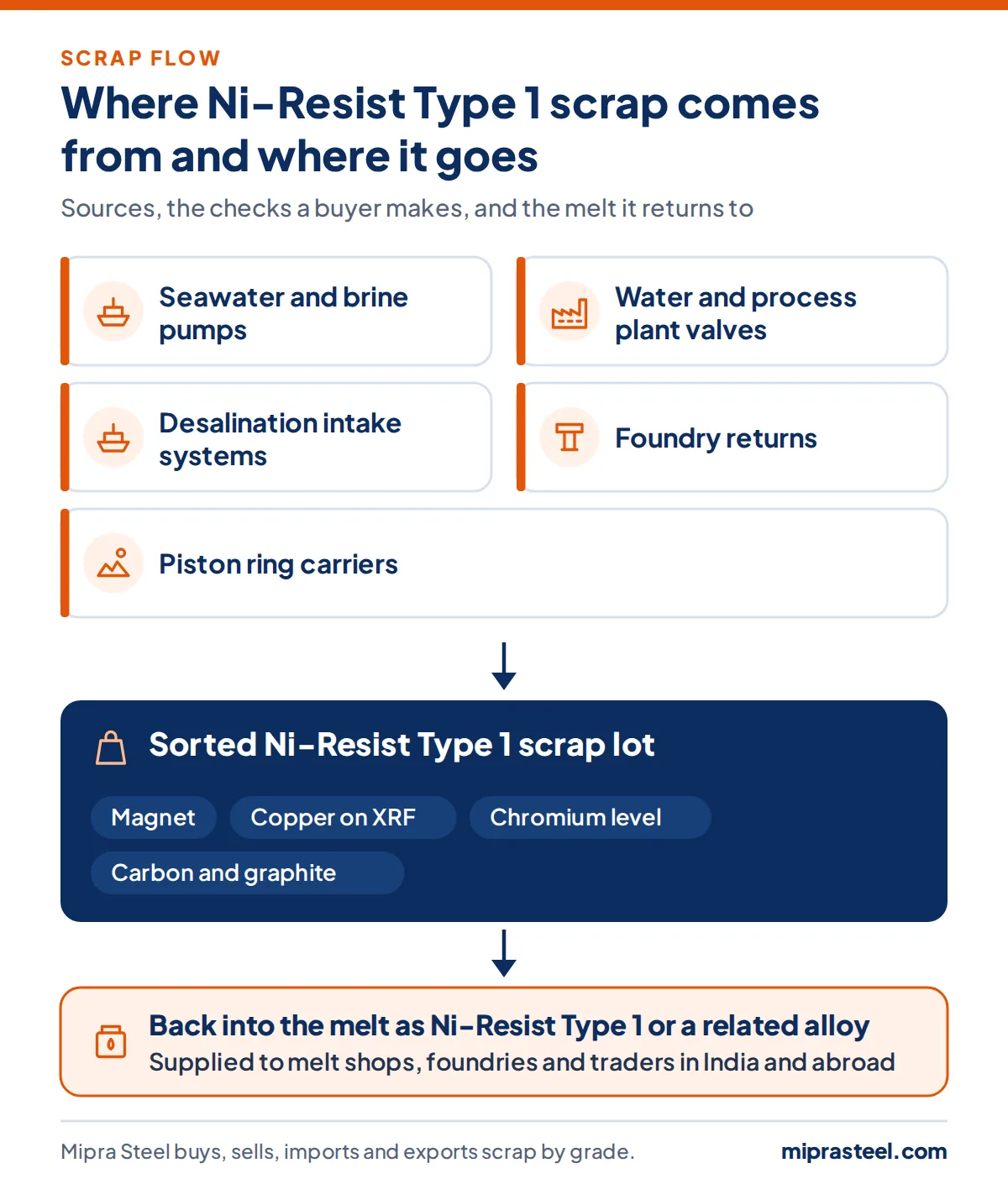
Type 1 is a casting material, so its scrap is almost always worn-out or replaced cast components, not offcuts.
Seawater and Brine Pumps
Volute casings, bowls, impellers and wear rings from cooling-water, firewater and ballast pumps. See marine and shipbuilding scrap.
Water and Process Plant Valves
Valve bodies and bonnets from water treatment, process water and mildly corrosive chemical lines.
Desalination Intake Systems
Seawater intake and transfer pumps replaced during plant upgrades. See desalination scrap.
Foundry Returns
Gates, risers and rejected castings from foundries pouring Type 1, usually of known chemistry and free of attachments.
Piston Ring Carriers
Ring inserts are bonded inside aluminium diesel pistons, so they only become Ni-Resist scrap once separated from the aluminium.
Ni-Resist Type 1 Scrap Specification Chart
| Grade | Ni-Resist Type 1 |
|---|---|
| UNS | F41000 |
| W.Nr. / EN | EN-GJLA-XNiCuCr15-6-2 |
| Also known as | Ni-Resist 1 |
| Alloy type | Austenitic flake-graphite cast iron |
| Density | 7.3 g/cm³ (0.264 lb/in³) |
| Magnetic | Non-magnetic. |
| HS code (customs heading) | 7204.10 (cast iron waste and scrap) |
Ni-Resist Type 1 Chemical Composition
Nominal composition in weight per cent, used to describe and identify the grade. The governing specification sets the limits for each product.
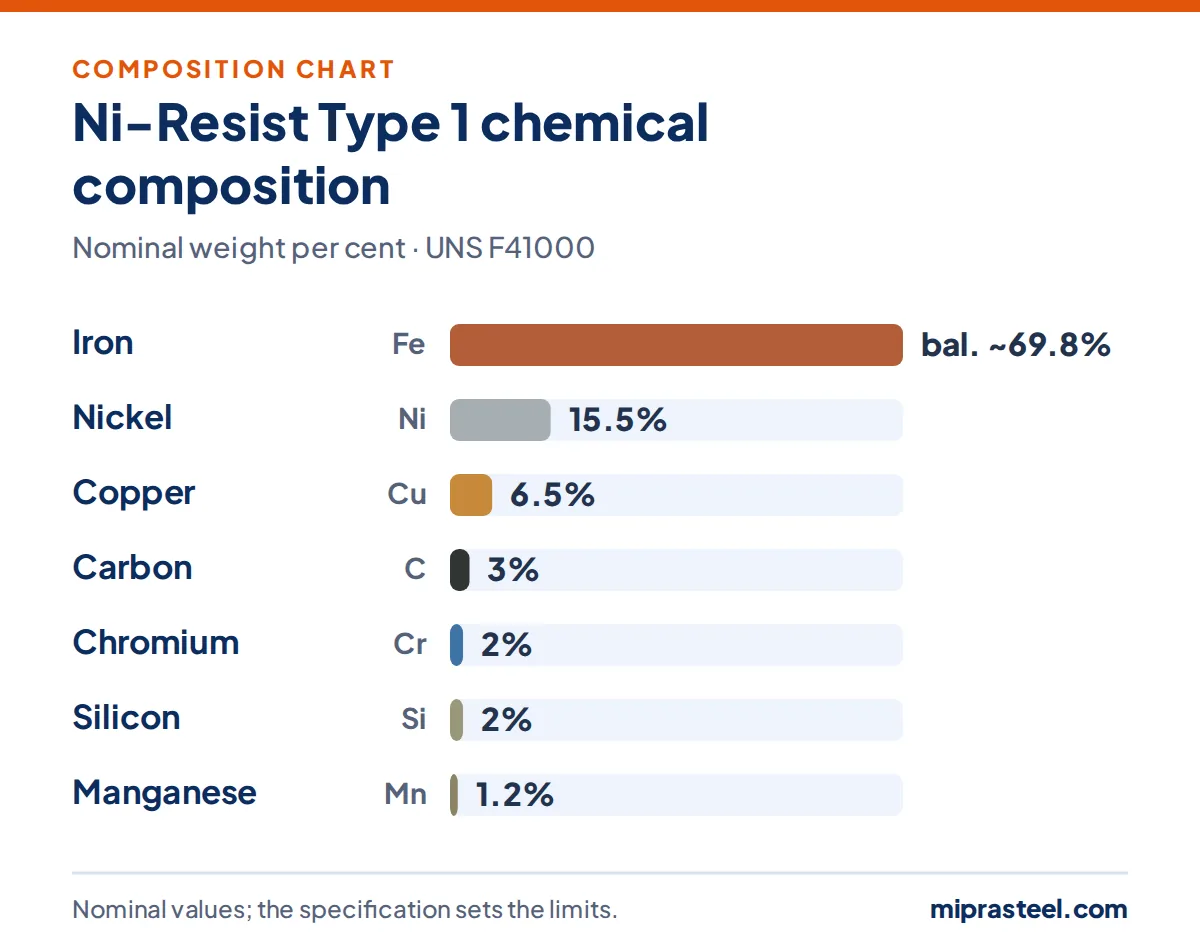
| Element | Symbol | Nominal wt% | |
|---|---|---|---|
| Iron | Fe | Balance (about 69.8) | |
| Nickel | Ni | 15.5 | |
| Copper | Cu | 6.5 | |
| Carbon | C | 3 | |
| Chromium | Cr | 2 | |
| Silicon | Si | 2 | |
| Manganese | Mn | 1.2 |
Ni-Resist Type 1 Equivalent Grades and Other Names
| Designation | Value |
|---|---|
| Trade name | Ni-Resist Type 1 |
| UNS | F41000 |
| W.Nr. / EN | EN-GJLA-XNiCuCr15-6-2 |
| Other names in the trade | Ni-Resist 1 |
Look up any designation in the grade name converter or the equivalent grade chart.
Ni-Resist Type 1 Standards and Specifications
| Product form | Standard | ASME equivalent |
|---|---|---|
| Austenitic grey iron castings | ASTM A436 | No ASME edition |
| Austenitic cast iron (Europe) | EN 13835 | No ASME edition |
Ni-Resist Type 1 Applications
- Pump casings and impellers
- Seawater and brine pumps
- Valve bodies
Source industries: marine and shipbuilding, desalination, chemical processing.
How Ni-Resist Type 1 Scrap Is Identified
A Type 1 casting looks like any grey iron pump body, so identification relies on a magnet and on the copper reading.
| Check | What it shows for Ni-Resist Type 1 |
|---|---|
| Magnet | Type 1 is non-magnetic. A casing that grabs a magnet strongly is plain or alloyed grey iron, not Type 1. See magnet sorting. |
| Copper on XRF | Around 5.5% to 7.5% copper with about 15% nickel is the Type 1 fingerprint. No copper means Type 2 or Type 5. |
| Chromium level | About 2% chromium is standard Type 1. A reading near 3% suggests Type 1b, the harder variant. |
| Carbon and graphite | XRF cannot see carbon. Spark OES confirms roughly 3% carbon, which separates cast Ni-Resist from wrought nickel-copper or stainless material. See XRF vs OES. |
| Fractured or cut face | A grey, graphitic break is typical of flake-graphite iron and supports the cast iron identification. |
| Casting marks | Pump makers often cast the material code or "NR1" on the body, and pump data sheets name ASTM A436 Type 1. |
Grades Most Often Confused with Ni-Resist Type 1
- Ni-Resist Type 1b: has the same 15.5% nickel and 6.5% copper but about 3% chromium for extra hardness and wear resistance.
- Ni-Resist Type 2: carries about 20% nickel with copper held to 0.5% or less.
- Plain grey cast iron: has little or no nickel or copper and is strongly magnetic.
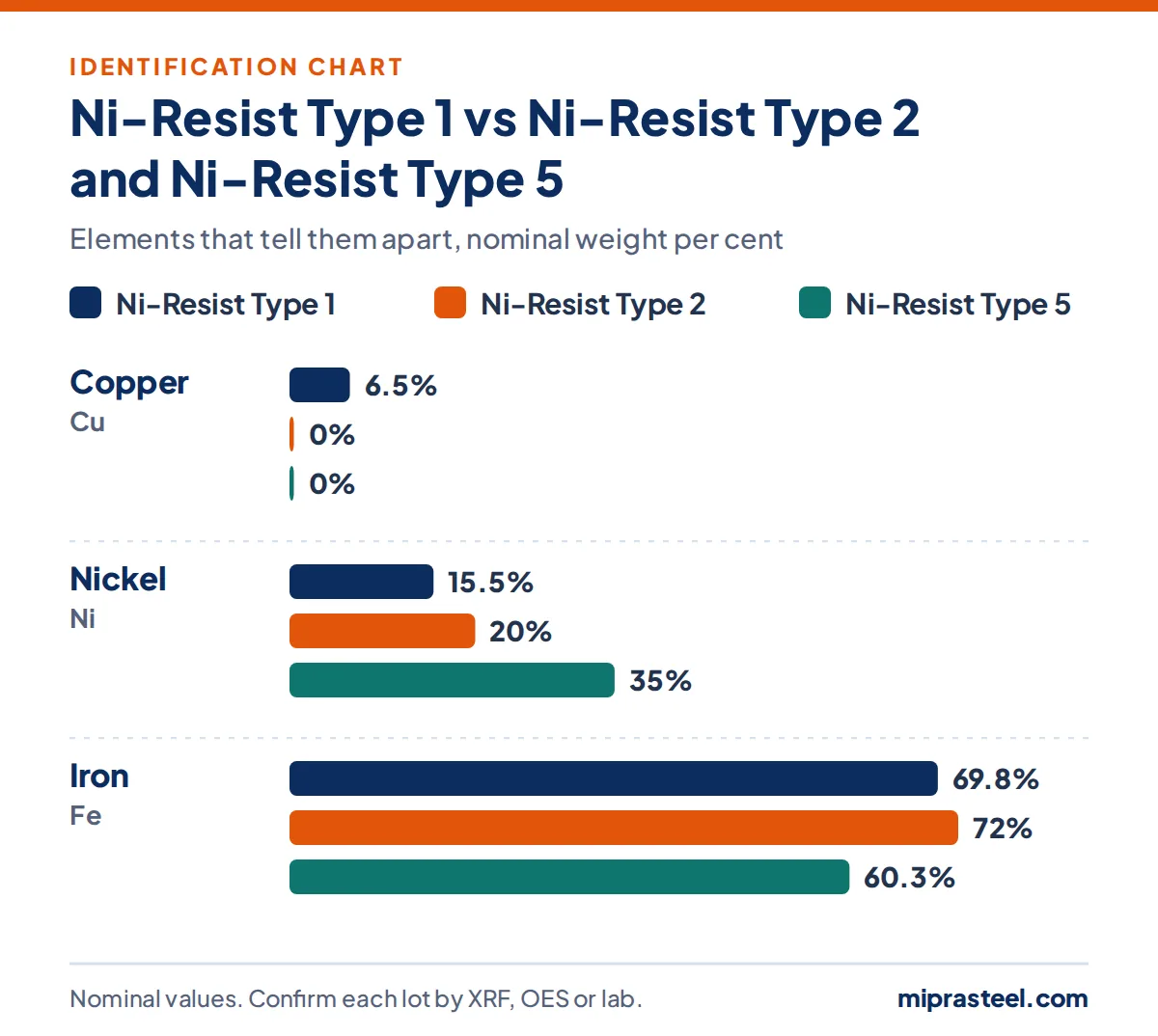
Nominal values for Ni-Resist Type 1 against its closest grades on this site.
Preparing Ni-Resist Type 1 Scrap for Sale
- Pull bronze or stainless impellers, shafts and wear rings out of Type 1 casings.
- Magnet-test every casting and set aside anything magnetic.
- Keep Type 1 apart from Type 2 and Type 5, which must stay copper-free.
- Strip rubber linings, coatings and heavy marine growth.
- Break oversized casings if your buyer has a piece-size limit.
- Keep pump data sheets or casting marks that name the material.
Ni-Resist Type 1 Scrap Price per Kg: What Decides It
Type 1 is not priced like cast iron, and not like a nickel alloy either. The offer sits on what the lot contains and on how cleanly it can be remelted.
- Contained nickel at around 15.5%, the main value driver, with copper at about 6.5% recognised by buyers who pour copper-bearing irons.
- Confirmed type: readings showing copper and no more than about 3% chromium let the lot be sold as Type 1 rather than mixed Ni-Resist.
- Bronze, gunmetal and stainless attachments: impellers, wear rings, shafts and sleeves of other alloys are common in pumps and must be removed.
- Plain grey iron in the lot: magnetic iron casings dilute the nickel and are an easy deduction to avoid.
- Coatings, rubber linings and marine fouling: weight that adds nothing to the melt.
- Piece size: large casings may need breaking to fit a furnace, which costs the buyer time.
Nickel and copper both move daily on world markets, so offers are dated. Use the contained metal calculator to estimate the nickel and copper in a lot by weight.
Ni-Resist Type 1 Scrap Import and Export
Importing Ni-Resist Type 1 Scrap into India
Seawater pumps and valves are replaced constantly on ships and in coastal plants across the Gulf, East Asia and Europe, which is where most imported Type 1 originates. Imported metal scrap into India normally needs a pre-shipment inspection certificate along with the commercial invoice, packing list and bill of lading. Ni-Resist is cast iron, so it is typically declared under HS 7204.10 as cast iron waste and scrap; confirm the national line with your broker. Stating "Ni-Resist Type 1, ASTM A436, UNS F41000" with nickel and copper readings keeps the description consistent on arrival at Nhava Sheva, Mundra or Chennai.
Exporting Ni-Resist Type 1 Scrap from India
Indian shipbreaking, shipyards, refineries and coastal power stations release Type 1 pump and valve castings that overseas Ni-Resist foundries can use as charge. Export lots carry the type, ASTM grade and UNS number on the invoice and packing list, are weighed, and go loose or palletised in containers from Nhava Sheva or Mundra. Our Dubai office works with the Gulf marine and desalination sector, and our South Korea office with East Asian buyers. See export documents.
Customs heading: 7204.10 (cast iron waste and scrap). The HS code is the international tariff heading the scrap is declared under; national tariff lines add further digits, so confirm the full line with your customs broker.
Other Ni-Resist Scrap Grades
Related Reading
Ni-Resist Type 1 Scrap FAQ
Is Ni-Resist Type 1 scrap valuable?
Yes, more than ordinary cast iron. It contains about 15.5% nickel and 6.5% copper, which Ni-Resist foundries can reuse. It is still cast iron with around 3% carbon, so it is not valued like a wrought nickel alloy. Grade certainty and clean, attachment-free castings decide where an offer lands.
How do I tell Ni-Resist Type 1 from Type 2?
Look for copper. Type 1 reads about 6.5% copper with 15% nickel; Type 2 reads 20% nickel with copper at 0.5% or less. Both are non-magnetic and look identical as castings, so an XRF reading is the practical test.
Why is copper a problem when Ni-Resist types are mixed?
Type 2 and Type 5 are specified with almost no copper. Type 2 serves food, soap and caustic duties where copper contamination is unwanted, so a foundry melting those grades cannot accept copper-bearing Type 1 in its charge. Keeping types separate protects both lots.
What HS code is used for Ni-Resist scrap?
Because Ni-Resist is an austenitic cast iron, its scrap is typically classified under HS 7204.10, waste and scrap of cast iron, not under the nickel scrap heading. National tariff lines vary, so confirm the full code with a customs broker.
Are piston ring carriers Ni-Resist Type 1?
Ring carriers in aluminium pistons have traditionally been Ni-Resist Type 1, chosen because its thermal expansion is close to that of aluminium piston alloys. They are bonded into the piston, so they reach the scrap trade only once the aluminium has been removed.
Can I sell Ni-Resist pump casings with the impeller still inside?
You can offer them, but say so. Impellers are often bronze or stainless, and leaving them in means the buyer must dismantle the pump and deduct the foreign metal. Removing them first makes the lot cleaner and easier to describe.
What does Mipra Steel need to quote on Type 1 castings?
Photographs of the castings, an estimated weight, the location and any reading or document showing nickel and copper. Say whether impellers, shafts or linings are still fitted. That lets us respond on how the lot can be described and moved.
What is Ni-Resist Type 1 made of?
Nominally 69.8% iron, 15.5% nickel, 6.5% copper, 3% carbon, 2% chromium, 2% silicon, 1.2% manganese. Specification ranges vary by product form and standard.
Published by Mipra Steel, Khetwadi, Mumbai · Updated