PWA 1483 Scrap Buyer, Importer and Exporter in India
Mipra Steel trades PWA 1483 as a separate rhenium-free single-crystal grade, kept apart from both aero rhenium alloys and equiaxed industrial blade alloys.
Sell PWA 1483 Scrap
To sell PWA 1483 scrap, send the number of blades, total weight, coating condition and location, with photographs showing the root form and any markings. Note the turbine type and stage the blades came from if you know them, and attach any readings. We review incoming enquiries and respond with relevant next steps.
Buy PWA 1483 Scrap
Melt shops and casting houses looking for rhenium-free single-crystal stock can ask for PWA 1483 by itself. Tell us the quantity, whether you accept coated blades or need stripped material or revert, and your destination port. We describe each lot by grade and discuss the readings and origin papers that come with it.
What Is PWA 1483 and How Does It Differ from Aero Single-Crystal Alloys?
Aero-engine single-crystal alloys push chromium down and refractory metals up to win creep strength. PWA 1483 goes the other way. Pratt & Whitney developed it for marine and industrial gas turbines, where blades run for long periods in combustion gas carrying sulfur and salts from fuel and intake air. At about 12.2% chromium it has more than double the chromium of PWA 1484, and that chromium is what protects the blade from hot corrosion.
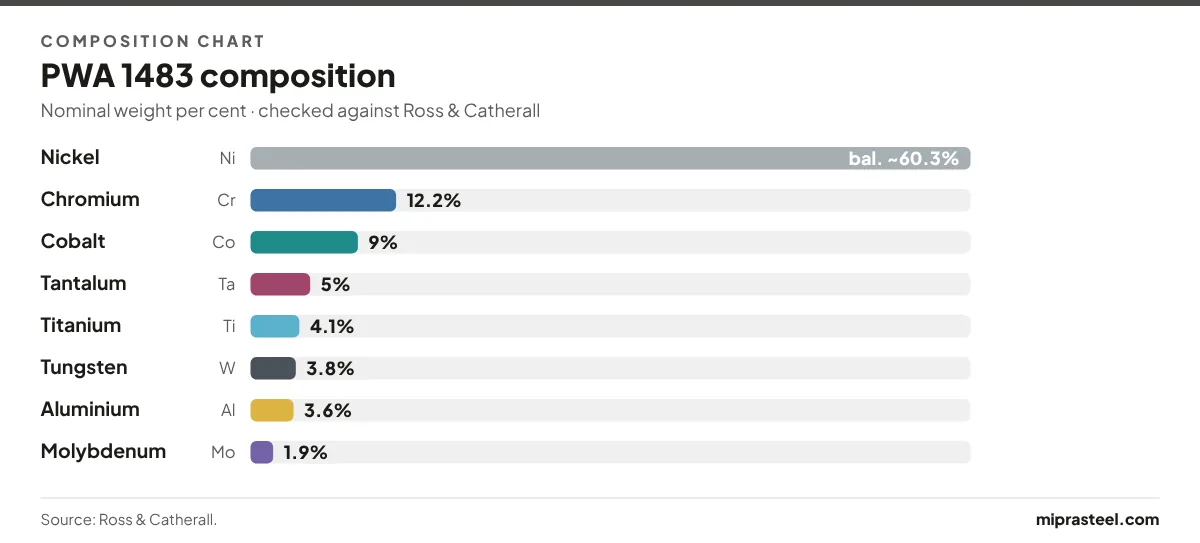
The rest of the chemistry follows from that choice: 9% cobalt, 5% tantalum, 4.1% titanium, 3.8% tungsten, 3.6% aluminium, 1.9% molybdenum and a small carbon content of about 0.07%. There is no rhenium. So PWA 1483 scrap is valued on nickel, cobalt, tantalum and tungsten, not on rhenium, and a buyer will not pay a rhenium premium for it however it is labelled.
Single-crystal casting matters for the blade, but less for the melt. With no grain boundaries to hold together, a single-crystal blade needs none of the boron and zirconium that equiaxed blade alloys rely on at their grain boundaries. Once remelted, a single-crystal alloy is valued on its chemistry. What matters is that the chemistry is one alloy, and that the lot is not padded with equiaxed industrial blades of similar appearance.
Industrial blades in this alloy can be large, so one blade may weigh many times as much as an aero blade. That makes counting pieces and weighing them both useful when checking a lot. The PWA alloy scrap page covers the family, and gamma prime superalloys explains the strengthening behind it.
PWA 1483 belongs to the PWA family, part of superalloy scrap.
Where Does PWA 1483 Scrap Turn Up?
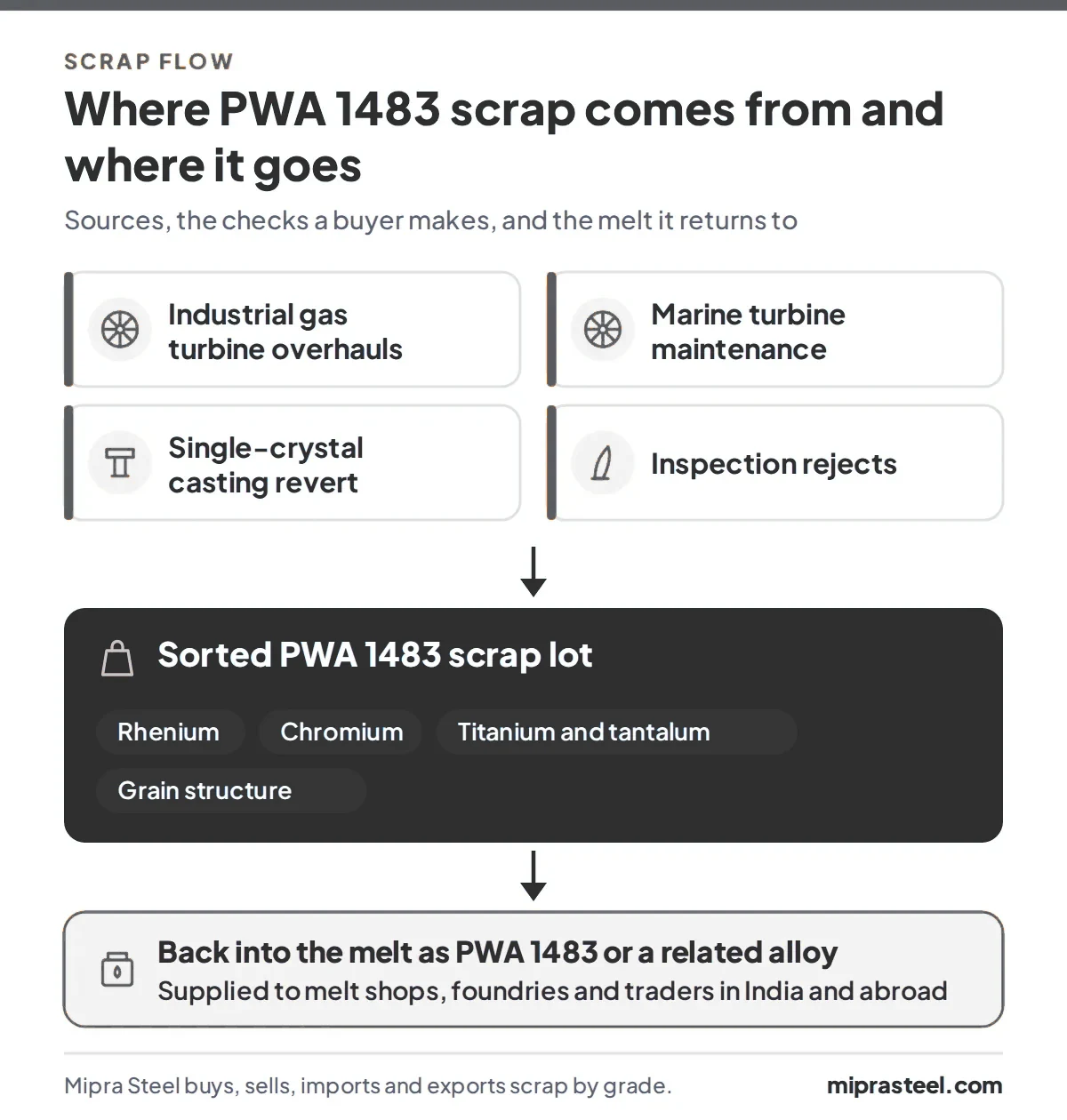
PWA 1483 leaves service through overhaul and blade replacement on land-based and marine turbines, and through the foundries that cast new blades.
Industrial Gas Turbine Overhauls
Blade rows replaced at scheduled inspections or after damage. Blades usually arrive coated and may show tip wear, erosion or burn damage. See power generation scrap.
Marine Turbine Maintenance
Blades from marine gas turbines, where the high-chromium chemistry is chosen for salt-laden air. See marine and shipbuilding scrap.
Single-Crystal Casting Revert
Gates, starters, grain selectors and castings rejected for stray grains or other defects. Revert is uncoated and traceable to a heat.
Inspection Rejects
Finished blades scrapped for dimensional or coating faults before entering service, usually with part numbers attached.
PWA 1483 Scrap Specification Chart
| Grade | PWA 1483 |
|---|---|
| UNS | Not assigned (proprietary Pratt & Whitney alloy) |
| W.Nr. / EN | Not assigned; specified by Pratt & Whitney specification PWA 1483 |
| Identified by | The PWA 1483 specification itself, with casting records |
| Also known as | PWA1483, PWA-1483 |
| Alloy type | Single-crystal nickel superalloy (high chromium) |
| Density | Not published |
| Magnetic | Non-magnetic. |
| HS code (customs heading) | 7503.00 (nickel waste and scrap) |
PWA 1483 Chemical Composition
Nominal values used on this site, checked against the published composition of PWA 1483 from Ross & Catherall. The right-hand column gives the published values; "max" marks a maximum. The specification on a mill certificate governs any particular product.
| Element | Symbol | Nominal wt% (this site) | Source value, wt% |
|---|---|---|---|
| Nickel | Ni | Balance (about 60.3) | Balance |
| Chromium | Cr | 12.2 | 12.2 |
| Cobalt | Co | 9 | 9.0 |
| Tantalum | Ta | 5 | 5.0 |
| Titanium | Ti | 4.1 | 4.1 |
| Tungsten | W | 3.8 | 3.8 |
| Aluminium (aluminum) | Al | 3.6 | 3.60 |
| Molybdenum | Mo | 1.9 | 1.9 |
| Carbon | C | 0.07 | 0.07 |
| Boron | B | – | 0.003 max |
| Zirconium | Zr | – | 0.0075 max |
PWA 1483 Equivalent Grades and Other Names
| Designation | Value |
|---|---|
| Trade name | PWA 1483 |
| UNS | Not assigned (proprietary Pratt & Whitney alloy) |
| W.Nr. / EN | Not assigned; specified by Pratt & Whitney specification PWA 1483 |
| Key specification | Pratt & Whitney specification PWA 1483 |
| Other names in the trade | PWA1483, PWA-1483 |
Look up any designation in the grade name converter or the equivalent grade chart.
PWA 1483 Standards and Specifications
Pratt & Whitney specification PWA 1483.
PWA 1483 Applications
- Industrial gas turbine single-crystal blades
- Marine gas turbine blades
Source industries: power generation, marine and shipbuilding.
How PWA 1483 Scrap Is Identified
PWA 1483 sits in a crowded neighbourhood of industrial blade alloys with 12% to 14% chromium. A clean reading of titanium, tantalum and rhenium sorts it out quickly.
| Check | What it shows for PWA 1483 |
|---|---|
| Rhenium | Should be absent. Any rhenium reading means a different alloy or a mixed lot. |
| Chromium | About 12.2%. Equiaxed industrial blade alloys such as GTD-111 and MGA 1400 read nearer 14%. |
| Titanium and tantalum | About 4.1% titanium with 5% tantalum. GTD-111 has more titanium and less tantalum; MGA 1400 has less titanium and similar tantalum. |
| Grain structure | A single-crystal blade shows a uniform surface after a light macro-etch, with no grains. Equiaxed blades show many small grains; directionally solidified blades show long columnar grains. |
| Coating | Read on a ground spot of the root or a section. Coatings on industrial blades change the chromium and aluminium seen at the surface. |
| Origin documents | Turbine type, stage and removal records tie a blade to its alloy. Buyers give more weight to these than to the reading alone. |
Grades Most Often Confused with PWA 1483
- PWA 1484: carries 3% rhenium and 8.7% tantalum with only 5% chromium and no titanium.
- GTD-111: same industrial service, but about 14% chromium, 4.9% titanium and 2.8% tantalum, cast equiaxed or DS.
- MGA 1400: about 14% chromium, 2.7% titanium and 4.7% tantalum, conventionally cast.
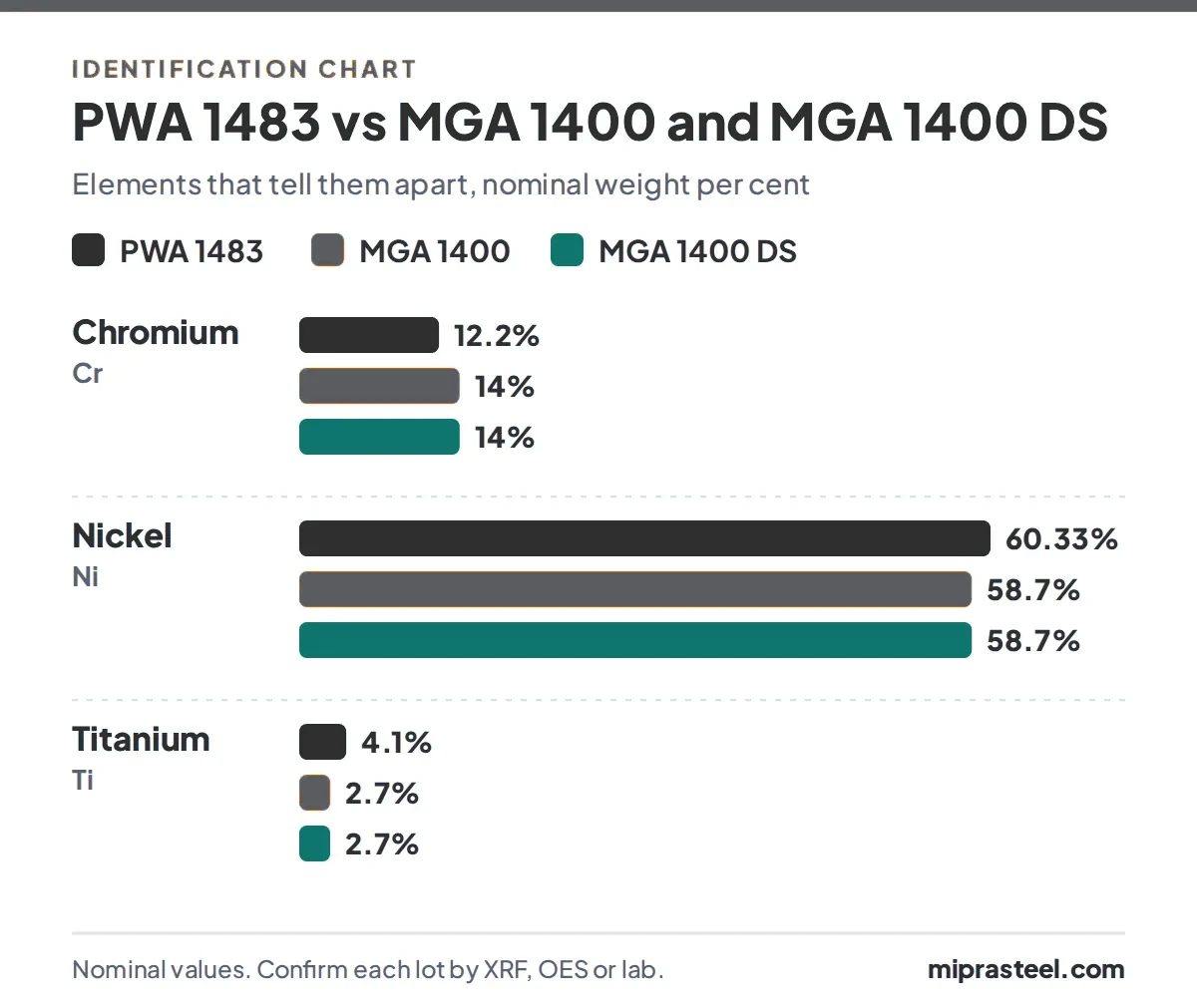
Nominal values for PWA 1483 against its closest grades on this site.
Preparing PWA 1483 Scrap for Sale
- Pack PWA 1483 blades in their own drums, never with GTD-111 or MGA 1400 buckets.
- Note the turbine type and stage on the drum label where known.
- Keep revert apart from ex-service blades.
- Remove fixings, locking plates and dissimilar seal pieces from blade roots.
- Weigh each drum and record the piece count.
PWA 1483 Scrap Price per Kg: What Decides It
Without rhenium, PWA 1483 is priced like a high-quality nickel-cobalt-tantalum melt stock, and the discount or premium comes from how certain and how clean the lot is.
- Contained nickel and cobalt (about 9%), which make up most of the metal value.
- Tantalum at about 5% and tungsten at about 3.8%, both costly as virgin additions.
- Single-grade certainty: no equiaxed industrial blades, no rhenium alloys and no vane alloys mixed in.
- Coating condition, since stripped blades and revert need less allowance than coated, oxidised ex-service blades.
- Piece size and form: large blades and revert handle easily; broken fragments and grindings need more checking.
The day's nickel and cobalt markets set the base. For the wider method, see what decides nickel alloy scrap value and the contained metal calculator.
PWA 1483 Scrap Import and Export
Importing PWA 1483 Scrap into India
Imports of PWA 1483 into India come from operators and overhaul shops for industrial and marine turbines in the Gulf, Europe and East Asia, either directly or through traders who collect blades from several sites. Consignments are inspected before shipment and travel with the pre-shipment inspection certificate, commercial invoice, packing list and bill of lading, usually into Nhava Sheva or Mundra. Ask the shipper to keep PWA 1483 in drums of its own, because blades of similar shape from different turbines are easy to mix in transit. More at import of nickel alloy scrap into India. We buy as a nickel alloy scrap importer and buyer in India.
Exporting PWA 1483 Scrap from India
Export lots of PWA 1483 are packed by grade in steel drums or strong bags and weighed before loading into containers at Nhava Sheva or Mundra. The invoice and packing list name the alloy and state that it carries no rhenium, which prevents confusion with aero single-crystal scrap at the receiving end. Our office in the UAE and our work in Saudi Arabia keep us close to turbine operators and traders across the Gulf. See alloy scrap export documents. Lots leaving India go through our nickel alloy scrap exporter desk.
Customs heading: 7503.00 (nickel waste and scrap). Confirm the full national tariff line with your customs broker.
Other PWA Scrap Grades
Related Reading
PWA 1483 Scrap FAQ
Does PWA 1483 contain rhenium?
No. PWA 1483 is a rhenium-free single-crystal alloy. Its value comes from nickel, about 9% cobalt, 5% tantalum and 3.8% tungsten. If a lot labelled PWA 1483 shows rhenium on a reading, it contains another alloy, most likely an aero single-crystal grade such as PWA 1484.
Why does PWA 1483 have so much more chromium than PWA 1484?
Because it was developed for industrial and marine gas turbines, where hot corrosion from sulfur and salts is a bigger threat than in aero engines. About 12.2% chromium gives that resistance. PWA 1484 uses about 5% chromium and adds rhenium for creep strength instead.
Is PWA 1483 scrap worth less than PWA 1484 scrap?
Usually, yes, because PWA 1484 carries about 3% rhenium and more tantalum. PWA 1483 is still a valuable nickel-cobalt-tantalum alloy, and a clean, single-grade lot is priced well above mixed blade scrap. The gap on any day depends on rhenium and tantalum markets.
How can I tell a single-crystal PWA 1483 blade from an equiaxed industrial blade?
A light macro-etch shows it. Equiaxed blades show many small grains and directionally solidified blades show long grains running along the airfoil, while a single-crystal blade shows none. The chemistry also differs: PWA 1483 reads about 12.2% chromium and 5% tantalum.
What tariff heading applies when shipping PWA 1483 scrap?
PWA 1483 is a nickel-base alloy, so its scrap typically goes under HS 7503.00, nickel waste and scrap. The national line has further digits and can differ by country. Your customs broker should confirm it before shipment.
Who can I contact in India to sell PWA 1483 turbine blades?
Mipra Steel in Mumbai buys PWA 1483 blades and revert from operators, overhaul shops and traders. Send the piece count, weight, coating condition, photographs and turbine details through the enquiry form.
Can PWA 1483 be mixed with other rhenium-free single-crystal scrap?
It should not be. Rhenium-free single-crystal alloys differ in chromium, titanium and tantalum, and a melt shop needs to know which one it is charging. Mixed rhenium-free blades are sold as mixed superalloy, at a lower value than a named grade.
What is PWA 1483 made of?
Nominally 60.3% nickel, 12.2% chromium, 9% cobalt, 5% tantalum, 4.1% titanium, 3.8% tungsten, 3.6% aluminium, 1.9% molybdenum, 0.07% carbon. Specification ranges vary by product form and standard.
Sources and Review
Figures are quoted as published in these sources; any value we could not confirm has been left out.
- Ross & Catherall, Vacuum Melted Superalloys, typical chemical compositions: PWA 1483.
- Values for other grades named in comparisons and identification charts are taken from those grades' own pages on this site, where each source is listed.
Published by Mipra Steel, Khetwadi, Mumbai · Last updated