Why Do the Three Haynes Grades End Up in Three Different Lots?
The Haynes name groups alloys by maker, not by chemistry, and the three grades covered here answer three separate engineering problems. Haynes 214 fights oxidation: with about 16% chromium and 4.5% aluminium it grows a thin alumina skin that holds up in furnace atmospheres where chromia-forming alloys scale away. Haynes 230 is about strength and stability at heat: 22% chromium, 14% tungsten and 2% molybdenum in a solid-solution matrix, used for combustors, transition ducts and radiant tubes. Haynes 282 is a precipitation-hardened superalloy with 10% cobalt, 8.5% molybdenum and about 2% titanium, made to be welded and formed into fabricated hot-section parts.
For a melt shop those are three raw materials with almost no overlap. 214 is valued largely as nickel with chromium and must be recognised for its aluminium. 230 carries a heavy tungsten content that only pays when a buyer making a tungsten-bearing alloy can use it. 282 brings cobalt and molybdenum together, which is what a γ′ or cobalt-tolerant melt is looking for. A single 230 duct dropped into a bag of 214 belting adds tungsten that the 214 buyer never asked for, and 282 trim in a 230 lot brings titanium and cobalt into a heat that was planned without them.
The usual sorting faults are easy to predict. 214 gets lumped with general furnace scrap such as Inconel 601 because both come out of the same heat-treat shop. 230 sheet is confused with Hastelloy X because both are combustor alloys. 282 is taken for Nimonic C-263, its closest cousin. Each confusion is settled by one or two elements on a reading, set out below.
Haynes is a trademark of Haynes International. Here it describes scrap of these alloys whoever produced the original material.
Haynes Scrap Grades We Buy and Sell
Haynes Chemical Composition
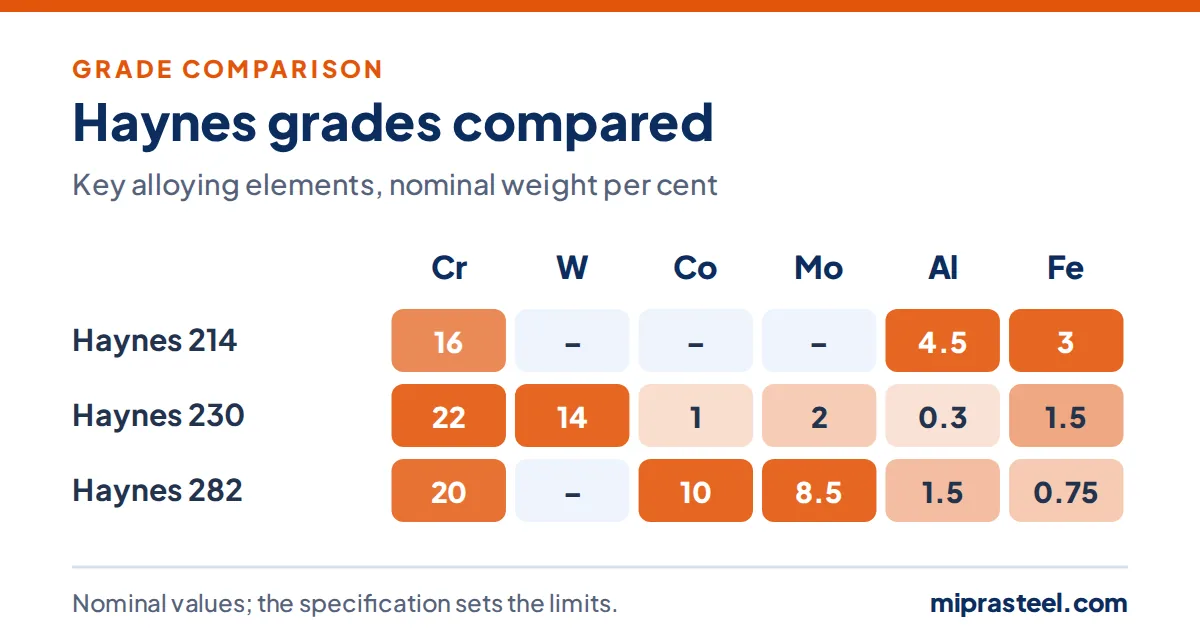
| Grade | Ni | Cr | W | Co | Mo | Al | Fe | Ti | Mn |
|---|---|---|---|---|---|---|---|---|---|
| Haynes 214 | 76.5 | 16 | – | – | – | 4.5 | 3 | – | – |
| Haynes 230 | 58.7 | 22 | 14 | 1 | 2 | 0.3 | 1.5 | – | 0.5 |
| Haynes 282 | 57.2 | 20 | – | 10 | 8.5 | 1.5 | 0.75 | 2.1 | – |
Nominal weight per cent. Specification ranges vary by product form and standard.
How to Tell Haynes Grades Apart
Two of the three Haynes grades announce themselves on a handheld XRF; the third depends on aluminium, which most handheld setups read poorly. The difference in method is covered in XRF vs OES vs lab analysis.
| Check | What it shows for Haynes |
|---|---|
| Tungsten | A reading near 14% tungsten with 22% chromium is 230. Neither 214 nor 282 carries tungsten in any quantity. |
| Cobalt and molybdenum together | About 10% cobalt alongside 8.5% molybdenum and 2% titanium marks 282. 230 shows only about 1% cobalt and 2% molybdenum. |
| A thin reading | A chromium-nickel spectrum with around 16% chromium, about 3% iron and nothing else of note points to 214. Confirm the 4.5% aluminium by OES or a light-element XRF method before calling it. |
| Product form | Wire mesh belts and thin foil are typical of 214; ducts and liners of 230; machined rings, casings and forged bar ends of 282. |
| Surface condition | Furnace parts in 214 and 230 carry oxide scale and sometimes refractory; grind a clean spot before reading so the scale does not distort chromium and aluminium. |
| Paperwork | Heat numbers, mill certificates and part drawings settle the grade quickly. See reading mill test certificates. |
Grades Most Often Confused with Haynes
- Hastelloy X: a combustor alloy like 230, but with about 9% molybdenum and 18.5% iron and well under 1% tungsten, against 14% tungsten and 1.5% iron in 230. Compare them on Hastelloy X vs Haynes 230.
- Nimonic C-263: the near twin of 282: similar chromium, titanium and molybdenum, but about 20% cobalt and 6% molybdenum against 10% and 8.5%.
- Inconel 601: shares furnace work with 214, yet reads about 23% chromium, 14% iron and only 1.4% aluminium.
Tungsten Identifies 230
14% tungsten is unusual in wrought alloys and reads clearly on XRF.
Aluminium Identifies 214
4.5% aluminium with little else. Confirm with a light-element XRF or OES.
282 Looks Like C-263
Both carry cobalt, molybdenum and titanium. 282 has about 10% cobalt; Nimonic C-263 has 20%.
Where Haynes Scrap Comes From
Each grade has its own home, so knowing where a lot was generated usually narrows the grade before anyone takes a reading.
Furnace and Heat-Treat Hardware
Mesh belts, baskets, trays and fixtures in 214 are retired when they sag or crack. Radiant tubes and muffles in 230 come out of furnace rebuilds. See heat treatment and furnace scrap.
Gas Turbine Combustion Sections
Combustor liners and transition ducts in 230, and 282 casings, rings and combustor parts on newer engines, are released at hot-section overhauls. See power generation scrap.
Turbine Seal Replacement
Honeycomb seals often use 214 foil brazed to a backing in another alloy; the backing and braze have to be accounted for when the lot is described.
Aerospace Component Manufacture
Machining and forming of 282 and 230 parts produces bar ends, plate offcuts, sheet skeletons and turnings with traceable heat numbers. See aerospace scrap.
Chemical and Process Plant
Nitric acid catalyst grids and thermocouple protection tubes in 230, and burner parts and flame hoods in 214, are changed out during shutdowns.
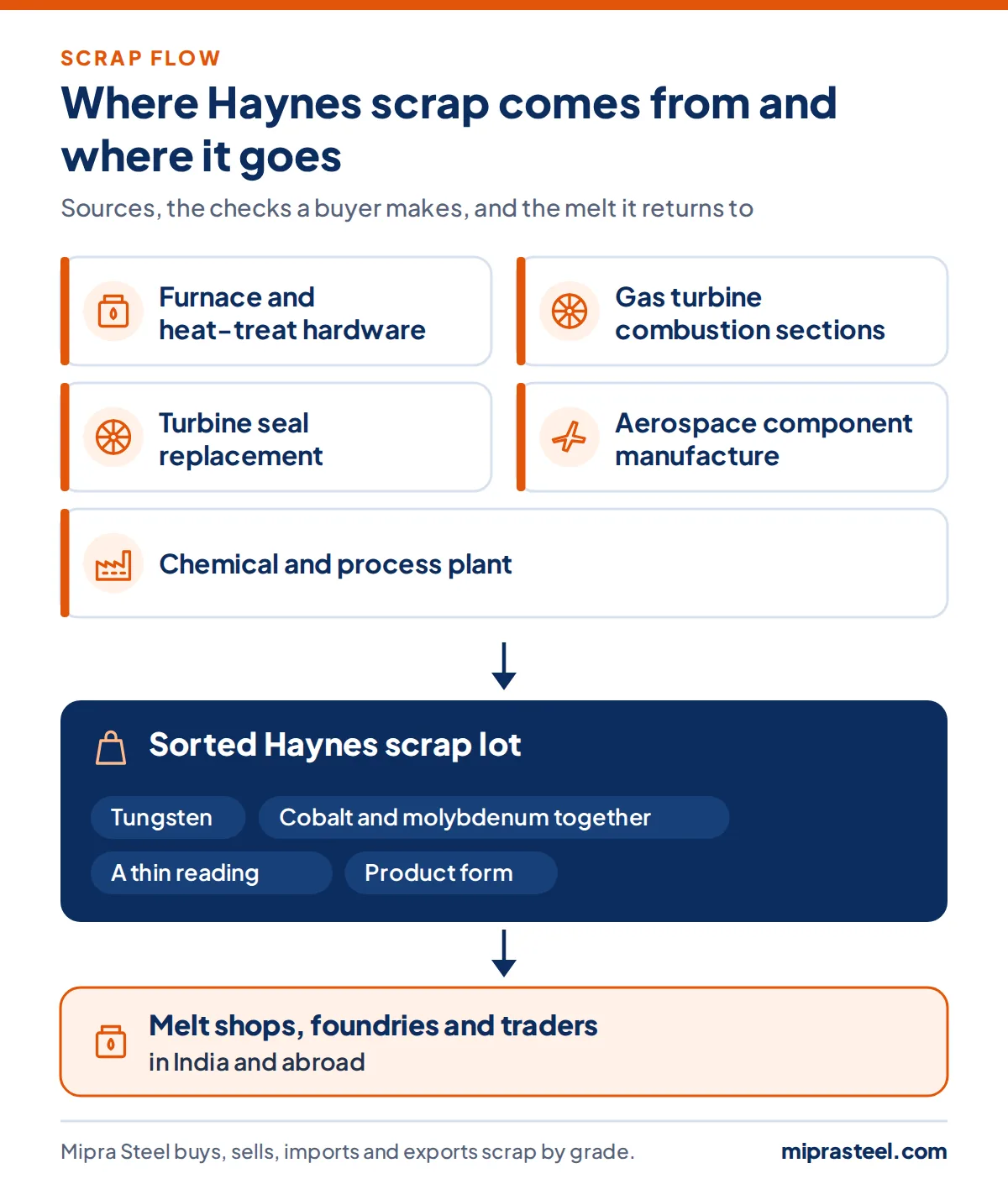
Source industries: heat treatment and furnaces, aerospace, power generation.
Haynes Alloy Scrap Buyer, Importer and Exporter in India
Mipra Steel trades Haynes 214, 230 and 282 scrap from Khetwadi, Mumbai, keeping each grade as its own lot whether it comes from an Indian furnace shop or an overseas turbine overhaul.
Sell Haynes Scrap
To sell Haynes scrap, tell us which of the three grades you have and roughly how much of each. Describe the form (belting, fixtures, ducts, liners, plate, bar ends, turnings), whether the pieces are scaled, coated or brazed, and where they are. Photos of markings and any XRF printout help, and for 214 an aluminium reading or certificate is especially useful. If the grades are mixed, tell us; a mixed lot can still be discussed. We review incoming enquiries and respond with relevant next steps.
Buy Haynes Scrap
Foundries, vacuum melters and traders looking for Haynes scrap should name the grade they can charge, the forms they accept, the tonnage, the port and the timing. Tungsten-bearing alloy makers usually ask for 230; γ′ alloy melters for 282; nickel-chromium melters can often take 214. Lots are described by grade and UNS number with whatever readings and certificates travel with them.
Preparing Haynes Scrap for Sale
- Put 214, 230 and 282 in separate, labelled containers from the start.
- Get an aluminium reading or certificate for any 214 before offering it.
- Grind a clean spot on scaled furnace parts so readings are not skewed.
- Cut off steel brackets and note any brazed backings on seal assemblies.
- Keep Hastelloy X combustor parts out of 230 lots and C-263 sheet out of 282.
- Bag 282 and 230 turnings by grade, dry and free of tool tips.
Haynes Scrap Price per Kg: What Decides It
Ask for a Haynes scrap price per kg and the first question back will be "which one?". The three grades are priced on different metals, so the family has no single number.
- Grade first: 214 is assessed mainly on nickel and chromium, 230 adds a large tungsten content, and 282 adds cobalt and molybdenum.
- Whether the buyer can use the alloying metal. Tungsten in 230 and cobalt in 282 earn credit only from melters whose own products need them.
- Proof of grade. 214 without an aluminium reading is often treated as generic nickel-chromium scrap, which hurts the offer.
- Form and cleanliness: plate, bar ends and clean sheet ahead of heavily scaled furnace parts, belts with refractory or brazed seal assemblies.
- Attachments and dissimilar metals: steel brackets, brazed backings, ceramic coatings on combustor parts.
- Nickel, tungsten, cobalt and molybdenum markets on the day, plus quantity and distance to port.
A worked explanation of how alloy content and lot condition feed into an offer is on how nickel alloy scrap is valued.
Haynes Scrap Import and Export
Importing Haynes Scrap into India
Haynes scrap reaches India mainly from places with large turbine fleets and aerospace supply chains: the Gulf, Europe, Japan, South Korea and Australia. Overhaul shops and fabricators abroad release 230 and 282, while furnace operators release 214 and 230. Imported consignments carry a pre-shipment inspection certificate, commercial invoice, packing list and bill of lading, and land at Nhava Sheva, Mundra or Chennai. A packing list that names each grade and UNS number, with readings for the 214, helps customs and the receiving melter. See importing nickel alloy scrap into India.
Exporting Haynes Scrap from India
Indian heat-treat shops, furnace builders and component makers generate Haynes scrap that often has more value to specialist melters overseas than to local buyers. Export lots are listed grade by grade on the invoice and packing list, weighed and shipped bagged, in drums or loose in containers. Buyers in Japan, South Korea, Italy and the Netherlands tend to want readings with the paperwork. Our Dubai and South Korea offices help match lots with buyers in the Gulf and East Asia.
Customs heading: 7503.00 (nickel waste and scrap). The HS code is the international tariff heading the scrap is declared under; national tariff lines add further digits, so confirm the full line with your customs broker.
Related Reading
Haynes Alloy Scrap FAQ
Which Haynes grade is worth the most as scrap?
There is no fixed order because each grade is priced on different metals. 230 carries 14% tungsten and 282 carries 10% cobalt with 8.5% molybdenum, so both usually draw more interest than 214, which is valued mostly for nickel and chromium. Which of 230 and 282 comes out ahead depends on tungsten and cobalt markets and on which buyer is in the market.
Are Haynes alloys the same as Hastelloy?
No. Both names come from the same producer, but Hastelloy grades are mostly corrosion alloys built on molybdenum, while the Haynes grades here are high-temperature alloys. The one that gets confused is 230 with Hastelloy X, and tungsten separates them. See the Hastelloy scrap family page.
Can a handheld analyser identify every Haynes grade?
It identifies 230 and 282 easily from tungsten, cobalt and molybdenum. Haynes 214 is harder because its defining 4.5% aluminium is a light element that many handheld units read weakly or not at all, so 214 is normally confirmed by OES, a light-element XRF setup or a certificate.
Is Haynes 282 classed as a superalloy?
Yes. It is strengthened by γ′ precipitates of titanium and aluminium, like cast turbine alloys, but is sold as sheet, plate and bar for welded parts. Its scrap goes to the same specialist melters as other wrought superalloy scrap. Background on γ′ is in γ′ superalloys.
Do old furnace belts and fixtures have resale value?
Yes, provided the alloy is known. 214 belting and 230 radiant tubes are recovered for their nickel and alloy content, but heavy scale, refractory and steel attachments reduce what a melter pays. Knock off loose scale, keep belts separate from fixtures, and say how long the parts were in service.
What tariff heading is normally used for Haynes scrap?
All three grades are nickel-predominant, so their scrap is typically declared under HS 7503.00, nickel waste and scrap. Countries add their own digits to the line, so confirm the full code with your customs broker before shipping.
How do I offer Haynes scrap to Mipra Steel from abroad?
Send the grade or grades, weights, forms, photos, readings and the port the material would ship from. We work with sellers in the Gulf, East Asia, Europe and Australia, and lots can ship to India or to a third country, so name the destination you have in mind.
Should Haynes turnings be kept separate from solids?
Yes. Turnings are assessed differently from solids because of oil, oxidation and the risk of tool tips, and a melter often prices them on their own. Keep each grade's turnings dry and in their own drums. See solids vs turnings.
Published by Mipra Steel, Khetwadi, Mumbai · Updated