René 80 Scrap Buyer, Importer and Exporter in India
Mipra Steel trades René 80 blades and revert, including lots offered as René 80 low Zr, from Mumbai, alongside its Dubai and South Korea offices.
Sell René 80 Scrap
Selling René 80? Tell us the weight, whether it is foundry revert or ex-service blades and vanes, whether the parts are coated, and where they are. Where the lot is offered as low Zr or 80 LZR, include the zirconium analysis, the method used and any heat certificates. Photos of part numbers help separate it from GTD-111. We review incoming enquiries and respond with relevant next steps.
Buy René 80 Scrap
Melters buying René 80 revert should tell us whether they need standard material or documented low zirconium, the paperwork required with each lot, whether coated blades are acceptable, the quantity and the delivery port. Lots are described as René 80, and as low Zr only where the analysis supports it.
What Is René 80, and What Does "René 80 Low Zr" Mean?
René 80 was already GE's production turbine blade alloy by the mid-1970s, and parts cast from it are still being retired today. It is a conventionally cast alloy with an unusually high titanium content, about 5%, sitting alongside 3% aluminium. Titanium-rich gamma prime gives strength, while 14% chromium keeps hot corrosion in check, a sensible balance for blades and vanes that see dirty combustion gas as well as high temperature. Later blade alloys such as René 125 were developed to run hotter than it.
The scrap trader's problem with René 80 is GTD-111. The two read almost the same for chromium, cobalt, titanium and aluminium. What separates them is tantalum: GTD-111 carries about 2.8%, René 80 essentially none, and René 80 has more molybdenum (4% against about 1.5%). A handheld XRF that is ground to clean metal and allowed enough time will see the tantalum. A quick shot through coating may not.
Then there are lots offered as "René 80 low Zr" or "80 LZR". No published specification defines that name. It is a trade description for René 80 revert set aside because its zirconium is low, for foundries whose melt specification caps that element, and it means something only when an analysis comes with it. Standard René 80 carries only a few hundredths of a percent zirconium nominally, about 0.03%, which is below what a quick handheld reading resolves well, so the evidence is normally an OES or laboratory result or the foundry heat certificate.
Why would anyone keep such lots apart? Zirconium and boron help grain boundaries in small amounts, but a melter producing an alloy with a tight zirconium limit cannot easily remove extra zirconium once it is in the charge. Revert with documented low zirconium gives that melter room to work, which is why such revert changes hands as a separate line.
René 80 belongs to the René family, part of superalloy scrap.
Where René 80 Scrap Comes From
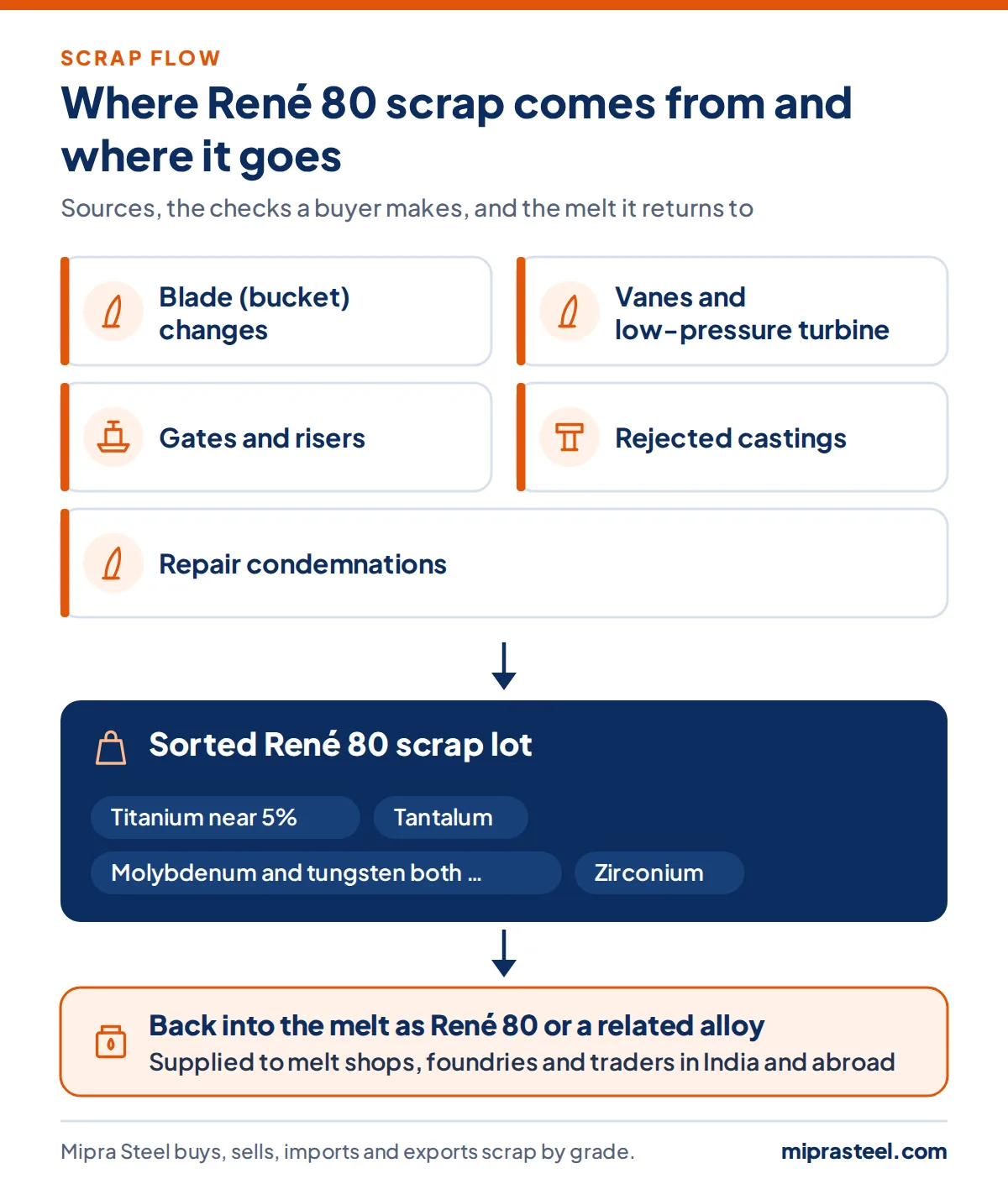
René 80 has a long service history, so its scrap reaches the market from both old fleets and active foundries.
Blade (Bucket) Changes
Rotating blades replaced at hot-gas-path work on industrial gas turbines and at aero engine overhaul, usually coated and sometimes cracked or eroded at the tip.
Vanes and Low-Pressure Turbine Parts
Stationary vanes and LPT components removed at overhaul, often in segments with platforms attached.
Gates and Risers
Foundry returns from René 80 pours, with heat numbers. This is where documented low Zr lots usually originate.
Rejected Castings
Blades scrapped for porosity, inclusions or dimensional faults before they ever ran, clean and uncoated.
Repair Condemnations
Stripped blades judged beyond repair, which arrive bare and easy to read.
René 80 Scrap Specification Chart
| Grade | René 80 |
|---|---|
| UNS | Not assigned (proprietary GE alloy) |
| W.Nr. / EN | Not assigned |
| Identified by | GE material specification, casting records and analysis |
| Also known as | Rene 80, René 80 low Zr |
| Alloy type | Cast γ′ superalloy |
| Density | 8.16 g/cm³ (0.295 lb/in³) |
| Magnetic | Non-magnetic. |
| HS code (customs heading) | 7503.00 (nickel waste and scrap) |
René 80 Chemical Composition
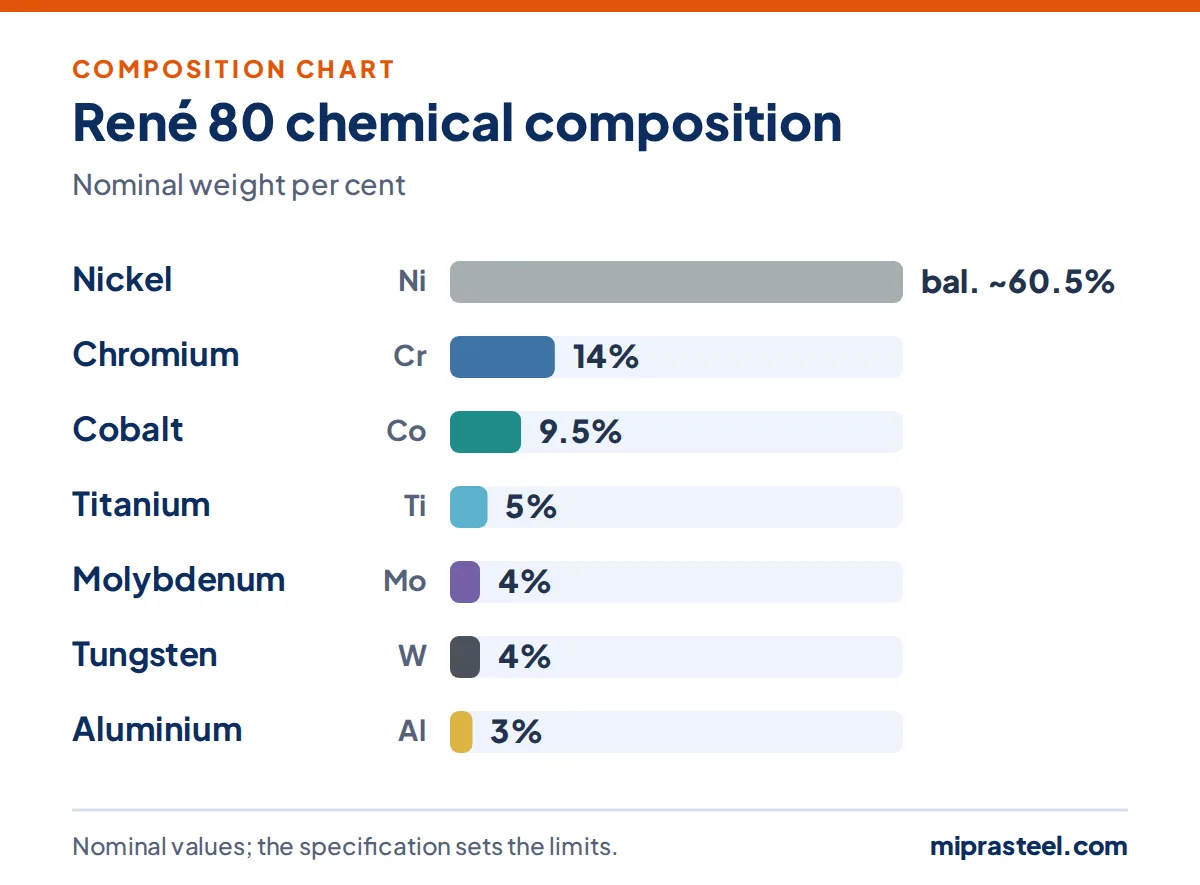
Nominal composition in weight per cent, used to describe and identify the grade. The governing specification sets the limits for each product.
| Element | Symbol | Nominal wt% | |
|---|---|---|---|
| Nickel | Ni | Balance (about 60.5) | |
| Chromium | Cr | 14 | |
| Cobalt | Co | 9.5 | |
| Titanium | Ti | 5 | |
| Molybdenum | Mo | 4 | |
| Tungsten | W | 4 | |
| Aluminium (aluminum) | Al | 3 |
René 80 Equivalent Grades and Other Names
| Designation | Value |
|---|---|
| Trade name | René 80 |
| UNS | Not assigned (proprietary GE alloy) |
| W.Nr. / EN | Not assigned |
| Other names in the trade | Rene 80, René 80 low Zr |
Look up any designation in the grade name converter or the equivalent grade chart.
René 80 Standards and Specifications
Supplied to turbine OEM specifications.
René 80 Applications
- Turbine blades (buckets) and vanes
- Low-pressure turbine components
Source industries: aerospace, power generation.
How René 80 Scrap Is Identified
Most René 80 questions come down to three: is it René 80 or GTD-111, is it single-grade, and can a low Zr description be supported?
| Check | What it shows for René 80 |
|---|---|
| Titanium near 5% | Few cast blade alloys run this high. MGA 1400 reads about 2.7% and René 125 about 2.5%. |
| Tantalum | Should be essentially absent. About 2.8% tantalum with otherwise similar figures means GTD-111. |
| Molybdenum and tungsten both near 4% | The matched pair is typical of René 80. GTD-111 has less molybdenum (about 1.5%). |
| Zirconium | Only matters for a low Zr description. Handheld readings at this level are uncertain, so ask for OES or laboratory analysis, or the heat certificate. |
| Coating | Aluminide or MCrAlY coatings raise aluminium, chromium and cobalt readings. Grind to bare metal first. |
| Records | Turbine model and stage, part numbers or foundry heat records turn a reading into a description. See choosing XRF, OES or a lab. |
Grades Most Often Confused with René 80
- GTD-111: 14% chromium and 9.5% cobalt as well, but about 2.8% tantalum, 4.9% titanium and only 1.5% molybdenum.
- MGA 1400: same 14% chromium, but 2.7% titanium, 4.7% tantalum and 4% aluminium.
- René 77: 15% cobalt and about 4.2% molybdenum, with no tungsten at all.
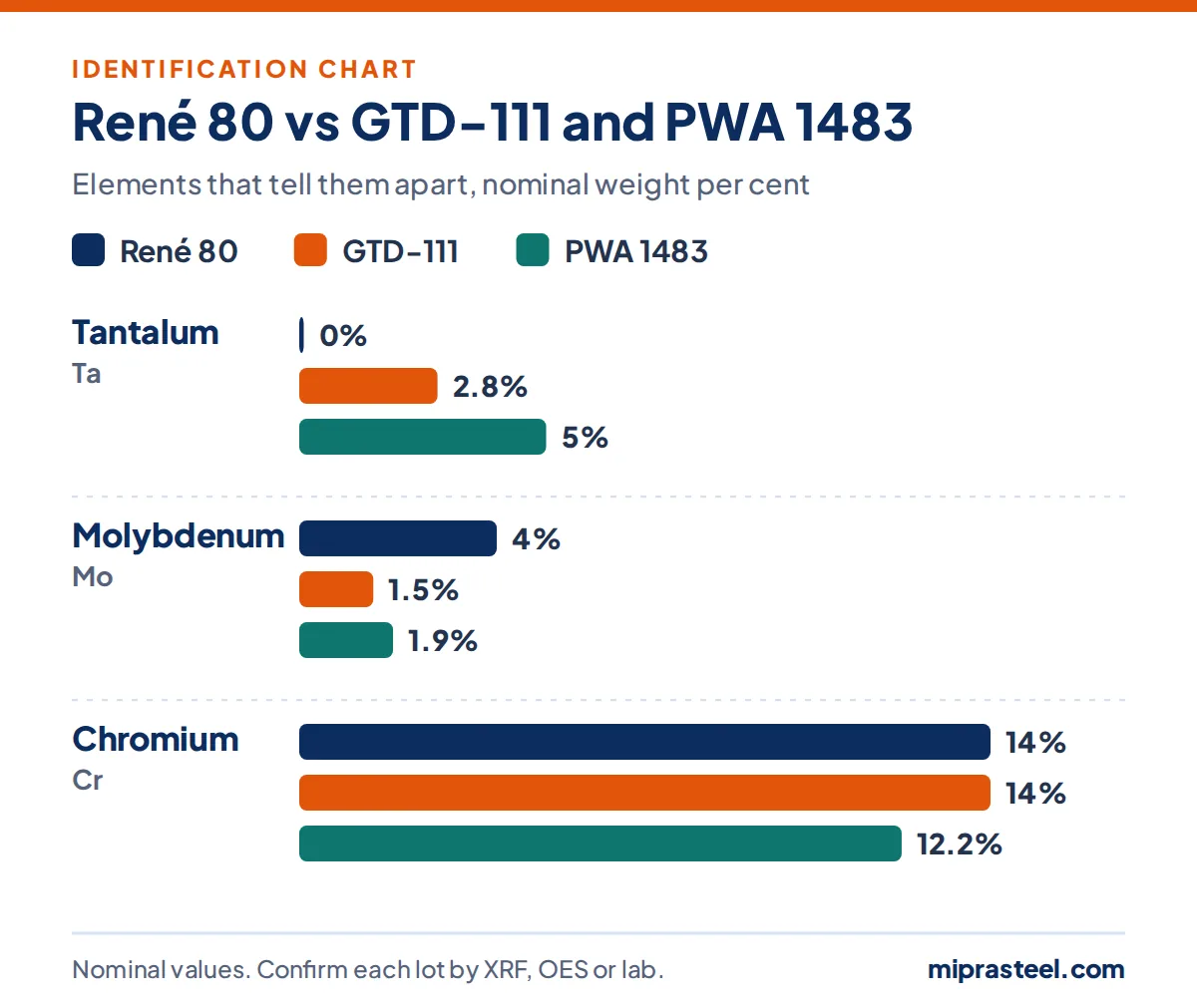
Nominal values for René 80 against its closest grades on this site.
Preparing René 80 Scrap for Sale
- Check tantalum on every blade type and move any GTD-111 into its own package.
- Pack low Zr pieces apart from standard René 80, with the analysis attached to each package.
- Separate foundry revert, stripped blades and coated blades.
- Remove seals, pins and shims from blade roots.
- Write turbine model, stage and heat numbers on a packing sheet.
René 80 Scrap Price per Kg: What Decides It
Several things decide a René 80 scrap price per kg, and the low Zr question is only one of them.
- Nickel near 60% and cobalt near 9.5%, which form the base of any offer.
- Tungsten and molybdenum at about 4% each, which add to the contained value.
- Clean separation from GTD-111 and MGA 1400, since all three can come out of power-station turbines.
- For low Zr lots: analysis showing zirconium for the lot, ideally from heat certificates, and evidence that low Zr pieces were never mixed with standard material.
- Foundry returns over coated service blades, which carry coating, oxide and sometimes braze.
- Piece size and packing: gates and whole blades handle better than broken fragments and grinding dust.
Metal prices move every day, so each offer is dated. More on the reasoning in how superalloy revert is recycled and why trace elements matter in remelting.
René 80 Scrap Import and Export
Importing René 80 Scrap into India
India imports René 80 from overhaul and foundry sources in Europe, North America, the Gulf and East Asia, often alongside GTD-111 from the same power-station outages. Ask the shipper to confirm tantalum on every package, and to keep low Zr lots physically separate with their analyses. Pre-shipment inspection happens at origin, and the inspection certificate accompanies the bill of lading, commercial invoice and packing list. Arrival is usually at Nhava Sheva, Mundra or Chennai. See importing nickel alloy scrap into India.
Exporting René 80 Scrap from India
René 80 lots exported from India are named on the invoice and packing list, with "low Zr" added only when analysis accompanies the lot. They are weighed and shipped in drums or crates inside containers from Nhava Sheva or Mundra. Buyers include revert melters in Europe and East Asia, and our Dubai and South Korea offices sit close to power-generation scrap flows in Saudi Arabia, the UAE and Korea. See export documents for alloy scrap.
Customs heading: 7503.00 (nickel waste and scrap). The HS code is the international tariff heading the scrap is declared under; national tariff lines add further digits, so confirm the full line with your customs broker.
Other René Scrap Grades
Related Reading
René 80 Scrap FAQ
Is GTD-111 just another name for René 80?
No. They are close, but GTD-111 contains about 2.8% tantalum and only around 1.5% molybdenum, while René 80 has essentially no tantalum and about 4% molybdenum. Lots of each should be kept and described separately.
Why is low-zirconium René 80 kept separate?
Because a melter who has to meet a tight zirconium limit cannot easily take zirconium back out of a charge. René 80 revert documented as low in zirconium lets that melter use it safely, so it is stored and sold apart from standard material.
What zirconium level counts as René 80 low Zr?
There is no published definition. "Low Zr" and "LZR" are trade descriptions, and the buyer's own limit decides whether a lot qualifies. What matters is an analysis of the lot, ideally an OES or laboratory result or the foundry heat certificate, not the label.
How is René 80 different from IN-738?
IN-738 runs higher in chromium, about 16%, with lower titanium (around 3.4%) and additions of tantalum and niobium. René 80 has 14% chromium, 5% titanium and no tantalum or niobium. Both are equiaxed blade alloys, but they should not share a lot.
Where does René 80 scrap come from in the Gulf and India?
Mainly from gas turbine blade and vane replacements at power stations and from aero engine overhaul, plus imports of foundry revert. Power-station outages often release René 80 alongside GTD-111, so separation by tantalum reading is the first job.
Which HS code covers René 80 scrap?
Typically HS 7503.00, the nickel waste and scrap heading, because nickel is the main element in René 80. Each customs tariff then adds its own subheading digits, so ask your broker for the exact line on every shipment.
Can Mipra Steel take mixed René 80 and GTD-111 blades?
We can discuss them, but separated lots get a clearer description. If the blades are already mixed, send photographs, part numbers and readings showing tantalum, and we can talk through how the lot should be described.
What is the density of René 80?
About 8.16 g/cm³. This is useful for estimating weight from blade dimensions or drum volume, but trading is always settled on the weighed figure at loading or delivery.
What is René 80 made of?
Nominally 60.5% nickel, 14% chromium, 9.5% cobalt, 5% titanium, 4% molybdenum, 4% tungsten, 3% aluminium. Specification ranges vary by product form and standard.
Published by Mipra Steel, Khetwadi, Mumbai · Updated