Key takeaways
- Turnings are valued below solids of the same grade because oil, moisture, oxide, mixed chips and handling reduce the share of clean, provable metal.
- Segregation at the machine decides most of the value; no later step can fix a drum of mixed 625 and 718 chips.
- Crushing, drying, sealed packing and a composite analysis close much of the gap to solids.
- Keep grinding swarf, carbide inserts, titanium chips and stainless chips out of nickel alloy turnings.
Nickel alloy turnings are often the largest single scrap stream a machine shop produces. Machining a forged ring or a thick-walled flange from a hard nickel alloy can turn a large share of the starting weight into chips, so a shop cutting Inconel 718 or Inconel 625 every day fills drums faster than it fills skips of offcuts.
Those drums contain the same alloy as the bar ends beside them, yet they rarely earn the same offer. This article explains the gap between solids and turnings in scrap value: where it comes from, which part of it a seller controls, and how to prepare turnings so the offer reflects the alloy rather than the mess around it.
What Are Nickel Alloy Turnings?
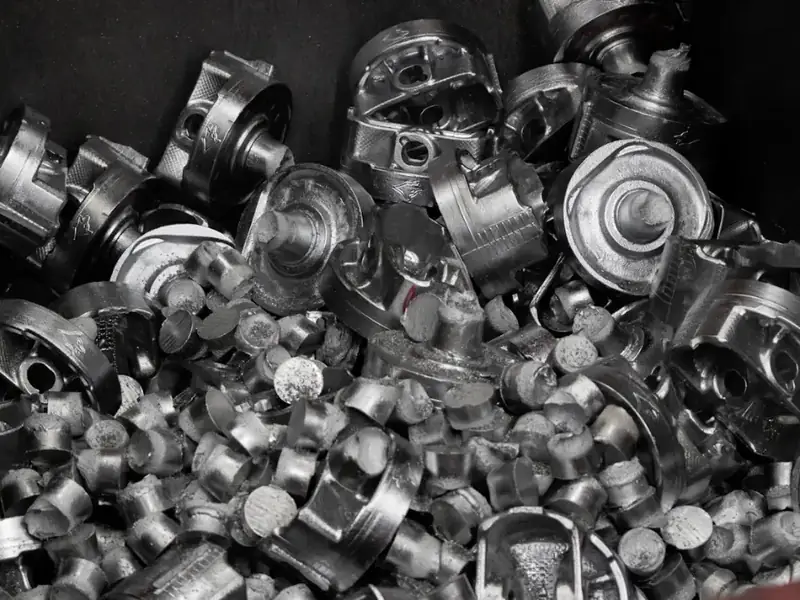
Nickel alloy turnings are the chips, curls and swarf produced when a nickel alloy is turned, milled, drilled or bored. The trade uses "turnings" for all machining chips, whatever the operation. They range from long, stringy curls off a lathe to short, broken chips from a milling cell, and they leave the machine coated in whatever coolant or cutting oil the shop uses.
The grades follow the work. Aerospace machining produces large volumes of 718 turnings from discs, shafts and casings. Oil and gas component shops produce 625, 718, 825 and Monel chips from flanges, valve bodies and tool parts. Chemical equipment makers produce Hastelloy C-276 and C-22 chips. See turnings as a scrap form for the full range.
Why Are Turnings Valued Below Solids of the Same Grade?
Turnings are valued below solids because a smaller and less certain share of what is weighed is clean metal of the declared grade. A melter buying solids can read each piece, weigh it and charge it. A melter buying turnings has to allow for what is on and among the chips, and for the work of getting them furnace-ready.
Solids
- Each piece can be read and its grade confirmed
- Little surface area, so little oxide
- No oil or water in the paid weight
- Dense, easy to charge
Turnings
- Grade proved only by sampling a composite
- Large surface area that oxidises and loses metal to slag
- Oil and coolant in the paid weight
- Bulky until crushed, harder to charge
The discount is not one number. It is the sum of several deductions, and each has a cause you can address.
| Issue | Why it matters to the melter | What reduces it |
|---|---|---|
| Oil and coolant | Weight that is not metal; smoke, carbon and hydrogen pickup, and a safety risk in the furnace | Centrifuging or drying |
| Moisture | Paid weight lost on arrival; steam hazard in a hot charge | Covered storage, sealed packing |
| Oxidation | Oxide is lost as slag, so less metal is recovered | Dry storage, prompt sale |
| Mixed grades | One wrong grade can put a heat off chemistry | One bin per grade at each machine |
| Foreign bodies | Broken carbide inserts, steel chips, rags and gloves | Separate bins, picking before packing |
| Bulk density | Long curls are hard to handle and charge | Crushing to short chips |
| Sampling cost and risk | Chemistry must be proved by sample and analysis | A composite analysis supplied with the lot |
Some of these costs exist even for perfect turnings: they still need sampling and still oxidise faster than solids. Most of the rest are preparation choices. That is why two drums of the same alloy from two shops can attract very different offers. For how form fits alongside grade, contamination and documents in the overall valuation, see what decides the value of a nickel alloy lot.
Why Must 625 and 718 Turnings Never Share a Bin?
Because their chemistry differs in ways a melter cannot correct, and once the chips are mixed nobody can separate them again. The two alloys look identical as chips and are often cut on the same machines, which is exactly why they get mixed.
Inconel 625 carries about 9% molybdenum and iron below 5%. Inconel 718 carries about 18.5% iron, about 5% niobium and about 3% molybdenum. A melter making 625 cannot take iron back out of the bath, and a melter making 718 cannot use 625's extra molybdenum. A drum of mixed chips is therefore neither grade, and is valued as mixed nickel alloy turnings. The Inconel 625 vs 718 comparison explains how the two are told apart in solid form.
The same applies to every pair of grades on the shop floor. Hastelloy C-276 chips in a 625 drum bring tungsten and extra molybdenum; Monel 400 chips anywhere in a nickel-chromium lot bring copper; stainless chips dilute nickel and add iron. With solids, a buyer can read and pull out the odd piece. With turnings, one shovel of the wrong chips changes the whole drum.
How Are Nickel Alloy Turnings Sampled and Analysed?
Turnings are proved by a representative composite sample, not by reading individual chips. A handheld XRF reading on a single chip tells you about that chip, and a pile can hide pockets of a different grade. The usual approach is to take increments from many points in each bag or drum, or from the stream at the crusher, combine them, and analyse the composite.
Laboratories often melt the composite into a small button or ingot first, which gives a solid, homogeneous piece for spectrometric analysis and shows how much oxide and dirt the chips carried. Where light elements, carbon or trace elements matter, analysis goes beyond handheld XRF; see choosing between XRF, OES and lab analysis. For superalloy turnings, the buyer may also test for tramp elements such as lead and bismuth, which are limited to very low levels.
Supplying a composite analysis with an offer does not replace the buyer's own check, but it changes the starting point. A buyer who sees a credible analysis of dry, single-grade chips can price on the grade rather than on the worst case.
How Do You Prepare Nickel Alloy Turnings for a Better Offer?
Prepare turnings in the order the problems arise: keep them pure at the machine, then make them dense, dry and provable. Every step after segregation improves material that is already one grade; no step can rescue a mixed drum.
- 1Bin at the machineone labelled bin per grade, emptied when the job changes
- 2Pick out foreign bodiesinserts, steel chips, rags, gloves and solid offcuts
- 3Crushlong curls to short, uniform chips
- 4Remove oilcentrifuge or dry to bring oil and water down
- 5Pack sealedlined bulk bags or closed drums, one grade each
- 6Sample and recordcomposite analysis, weights and photographs
A few practical notes make each step work. Change the bin label when the machine changes job, not at the end of the shift. Pull solid offcuts and bar ends out before crushing; they damage crushers and are worth more sold as bar ends anyway. Keep broken carbide inserts out of the chips, because they bring tungsten, cobalt and carbon the melter did not ask for; carbide is itself a separate scrap, covered under tungsten carbide scrap. Store packed turnings under cover, because a bag that sits in monsoon rain is paid on its weight at the buyer's scale, after the water has drained.
The scrap preparation guide sets out packing for each form, and the Inconel 718 turnings page covers the grade that most often comes in large volumes.
Send the grade, form, approximate quantity and location.
Should Nickel Alloy Turnings Be Briquetted?
Briquetting helps when the turnings are already dry and single-grade and the buyer wants briquettes; otherwise it locks problems in. Pressing chips into dense briquettes cuts storage and freight volume, reduces the surface exposed to air, and makes charging and sampling more consistent.
The limits are just as real. A briquette made from wet or oily chips traps the liquid inside, and one made from mixed chips is a mixed briquette that can no longer be picked. Some melters prefer loose crushed chips for their own charging systems. Ask the buyer before investing in a press.
Is This Drum of Turnings Ready to Offer?
A drum is ready when its grade, cleanliness and weight are all known; each unanswered question costs value. Run through the gates below before you ask for a price.
- Does it hold chips from more than one grade?YesOffer it honestly as mixed turnings, and bin by grade from now on
- Are there inserts, steel chips or rags in it?YesPick them out before anything else
- Are the chips long and stringy?YesCrush them, or expect a handling deduction
- Is the oil or water visible or dripping?YesDry or centrifuge before packing
- Is there no composite analysis?YesSample and analyse, or expect a cautious offer
- Ready: offer it as single-grade, dry turnings with its analysis and weights
Grinding Swarf and Fines Are a Different Product
Grinding swarf, polishing dust and fine sludge are not turnings, and they are valued far lower. They are extremely fine, heavily oxidised and usually mixed with abrasive grit and coolant, so they cannot simply be charged to a furnace. They are processed by other recovery routes, as described in how superalloy revert returns to the melt. Keep them out of turnings drums, where they add weight that a buyer will deduct.
Selling Turnings on a Regular Schedule
A shop that produces turnings every week gets more from a standing arrangement than from selling drum by drum. When the same buyer takes the same grade in the same packing at regular intervals, both sides can agree the details once and stop renegotiating them each time.
The points worth fixing in writing are few but specific:
- Grades and bins. Which grades are collected separately, and how each bin or bag is labelled.
- Preparation standard. Crushed or loose, the drying expected, and what counts as a foreign body.
- Sampling method. Who takes the composite, from how many points, and which analysis is used if the two sides disagree.
- Weight basis. Whose weighbridge counts, and how oil and moisture are deducted.
- Pricing reference. How the offer is tied to the metal market, and how often it is re-set.
With those agreed, each collection becomes a matter of weights and an analysis rather than a fresh argument about condition. It also gives the shop floor a clear standard to work to, which is usually what keeps the bins pure. For the documents that move with each lot when the buyer is overseas, see documents for exporting alloy scrap.
What About Titanium and Stainless Turnings?
Titanium turnings follow stricter rules and must never meet nickel alloy chips. Dry titanium fines can ignite, and aerospace remelting demands chips free of carbide fragments, which form high-density inclusions. See selling titanium scrap for handling. Stainless turnings, such as 304 turnings, follow the same logic as nickel alloy chips at a lower value, and should be kept apart from nickel alloy bins for the same reasons that grades are kept apart.
If you machine several alloys, the cheapest improvement is often a second or third labelled bin per machine. The contained metal calculator shows how much nickel, molybdenum or niobium a drum holds, which helps make the case for keeping it pure. When you have turnings to sell, send the grade, quantity, packing, location, photographs and any analysis, and we'll review your enquiry. Mipra Steel buys and supplies nickel alloy scrap described by grade, in solid and turnings form.
Submit a requirement with the grade, form, quantity and delivery location.
Source a GradeFAQ
Are nickel alloy turnings worth selling separately from solids?
Yes. Turnings and solids are valued differently, so mixing them helps neither. Solids can be read piece by piece and sold as their grade, while turnings are proved by sampling. Kept apart, each is priced on its own merits; mixed together, the solids are often valued at the turnings basis, and loose solids in a turnings lot can damage crushing equipment.
How much oil is acceptable in nickel alloy turnings?
There is no single figure. Each buyer sets its own limit and deducts for oil and moisture above it, often after drying or weighing a sample. The practical aim is turnings that do not drip or leave a film when squeezed, which usually means centrifuging or drying. Ask the buyer for their limit and how they measure it before you ship.
Can mixed nickel alloy turnings still be sold?
Yes, but as mixed turnings, and usually valued well below single-grade material, because the buyer has to price for unknown chemistry and blend carefully. Some mixtures are easier to use than others; mixed chips of very different alloys, or chips containing copper-bearing Monel or stainless, are the hardest to place. Declare the mixture honestly rather than risk a claim.
Why do buyers ask for a composite sample of turnings?
Because a single chip, or a reading on the surface of a pile, says little about the whole lot. A composite built from many increments across every bag or drum represents the average chemistry. Analysed after melting into a small button, it gives the buyer a reliable grade basis and shows how much oxide and dirt the chips carry.
Do Inconel 718 turnings need to be crushed before sale?
Many buyers prefer or require crushed chips, because long, stringy curls are bulky, tangle in handling equipment and are hard to charge to a furnace. Crushing also makes drying and sampling more effective. If you cannot crush, ask the buyer first; some accept uncrushed turnings with a handling deduction, while others decline them. See Inconel 718 solids for the solid form.
How should nickel alloy turnings be stored before sale?
Under cover, off the ground and in closed drums or lined bags, one grade per container, each labelled with grade and weight. Keep them away from carbon-steel chips, grinding swarf and general waste. Dry storage limits oxidation and stops rainwater adding weight that will be deducted, and prompt sale means less oxide by the time the chips reach a furnace.