Hastelloy B-3 Scrap Buyer, Importer and Exporter in India
B-3 is among the richest molybdenum scrap streams in the nickel alloy trade, at about 28.5%. Mipra Steel buys and sells it as its own grade and keeps it away from chromium-bearing C-type alloys that would dilute it.
Sell Hastelloy B-3 Scrap
Tell us the form (plate trim, pipe, fittings, reactor parts, turnings), weight and location, and send photographs. Mill certificates naming N10675 or 2.4600, or an XRF reading, help most. Mention any linings, gaskets or other alloys attached. We review incoming enquiries and respond with relevant next steps.
Buy Hastelloy B-3 Scrap
Melters and alloy producers can tell us the quantity, accepted forms, chromium and iron limits and receiving port. Lots are described as Hastelloy B-3, UNS N10675.
What Is Hastelloy B-3 Scrap?
Hastelloy B-3 is a nickel-molybdenum alloy made for strongly reducing acids: hydrochloric acid, sulphuric acid and similar media. Haynes International lists exceptional resistance to hydrochloric and sulphuric acid and resistance to chloride stress corrosion cracking among its main features. It is used across the chemical process industry, especially for reaction vessels handling pure reducing acids.
B-3 was developed to fix the main weakness of Hastelloy B-2. B-2 forms the brittle Ni4Mo phase rapidly at around 750°C, which can crack equipment during welding, heat treatment or fabrication. According to Haynes, B-3 takes several hours at about 650°C to form harmful second phases, so it is much more forgiving to fabricate.
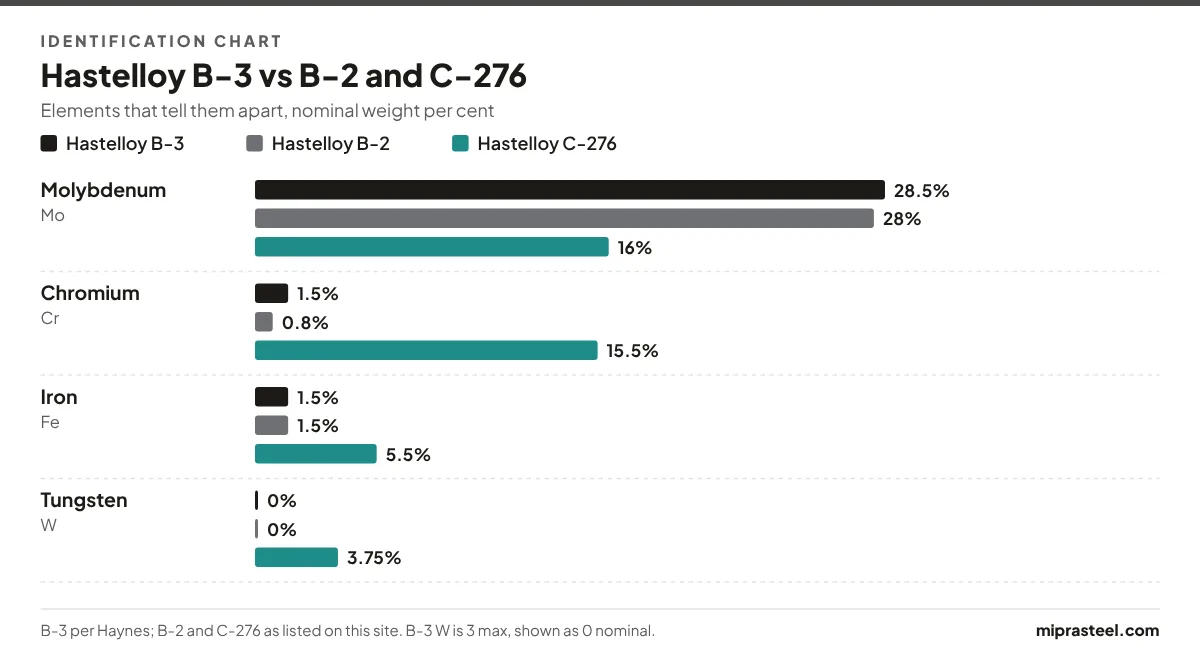
For scrap, B-2 and B-3 are worth almost the same on contained metal: both are about two-thirds nickel and over a quarter molybdenum. The difference matters to a melter making one grade to specification, and a handheld XRF struggles to separate them because the distinguishing elements sit at 1 to 3%. Certificates and markings are therefore the best evidence.
HASTELLOY is a trademark of Haynes International, used here only to identify the alloy.
B-3 belongs to the Hastelloy family.
Where Hastelloy B-3 Scrap Comes From
Almost all B-3 scrap comes from acid-handling chemical plant.
Fabrication Shops
Plate and sheet trim, pipe offcuts and turnings from building reactors, columns and piping.
Plant Turnarounds
Replaced reactor internals, piping, valves and pump parts.
Stockists
Surplus plate, bar and pipe ends, usually certified.
Hastelloy B-3 Scrap Specification Chart
| Grade | Hastelloy B-3 |
|---|---|
| UNS | N10675 |
| W.Nr. / DIN | 2.4600 (DIN 17744, NiMo29Cr) |
| Alloy type | Nickel-molybdenum, solid solution |
| Density | 9.22 g/cm³ (0.333 lb/in³) |
| Melting range | 1370 to 1418°C (2500 to 2585°F) |
| HS code (customs heading) | 7503.00 (nickel waste and scrap) |
Hastelloy B-3 Chemical Composition
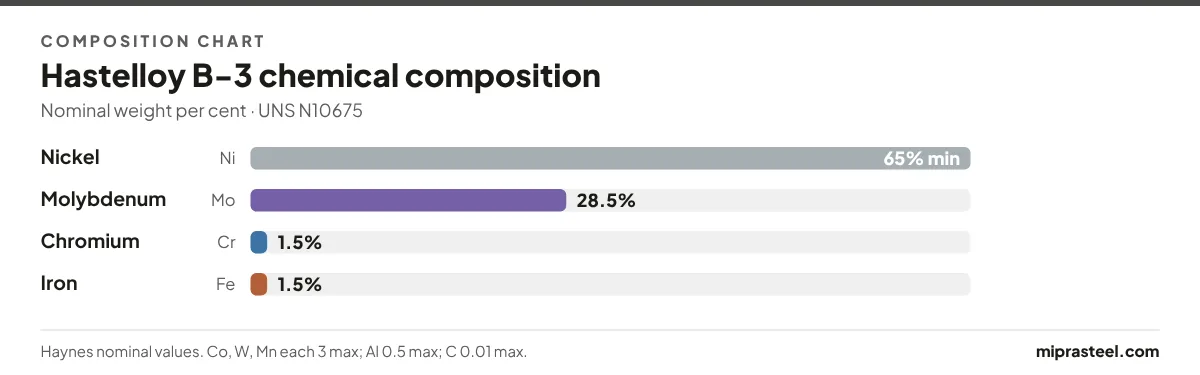
Nominal composition in weight per cent as published by Haynes International. Values marked max are maximums; nickel is a minimum.
| Element | Symbol | Nominal wt% |
|---|---|---|
| Nickel | Ni | 65 min |
| Molybdenum | Mo | 28.5 |
| Chromium | Cr | 1.5 |
| Iron | Fe | 1.5 |
| Cobalt | Co | 3 max |
| Tungsten | W | 3 max |
| Manganese | Mn | 3 max |
| Aluminium | Al | 0.5 max |
| Silicon | Si | 0.1 max |
| Carbon | C | 0.01 max |
| Niobium, vanadium, titanium, copper, tantalum | Nb, V, Ti, Cu, Ta | 0.2 max each |
Hastelloy B-3 Standards and Specifications
| Product form | ASTM / ASME |
|---|---|
| Sheet, plate and strip | B 333 / SB 333 |
| Rod and bar | B 335 / SB 335, B 472 |
| Seamless pipe and tube | B 622 / SB 622 |
| Welded pipe and tube | B 619 / SB 619, B 626 / SB 626 |
| Fittings | B 366 / SB 366, B 462 / SB 462 |
| Forgings | B 564 / SB 564, B 462 / SB 462 |
| Welding consumables | SFA 5.11 ENiMo-10, SFA 5.14 ERNiMo-10 |
More: ASTM B specifications and ASME SB specifications.
Hastelloy B-3 Applications
- Reaction vessels for pure reducing acids
- Hydrochloric acid handling equipment
- Sulphuric acid service
- Piping, valves and pumps in reducing-acid plants
Source industry: chemical processing.
How Hastelloy B-3 Scrap Is Identified
| Check | What it shows |
|---|---|
| Molybdenum about 28% | Marks a B-type alloy. C-type alloys carry 13 to 16%. |
| Chromium about 1.5% | B-2 is 1% max; a reading above 1% leans to B-3 but is not proof on its own. |
| Iron about 1.5% | Similar to B-2 (2% max); not decisive. |
| Certificates and markings | The most reliable way to separate B-3 from B-2. |
Grades Most Often Confused with Hastelloy B-3
- Hastelloy B-2: same molybdenum; lower chromium. Records decide.
- Hastelloy C-276: 16% chromium and 16% molybdenum; easy to separate by XRF.
Preparing Hastelloy B-3 Scrap for Sale
- Keep B-3 apart from B-2 unless the buyer accepts them together.
- Keep B-types well away from C-type alloys.
- Remove gaskets, linings and carbon steel attachments.
- Keep certificates and heat numbers with each lot.
Hastelloy B-3 Scrap Price per Kg: What Decides It
- Molybdenum at about 28.5%, the largest value driver after nickel.
- Nickel at 65% minimum.
- Grade evidence, especially B-3 against B-2.
- Form, cleanliness and contamination.
- Lot size.
Hastelloy B-3 Scrap Import and Export
B-3 lots are imported into India and exported under heading 7503.00, named as Hastelloy B-3, N10675, with certificates or readings. See importing and export documents. Lots leaving India go through our nickel alloy scrap exporter desk.
Related Reading
Hastelloy B-3 FAQ
What is the difference between Hastelloy B-2 and B-3?
B-3 has much better thermal stability: B-2 forms the brittle Ni4Mo phase quickly at around 750°C, while B-3 takes several hours at about 650°C to form harmful phases. Its published nominal chromium is also slightly higher.
What is the UNS number of Hastelloy B-3?
UNS N10675. Its DIN number is 2.4600 (NiMo29Cr).
Can B-3 and B-2 scrap be sold together?
Some buyers accept them together on contained metal because their nickel and molybdenum are almost the same. Melters producing one grade to specification usually want them apart, so lots should be described by grade.
Which HS code applies to Hastelloy B-3 scrap?
Heading 7503.00, nickel waste and scrap.
Sources and Review
Figures are quoted as published in these sources; any value we could not confirm has been left out.
- Haynes International, alloy nominal compositions table: HASTELLOY B-3 alloy.
- Haynes International, HASTELLOY B-3 alloy data sheet: principal features, Ni4Mo comparison with B-2, applications, ASTM/ASME specifications, DIN 2.4600, density and melting range.
- Hastelloy B-2 and C-276 values as listed on this site.
Reviewed by Mitesh Shah, Proprietor, Mipra Steel · Published by Mipra Steel, Khetwadi, Mumbai · Last updated