What Are René Alloys?
René is not one alloy but a set of designations for nickel-base superalloys. Most of the grades seen in the trade are General Electric alloys for aircraft engines and industrial gas turbines: a 2008 TMS paper by Bouse, Schaeffer and Henry lists René 108, 125, 142, N4, N5 and N6 among GE's equiaxed, directionally solidified and single-crystal turbine alloys. René 41 is the wrought exception, produced today by Haynes International as HAYNES R-41.
The grades share a nickel base, chromium and cobalt, and strengthening by gamma prime (see gamma prime superalloys explained). What separates them is how the part is made and which heavy elements are added for strength at temperature. That is also what decides how their scrap is sorted.
Wrought, Equiaxed, Directionally Solidified or Single Crystal: What Is the Difference?
Wrought alloys are melted, then rolled or forged into sheet, bar and rings. René 41 is in this group.
Equiaxed castings are poured into a mould and freeze with many grains of random orientation. René 77, René 80 and René 125 are cast this way.
Directionally solidified (DS) castings are withdrawn slowly from the furnace so the grains grow as long columns along the part. René 108 and René 142 are DS alloys.
Single-crystal (SC) castings grow as one grain, with no grain boundaries at all. René N4, N5, N500 and N6 are single-crystal alloys.
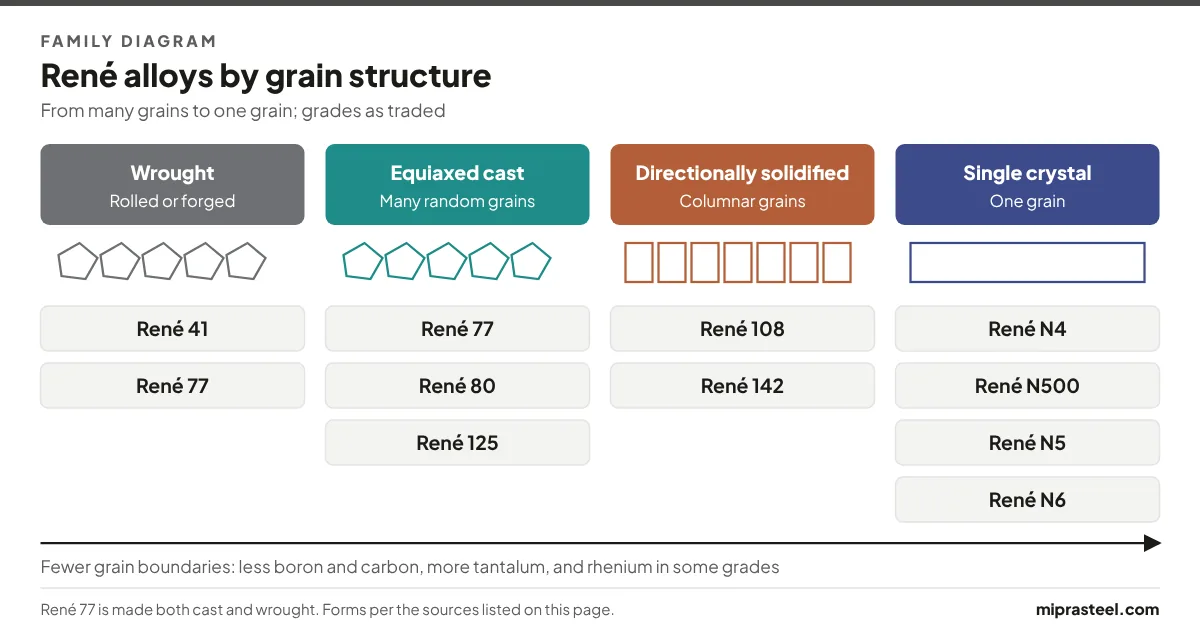
The composition follows the structure. Grain boundaries need strengthening elements, so the polycrystalline grades carry more boron, zirconium and carbon: Ross & Catherall list René 108 at 0.08% carbon and 0.015% boron against 0.05% carbon and 0.004% boron for René N5. The DS grades René 108 and 142 also carry about 1.5% hafnium, while the single crystals carry about 0.15%. The single-crystal grades carry more tantalum, and some of them carry rhenium.
How Do the René Grades Compare?
Nominal weight per cent, nickel balance. Each row names its source; small differences between published sources are normal for these alloys, and the governing specification sets the limits for any product.
| Grade | Form | Cr | Co | Mo | W | Ta | Al | Ti | Hf | Re | Source |
|---|---|---|---|---|---|---|---|---|---|---|---|
| René 41 | Wrought | 19 | 11 | 10 | – | – | 1.5 | 3.1 | – | – | Haynes |
| René 77 | Cast and wrought | 14.7 | 15 | 4.2 | – | – | 4.3 | 3.4 | – | – | Ross & Catherall |
| René 80 | Cast | 14 | 9.5 | 4 | 4 | – | 3 | 5 | – | – | TMS cast table |
| René 125 | Cast, equiaxed | 8.9 | 10 | 2 | 7 | 3.8 | 4.8 | 2.5 | 1.5 | – | Bouse et al. 2008 |
| René 108 | Directionally solidified | 8.4 | 9.5 | 0.5 | 9.5 | 3 | 5.5 | 0.7 | 1.5 | – | Bouse et al. 2008 |
| René 142 | Directionally solidified | 6.8 | 12 | 1.5 | 4.9 | 6.4 | 6.1 | – | 1.5 | 2.8 | Bouse et al. 2008 |
| René N4 | Single crystal | 9.8 | 7.5 | 1.5 | 6 | 4.8 | 4.2 | 3.5 | 0.15 | – | Bouse et al. 2008 |
| René N500 | Single crystal | 6 | 7.5 | 1.5 | 6.3 | 6.6 | 6.6 | – | 0.15 | – | Ross & Catherall |
| René N5 | Single crystal | 7 | 7.5 | 1.5 | 5 | 6.5 | 6.2 | – | 0.15 | 3 | Bouse et al. 2008 |
| René N6 | Single crystal | 4.2 | 12.5 | 1.4 | 6 | 7.2 | 5.8 | – | 0.15 | 5.4 | Bouse et al. 2008 |
Sources by row: Haynes R-41 data sheet (René 41); Ross & Catherall typical compositions (René 77 and N500); TMS table of typical cast superalloys (René 80); Bouse, Schaeffer and Henry, Superalloys 2008, Table 1 (René 108, 125, 142, N4, N5 and N6). René N4 also carries 0.5% niobium. Full analyses, including carbon, boron and zirconium, are on each grade page.
Which René Alloys Contain Rhenium, Tantalum and Hafnium?

- Rhenium appears only in René 142 (2.8%), René N5 (3%) and René N6 (5.4%). The 2008 TMS paper calls René N4 a "low-cost 1st generation single crystal" alloy; it has no rhenium.
- René N500 is a single crystal without rhenium, with about 6.6% tantalum (Ross & Catherall).
- Tantalum rises from none in René 77 and 80 to 6.4 to 7.2% in René 142, N5 and N6.
- Hafnium at about 1.5% marks René 108, 125 and 142; the single crystals carry about 0.15%.
How Are René Grades Told Apart on an Analyser?
Handheld XRF reads the heavy elements (rhenium, tantalum, tungsten, hafnium, molybdenum) well, which is why they make the best markers. Aluminium, carbon and boron need spark OES or a laboratory.
| Reading | Points to |
|---|---|
| Rhenium about 5.4%, cobalt about 12.5% | René N6 |
| Rhenium about 3%, hafnium about 0.15% | René N5 |
| Rhenium about 2.8%, hafnium about 1.5% | René 142 |
| No rhenium, tantalum about 6.6%, no titanium | René N500 |
| No rhenium, titanium about 3.5%, niobium about 0.5% | René N4 |
| Hafnium about 1.5%, tungsten about 9.5% | René 108 |
| Hafnium about 1.5%, tungsten about 7%, titanium about 2.5% | René 125 |
| No tantalum, titanium about 5%, tungsten about 4% | René 80 |
| No tungsten or tantalum, cobalt about 15% | René 77 |
| Molybdenum about 10%, aluminium about 1.5% | René 41 |
Readings are a starting point. Similar alloys from other makers can fall close to these values; for example GTD-111 and René 80 are both near 14% chromium. Heat records and part paperwork settle what a reading cannot. See XRF, OES or a lab?
Why René Scrap Is Sold Grade by Grade
Revert melters charge returns into a specific alloy. A drum that mixes René N5 with N500 dilutes rhenium that only the N5 melt pays for, and René 108 or 125 tipped into a René 80 lot brings hafnium and tantalum that René 80 does not carry. The same logic applies to every pair in the table above, so René scrap is lotted by grade, with coatings and attachments noted. How cast revert returns to the melt is covered in superalloy revert recycling.
Mipra Steel buys and sells René scrap by grade: see the René alloy scrap page for the grades we handle, or offer a lot with the grade, form, weight, location and any readings or records. We review incoming enquiries and respond with relevant next steps.
René alloys FAQ
What are René alloys?
A family of nickel-base superalloys, most of them General Electric turbine alloys. They range from wrought René 41 to cast René 77, 80 and 125, directionally solidified René 108 and 142, and single-crystal René N4, N5, N500 and N6.
Which René alloys contain rhenium?
René 142 (about 2.8%), René N5 (about 3%) and René N6 (about 5.4%). René N4 and N500 are single crystals without rhenium.
What is the difference between René N5 and René N500?
Both are single-crystal alloys with similar tantalum, tungsten and aluminium. René N5 carries about 3% rhenium; René N500 has none.
Is René 108 directionally solidified?
Yes. The 2008 TMS paper by Bouse, Schaeffer and Henry lists René 108 as a DS alloy, with about 1.5% hafnium, 9.5% tungsten and 3% tantalum.
Is René 41 a cast alloy?
No. René 41 is wrought, supplied as sheet, plate, bar and forgings, and produced today as Haynes R-41.
Can a handheld XRF identify René grades?
It reads the heavy markers well (rhenium, tantalum, tungsten, hafnium, molybdenum), which separates most grades. Light elements and close look-alikes need OES, a laboratory and the part records.
Sources and Review
Figures are quoted as published in these sources; any value we could not confirm has been left out.
- Bouse, G. K., Schaeffer, J. C. and Henry, M. F., "Optimizing SC René N4 alloy for DS aft-stage bucket applications in industrial gas turbines", Superalloys 2008 (TMS), Table 1: compositions and casting forms of René 108, 125, 142, N4, N5 and N6.
- Ross & Catherall, Vacuum Melted Superalloys, typical chemical compositions: René 77 and N500, and carbon and boron levels of René 108 and N5.
- TMS, Compositions of Typical Cast Superalloys table: René 80.
- Haynes International, HAYNES R-41 alloy data sheet (H-3056C): René 41.
- Kawagishi et al., "Development of low or zero-rhenium high-performance Ni-base single crystal superalloys", Superalloys 2016 (TMS): René N500 listed among single-crystal alloys.
- MetalTek, MTEK René 77 page: René 77 composition ranges and cast and wrought supply.
Published by Mipra Steel, Khetwadi, Mumbai · Last updated