Waspaloy Scrap Buyer, Importer and Exporter in India
Forging flash from a ring mill, a bin of chips from a disc lathe, a crate of retired engine discs: Mipra Steel processes and trades Waspaloy lots like these, matching sellers with superalloy melt shops that can use cobalt-bearing gamma-prime scrap.
Sell Waspaloy Scrap
Selling Waspaloy? Tell us the form (forging flash, ring crops, turnings, bar ends or whole parts), the approximate weight and where the material is. Photos, the forging or part numbers, and any readings for cobalt, molybdenum, titanium, aluminium, iron and niobium help us respond faster. We review incoming enquiries and respond with relevant next steps.
Buy Waspaloy Scrap
Melt shops and superalloy remelters who can take N07001 chemistry can source Waspaloy from us. Say which forms you accept (solids only, or clean briquetted turnings), the tonnage per shipment, your limits on iron and niobium, and your receiving port. We describe every lot as Waspaloy, UNS N07001, with the evidence behind the grade.
What Is Waspaloy Scrap?
Waspaloy is a wrought nickel superalloy hardened by gamma prime, the same Ni₃(Al,Ti) phase that strengthens turbine blade alloys. Its 19.5% chromium gives oxidation resistance, 13.5% cobalt and 4.3% molybdenum strengthen the matrix, and about 3% titanium with 1.4% aluminium form the gamma prime. The result keeps useful strength up to about 870°C (1600°F), which is why it is chosen for parts that spin or carry load in the hot end of a gas turbine: compressor and turbine discs, shafts, spacers, seals, rings and casings, plus engine bolts.
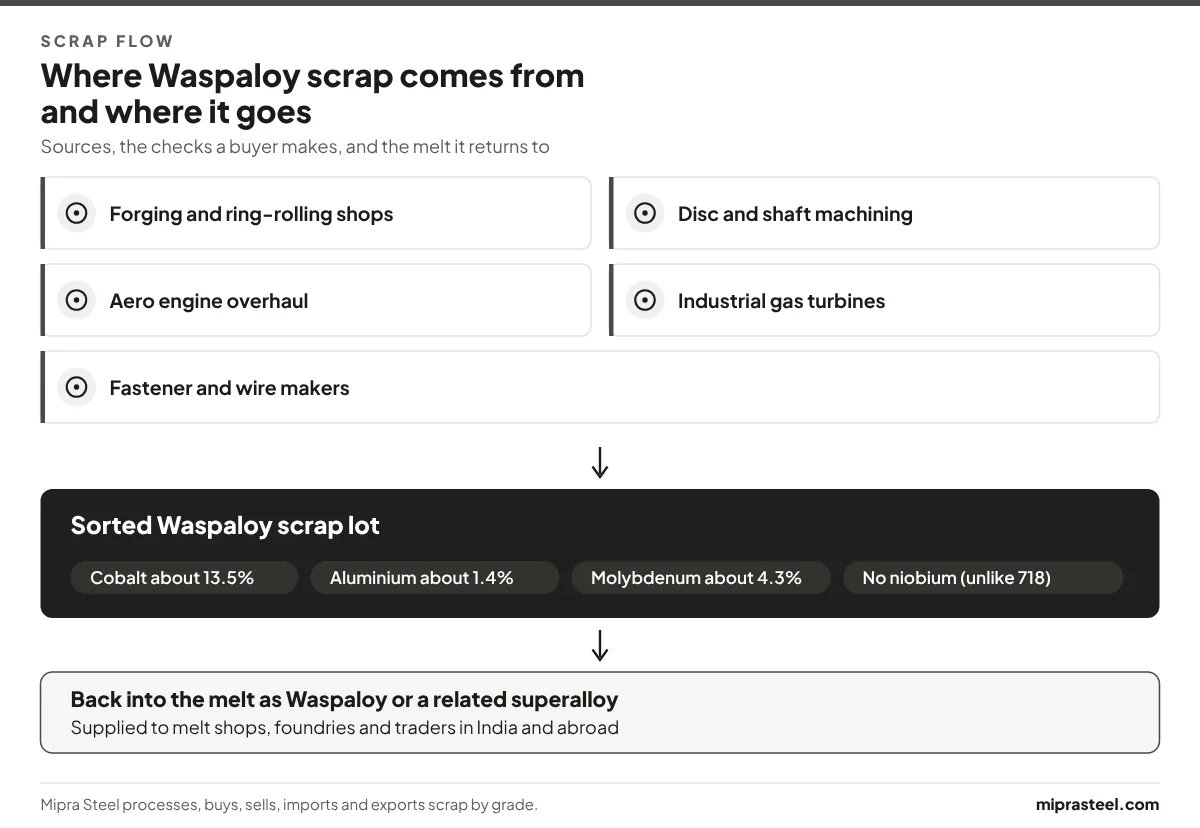
Most Waspaloy scrap is made in the factory rather than in service. A disc or ring starts as a forging that is much heavier than the finished part, and machining it to shape turns a large share of the forging into chips and offcuts. Forging flash, ring-rolling crops, test rings and rejected forgings add solid scrap. The second source is engine overhaul: discs and shafts are life-limited parts, retired once they reach their certified number of cycles, so whole Waspaloy parts reach the market even when they look perfectly sound.
The main risk in a Waspaloy lot is the alloy machined on the next lathe. Disc and ring shops often cut Inconel 718 as well, and 718 turnings look the same. Iron and niobium give it away: 718 carries about 18% iron and 5% niobium, Waspaloy almost none of either. Closer cousins, such as Udimet 500 and Nimonic C-263, need cobalt and aluminium readings to separate.
Waspaloy is a trade name; this page uses it only to say which alloy a scrap lot contains.
Waspaloy belongs to the superalloy family, part of high nickel alloys.
Where Waspaloy Scrap Comes From
Waspaloy scrap follows the supply chain for rotating engine parts, from the forge to the overhaul shop.
Forging and Ring-Rolling Shops
Flash, ring crops, test rings and discarded forgings. Usually clean, solid and traceable to a heat, which makes them the most valued Waspaloy solids.
Disc and Shaft Machining
Turnings, chips and solid offcuts from turning forgings to final shape. Kept single-grade and dry, they are a large, regular stream. See solids vs turnings.
Aero Engine Overhaul
Discs, shafts, spacers and seals retired at their life limit, plus rejected parts. See aerospace scrap.
Industrial Gas Turbines
Rings, casings and rotating parts replaced during major overhauls of power and mechanical-drive turbines. See power generation scrap.
Fastener and Wire Makers
Bar ends, rejected bolts and welding wire ends made to AMS 5828.
Waspaloy Scrap Specification Chart
| Grade | Waspaloy |
|---|---|
| UNS | N07001 |
| W.Nr. / EN | 2.4654 |
| Also known as | Alloy N07001 |
| Alloy type | Precipitation-hardened (γ′) nickel superalloy |
| Density | 8.19 g/cm³ (0.296 lb/in³) |
| Melting range | 1330 to 1360°C (2425 to 2475°F) |
| Magnetic | Non-magnetic. |
| HS code (customs heading) | 7503.00 (nickel waste and scrap) |
Waspaloy Chemical Composition
Nominal composition in weight per cent, taken as the middle of the usual specification ranges. The governing specification sets the limits for each product.
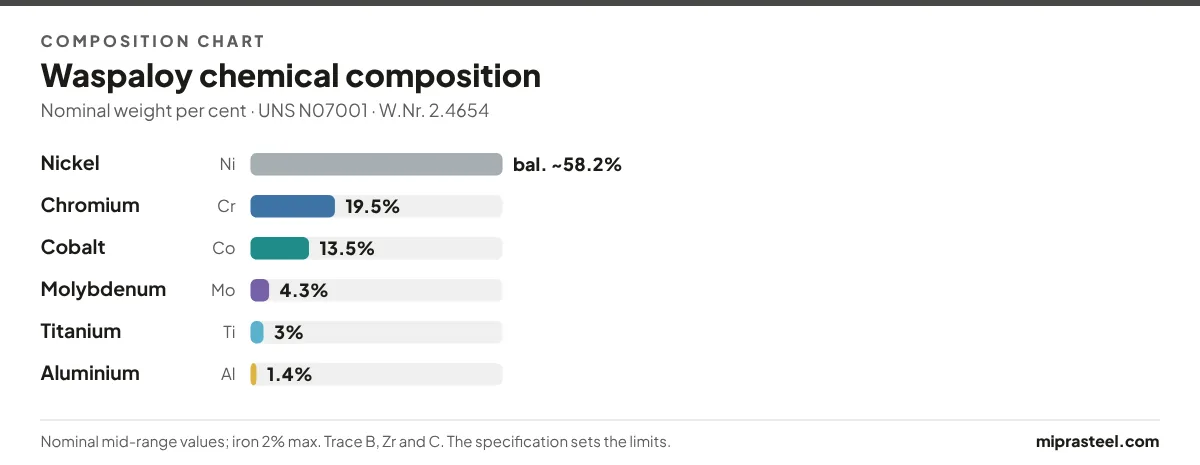
| Element | Symbol | Nominal wt% | Typical limits wt% |
|---|---|---|---|
| Nickel | Ni | Balance (about 58) | Balance |
| Chromium | Cr | 19.5 | 18.00 to 21.00 |
| Cobalt | Co | 13.5 | 12.00 to 15.00 |
| Molybdenum | Mo | 4.3 | 3.50 to 5.00 |
| Titanium | Ti | 3.0 | 2.75 to 3.25 |
| Aluminium (aluminum) | Al | 1.4 | 1.20 to 1.60 |
| Iron | Fe | – | 2.00 max |
| Carbon | C | – | 0.02 to 0.10 |
| Zirconium | Zr | – | 0.02 to 0.12 |
| Boron | B | – | 0.003 to 0.01 |
Limits differ slightly between specifications and producers; the purchase specification on the certificate governs.
Waspaloy Equivalent Grades and Other Names
| Designation | Value |
|---|---|
| Trade name | Waspaloy |
| UNS | N07001 |
| W.Nr. / EN | 2.4654 |
| Key specification | AMS 5706 / AMS 5708 (bar and forgings), AMS 5544 (sheet, strip, plate) |
| Other names in the trade | Alloy N07001 |
Look up any designation in the grade name converter or the equivalent grade chart.
Waspaloy Standards and Specifications
| Product form | Standard | ASME equivalent |
|---|---|---|
| Bar and forging stock | ASTM B637 | No ASME edition |
| Forgings | AMS 5704 | No ASME edition |
| Bar, rod, rings and forgings | AMS 5706, 5707, 5708, 5709 | No ASME edition |
| Sheet, strip and plate | AMS 5544 | No ASME edition |
| Welding wire | AMS 5828 | No ASME edition |
Waspaloy Applications
- Compressor and turbine discs, shafts and spacers
- Seals, rings and casings in the hot end of gas turbines
- Engine bolts, fasteners and other hardware
- Airframe and missile parts that see high temperature
Source industries: aerospace, power generation, oil and gas.
How Waspaloy Scrap Is Identified
Waspaloy has no single unusual element, so it is confirmed by the balance of cobalt, molybdenum, titanium and aluminium, and by the absence of niobium and iron. A buyer works through these checks.
| Check | What it shows for Waspaloy |
|---|---|
| Cobalt about 13.5% | The core of the fingerprint. Near 18 to 20% cobalt points to Udimet 500 or Nimonic C-263; near 10% with high molybdenum points to Haynes 282. |
| Molybdenum about 4.3% | Haynes 282 reads about 8.5% and C-263 about 6%. Nimonic 80A has none. |
| Titanium 3%, aluminium 1.4% | Titanium clearly above aluminium. Aluminium needs OES or a light-element XRF; see XRF, OES or a lab?. |
| Niobium and iron | Both should be near zero (iron 2% max). About 5% niobium with 18% iron means Inconel 718. |
| Form and records | Forging numbers, heat numbers and engine part numbers on discs and rings are often the quickest confirmation. |
Grades Most Often Confused with Waspaloy
- Inconel 718: machined in the same disc shops; reads about 18% iron, 5% niobium and no significant cobalt.
- Udimet 500: similar family, but about 18.5% cobalt and 2.9% aluminium.
- Haynes 282: close chromium, but about 10% cobalt and 8.5% molybdenum.
- Nimonic C-263: about 20% cobalt and only 0.45% aluminium.
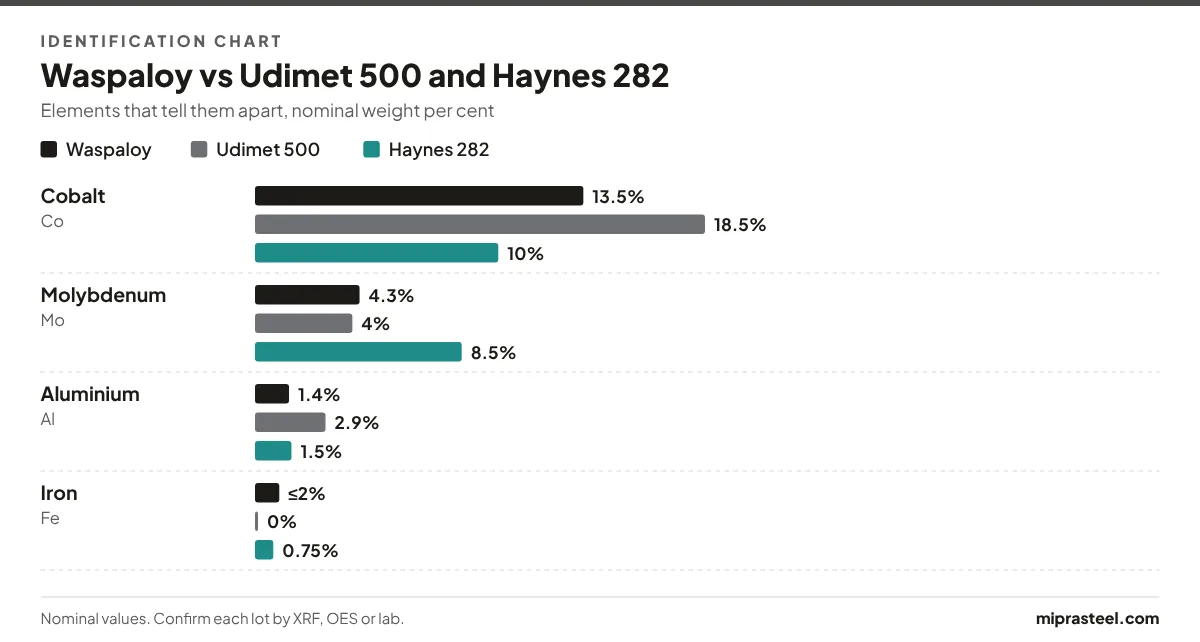
Nominal values for Waspaloy against its closest grades on this site.
Preparing Waspaloy Scrap for Sale
- Keep Waspaloy apart from Inconel 718 and other disc alloys, machine by machine.
- Separate forging flash and ring crops, whole parts, bar ends and turnings into their own lots.
- Drain and dry turnings, and keep tool tips and inserts out of the bins.
- Remove bolts, coatings and fittings of other alloys from retired engine parts.
- Record heat, forging or part numbers and keep certificates with the lot.
Waspaloy Scrap Price per Kg: What Decides It
There is no single Waspaloy scrap price per kg. An offer starts from the nickel, cobalt and molybdenum in the lot, then moves with how sure the buyer can be about the grade and how much work the lot needs.
- Contained nickel at about 58%, plus cobalt at about 13.5%, which adds a large share of the value.
- Molybdenum at about 4.3%, a smaller credit.
- Grade certainty: forging or heat numbers, readings on every piece, or a single machine source make a lot easier to describe as Waspaloy.
- Form: forging flash, ring crops and whole parts are valued above turnings, which carry oil, moisture and contamination risk.
- Iron and niobium pick-up: any Inconel 718 in the lot lowers its value to a Waspaloy melter.
- Lot size, packing and location: a full container of sorted, drummed material from a port city costs less to handle.
Nickel and cobalt both trade daily, so every offer carries a date. Read how nickel alloy scrap is valued and how superalloy revert returns to the melt.
Waspaloy Scrap Import and Export
Importing Waspaloy Scrap into India
Waspaloy scrap arises wherever turbine discs are forged, machined or overhauled: Europe, North America, the Gulf and East Asia. Lots for India go through pre-shipment inspection before loading, and the certificate travels with the invoice, packing list and bill of lading to Nhava Sheva or Mundra. Naming the cargo as "Waspaloy nickel superalloy scrap, UNS N07001" with readings attached keeps it from being lumped in with mixed turbine scrap. More detail: importing nickel alloy scrap into India.
Exporting Waspaloy Scrap from India
India's aerospace and turbine supply chain produces Waspaloy flash, crops and turnings that overseas superalloy melters value when they are single-grade and documented. For export, each drum or crate is weighed and listed by form, and the invoice names Waspaloy and N07001. Buyers in the Gulf and East Asia can work through our Dubai office or South Korea office. Paperwork is covered in alloy scrap export documents.
Customs heading: 7503.00 (nickel waste and scrap). The HS code is the international tariff heading the scrap is declared under; national tariff lines add further digits, so confirm the full line with your customs broker.
Related Reading
Waspaloy Scrap FAQ
What is Waspaloy scrap?
Waspaloy scrap is any recovered material made from Waspaloy, UNS N07001: forging flash, ring crops, machining turnings, bar ends and retired engine parts. It is a nickel superalloy with about 13.5% cobalt and 4.3% molybdenum, so it is valued on nickel, cobalt and molybdenum together.
How do I tell Waspaloy scrap from Inconel 718?
Check niobium and iron. Inconel 718 reads about 5% niobium and 18% iron. Waspaloy has no niobium, iron of 2% or less, and about 13.5% cobalt. A handheld XRF separates the two in seconds, which matters because many disc shops machine both alloys.
Is Waspaloy the same as Udimet 500?
No. Both are cobalt-bearing gamma-prime alloys, but Udimet 500 reads about 18.5% cobalt and 2.9% aluminium, while Waspaloy reads about 13.5% cobalt and 1.4% aluminium. Aluminium needs OES or a light-element XRF reading to separate them with confidence.
What is the W.Nr. or UNS number for Waspaloy?
Waspaloy is UNS N07001 and W.Nr. 2.4654. Bar and forgings are bought to AMS 5704, 5706, 5707, 5708 and 5709 or ASTM B637; sheet, strip and plate to AMS 5544; welding wire to AMS 5828.
Why are Waspaloy turnings worth less than solids?
Turnings carry cutting oil and moisture, oxidise more easily and can pick up tool fragments or chips of other alloys from the same machine. Clean, dry, single-grade turnings close much of the gap; mixed or oily turnings are priced for the cleaning and the risk.
Does Mipra Steel buy and export Waspaloy scrap?
Yes. Mipra Steel buys, sells, imports and exports Waspaloy scrap, solids and turnings, from Mumbai, with offices in Dubai and South Korea. Send the form, weight, location, photos and any readings. We review incoming enquiries and respond with relevant next steps.
Which HS code applies to Waspaloy scrap?
Nickel is the largest element, at about 58%, so Waspaloy scrap is normally declared under heading 7503.00, nickel waste and scrap. National tariff lines add further digits, so confirm the full line with your customs broker.
Published by Mipra Steel, Khetwadi, Mumbai · Updated