Why Do Nickel Alloy Turnings Have to Be Kept to One Grade?
Turnings are the chips that come off a lathe, mill or drill. When a shop in Mumbai cuts Inconel 718 bar on Monday and Inconel 625 on Tuesday, the two piles of chips look the same. They are not the same to a melter. 718 carries far more iron and niobium than 625, Monel 400 is nickel and copper, and Hastelloy C-276 carries molybdenum and tungsten. A melt shop charges turnings into a heat of a known alloy, so it can only use a lot whose grade it can trust.
A drum of mixed nickel alloy chips has to be sorted again, which is slow for small chips, or it is valued as its least useful grade. Keeping grades apart at the machine costs very little; separating them later is rarely practical. How turnings compare with solid scrap is covered in solids vs turnings.
How Should a Shop Set Up Bins at the Machine?
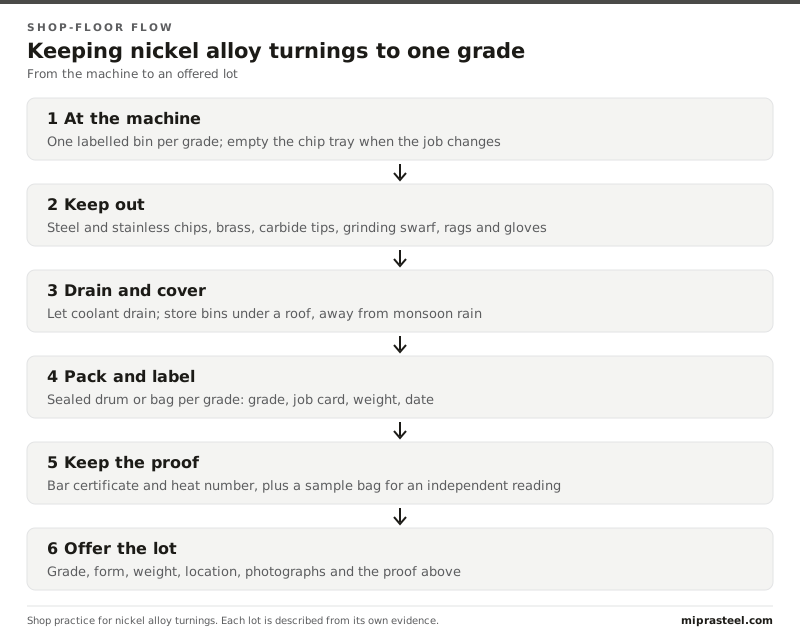
- Give every machine that cuts nickel alloys one bin per grade it runs, and label each bin with the grade name and UNS number, for example "Inconel 718, N07718".
- When a job changes grade, empty the chip tray, conveyor and coolant sump strainer into the old grade's bin before the first cut of the new job.
- Write the grade, job card or order number and date on a tag fixed to the bin, not on a loose sheet.
- Keep a separate small bin for broken carbide tips and inserts. Tungsten carbide is its own scrap material and does not belong in nickel alloy turnings.
- Keep grinding swarf, sweepings, rags and gloves out of the turnings bins entirely.
Machine operators decide the quality of the lot more than anyone else in the chain, so the bin rules work best when they are written at each machine in the language the operators read.
What Should Never Go Into a Nickel Alloy Turnings Bin?
| Material | Why it causes trouble | What to do |
|---|---|---|
| Carbon and alloy steel chips | Steel adds iron the melt did not plan for and is magnetic | Separate bin; check suspect bins with a magnet |
| Stainless steel chips | Looks like nickel alloy and is not magnetic, so it hides easily | Separate bin; job card shows which jobs were stainless |
| Brass and bronze chips | Copper, zinc and lead are unwelcome in most nickel melts | Separate bin, away from Monel and copper-nickel |
| Carbide tips and inserts | Tungsten carbide is a different scrap material | Own bin; see tungsten carbide scrap |
| Grinding swarf and sweepings | Fine, oxidised and mixed with abrasive | Keep out of turnings altogether |
| Rags, gloves, plastic, wood | Non-metallic contamination | Separate waste bin at the machine |
A magnet catches steel but not stainless or brass, which is why separation at the machine matters more than checking afterwards. Most nickel alloys are non-magnetic, so a magnet only tells you something is wrong; see the magnet test.
How Do Coolant, Oil and the Mumbai Monsoon Affect Turnings?
Turnings leave the machine wet with coolant or cutting oil. Liquid in a drum is weight the buyer will not pay for, and wet, oily chips are harder to sample and to handle. Let bins drain over a tray before they are emptied into drums, and do not top up a drum that is still dripping.
In Mumbai, the monsoon months add rain and high humidity. Store bins and filled drums under a roof and off the ground, close drum lids, and do not leave turnings in an open yard between June and September. Rainwater in a drum adds weight, can carry dirt in, and makes the lot harder to describe honestly. Where turnings need crushing, drying or degreasing before melting, that work is done further along the chain by processors or the melter; the shop's part is to keep the chips clean, dry and to one grade.
What Proof Should a Shop Keep for Each Lot?
- The bar or forging certificate for the material the job was cut from, with its heat number. See reading mill test certificates.
- The job card or order number written on the bin tag, so the chips can be traced to that certificate.
- A sample bag of a few handfuls from each drum, labelled with the drum number, so a reading can be taken without opening every drum.
- An independent reading where the grade needs confirming: handheld XRF for most elements, spark OES or a laboratory where light elements matter. See XRF, OES or a lab? and PMI testing.
Mipra Steel reviews this evidence when a lot is offered and, where the grade needs confirming, arranges independent testing. The checks we look for are listed on our quality page.
How Do You Offer a Turnings Lot from a Mumbai Shop?
Pack each grade in its own sealed drum or bag, mark the grade, UNS number, drum number and net weight on it, and photograph the drums and a close-up of the chips. Then send the grade, form, weight, location, photographs and whatever certificates and readings you hold. Shops in Mumbai, Thane, Navi Mumbai and the industrial belts around them can offer lots through our Mumbai page or the sell your scrap form. The scrap preparation guide covers packing in more detail. We review incoming enquiries and respond with relevant next steps.
Turnings segregation FAQ
Can different nickel alloy turnings go in one drum?
No. Each grade should have its own bin and drum. A mixed drum has to be re-sorted, which is slow for small chips, or it is valued as its least useful grade.
How do I tell Inconel turnings from stainless steel turnings?
Neither is strongly magnetic, so a magnet will not separate them. Keep them apart at the machine using the job card, and confirm doubtful bins with an independent XRF reading.
Should turnings be dried before they are sold?
Let them drain and keep them dry and covered, especially in the monsoon. Any crushing, drying or degreasing needed before melting is done further along the chain; the shop should not add water or leave drums open.
What should go on a turnings drum label?
The grade and UNS number, the drum number, the net weight, the date and the job card or heat number that links the chips to their certificate.
Do carbide inserts belong with nickel alloy turnings?
No. Broken carbide tips and inserts are tungsten carbide, a separate scrap material. Collect them in their own small bin at the machine.
Sources and Review
Figures are quoted as published in these sources; any value we could not confirm has been left out.
- Grade descriptions on this page (iron and niobium in Inconel 718 against 625, copper in Monel 400, molybdenum and tungsten in Hastelloy C-276) summarise the grade pages linked above. Their compositions come from the producer datasheets named on those pages: Special Metals Corporation for Inconel 625, Inconel 718 and Monel 400, and Haynes International for Hastelloy C-276.
- Shop-floor practice on this page (bins per grade, labelling, keeping out other materials, drainage and covered storage, sample bags) describes general handling of machining scrap and is not a specification.
Published by Mipra Steel, Khetwadi, Mumbai · Last updated