Key takeaways
- Ferro tungsten is 70–85% tungsten under ISO 5450 and is used mainly in high-speed, hot-work and other tool steels.
- Grades differ by tungsten band, carbon class and residual limits on copper, tin and other tramp elements.
- Ferro tungsten, pure tungsten, tungsten carbide and heavy alloy are four separate materials with different buyers; keep them apart.
- Ferro tungsten scrap is valued on contained tungsten, adjusted for carbon, residuals, form and how fairly the lot was sampled.
The uses of ferro tungsten all come back to one property: tungsten keeps steel hard when it gets hot. A drill or a hot-forging die that softens at working temperature is useless, and tungsten, added through ferro tungsten, is one of the elements that stops that happening.
This article covers what ferro tungsten is, the steels and alloys it goes into, the grades in the standards, and how ferro tungsten scrap is described and valued. It also explains, carefully, why ferro tungsten is not the same thing as pure tungsten or tungsten carbide, three materials that are often confused and that go to three different kinds of buyer.
What Is Ferro Tungsten?
Ferro tungsten is a master alloy of iron and tungsten made by reducing tungsten concentrates and supplied as crushed lumps for steelmaking. ISO 5450 defines it as containing between 70% and 85% tungsten. Commercial material is most often traded in the 75–85% band and called FeW 80.
The raw materials are concentrates of wolframite or scheelite, the two main tungsten ores. They are reduced by thermite or electric furnace methods, and the solid alloy is broken and crushed to size. Thermite-produced alloy can have a segregated structure, meaning tungsten is not perfectly even from one part of a block to another. That matters later, when a lot has to be sampled fairly.
Why not add pure tungsten to steel? Pure tungsten melts at about 3,420°C, far above the temperature of liquid steel, so it would dissolve slowly and unevenly. In an iron-tungsten alloy the tungsten goes into the melt far more readily, and the iron that comes with it is simply part of the steel.
What Are the Uses of Ferro Tungsten?
The main uses of ferro tungsten are in high-speed steels, hot-work and other tool steels, heat-resistant steels, and hardfacing and welding alloys. In each case tungsten is there to form hard carbides and to hold strength and hardness at high temperature.
High-Speed Steels
High-speed steels are the classic home for tungsten. The tungsten-based grades carry a large tungsten content, and the molybdenum-based grades carry less tungsten with molybdenum doing part of its job. Drills, taps, milling cutters, broaches and saw blades made from these steels keep their edge even when friction heats them close to red heat, a property called red hardness.
Hot-Work Tool Steels
Dies for hot forging, extrusion and die casting are in contact with hot metal for long periods. Tungsten-bearing hot-work steels resist softening and thermal fatigue in this service.
Heat-Resistant Steels and Hardfacing
Tungsten also appears in some heat-resistant steels and in hardfacing and welding consumables, where hard tungsten carbides in a steel matrix resist abrasion. Valve seats, wear plates and earth-moving parts are typical applications.
Ferro tungsten is one of several special additions that tool steel melters buy. Vanadium usually arrives with it, through ferro vanadium, and molybdenum from ferro molybdenum. The overview of ferro alloy types sets out where each one fits.
- 74WTungstenthe paying element, 70 to 85 per cent under ISO 5450
- 6CCarbonsets the grade class, low-carbon grades suit more steels
- 42MoMolybdenumlimited, because it changes the steel’s balance
- 29CuCoppera residual that cannot be removed from steel
- 50SnTina tramp element that harms hot working
- 15PPhosphorusheld low to protect toughness
Which Industries Rely on Tungsten-Bearing Steels?
The demand for ferro tungsten follows the industries that cut, form and wear metal. When those industries are busy, tool steel melters buy more tungsten additions; when they slow, surplus ferro tungsten starts to appear at plants.
- Machining and tool making. Drills, taps, reamers, milling cutters and saw blades in high-speed steel, used across automotive, general engineering and aerospace machining.
- Forging and extrusion. Hot-work dies and punches that run against hot billets for hours at a time.
- Mining, earthmoving and oil and gas. Hardfaced wear parts, drilling tools and valve components that face abrasion and heat.
- Welding consumables. Hardfacing electrodes and wires that deposit tungsten-bearing, wear-resistant layers.
Many of these tools are now made in tungsten carbide rather than tool steel, which is why carbide and high-speed steel scrap so often turn up side by side in a machine shop's bins.
What Are the Ferro Tungsten Grades?
Ferro tungsten grades are defined by tungsten band and by carbon class, with limits on residual elements. ISO 5450 sets the overall 70–85% tungsten range, and national standards break it into designations.
The current Indian draft revision of the ferrotungsten standard is a useful illustration because it publishes its grade table in full. It lists these main grades:
| Designation | Tungsten | Carbon, max | Where it fits |
|---|---|---|---|
| FeW90C05 | 85.0–95.0% | 0.05% | Special high-purity uses, including nuclear applications |
| FeW80C10 | 75.0–85.0% | 0.10% | Low-carbon grade for tool and alloy steels |
| FeW80C60 | 75.0–85.0% | 0.60% | General steelmaking where carbon is less critical |
The same standard sets maximums for silicon, phosphorus, sulfur, molybdenum and aluminium, and for residual metals such as manganese, copper, nickel, arsenic, antimony, tin and bismuth. Those residuals are the reason a tool steel melter reads the whole certificate, not just the tungsten figure: copper and tin cannot be refined out of steel once they are in, as explained in tramp elements in remelting.
Ferro-silico-tungsten, a related alloy with silicon, shares HS subheading 7202.80 with ferro tungsten but is described separately in trade.
How Is Ferro Tungsten Different from Pure Tungsten and Tungsten Carbide?
Ferro tungsten is an iron-based steelmaking alloy; pure tungsten is unalloyed refractory metal; tungsten carbide is a cemented material of carbide grains held in a cobalt or nickel binder. They share an element, but they come from different sources, look different and go to different processors.
| Ferro tungsten | Pure tungsten | Tungsten carbide | Tungsten heavy alloy | |
|---|---|---|---|---|
| Iron as the main other element | ● | ○ | ○ | ◐ |
| Cobalt or nickel binder | ○ | ○ | ● | ◐ |
| Typical form in scrap | crushed lumps and fines | sheet, rod, wire, electrodes | inserts, rods, buttons, sludge | blocks, weights, shielding |
| Usual end user | steel melt shop | tungsten processor | carbide recycler | tungsten processor |
| HS subheading | 7202.80 | 8101.97 | 8101.97 | 8101.97 |
● yes ◐ partly ○ no
- Pure tungsten is about 99.95% tungsten and has a density of about 19.3 g/cm³. It comes from furnace elements and shields, lamp and electronic wire, and welding electrodes. It is recycled by tungsten processors, not charged into steel as an alloying addition.
- Tungsten carbide is tungsten carbide grains bonded with cobalt, typically 6–12% cobalt, at around 14–15 g/cm³. It comes from worn inserts, end mills, drills and mining bits, and goes to carbide recyclers who recover both tungsten and cobalt. The tungsten carbide scrap guide explains those routes.
- Tungsten heavy alloys are about 90–97% tungsten with nickel and iron or copper, used for counterweights and radiation shielding.
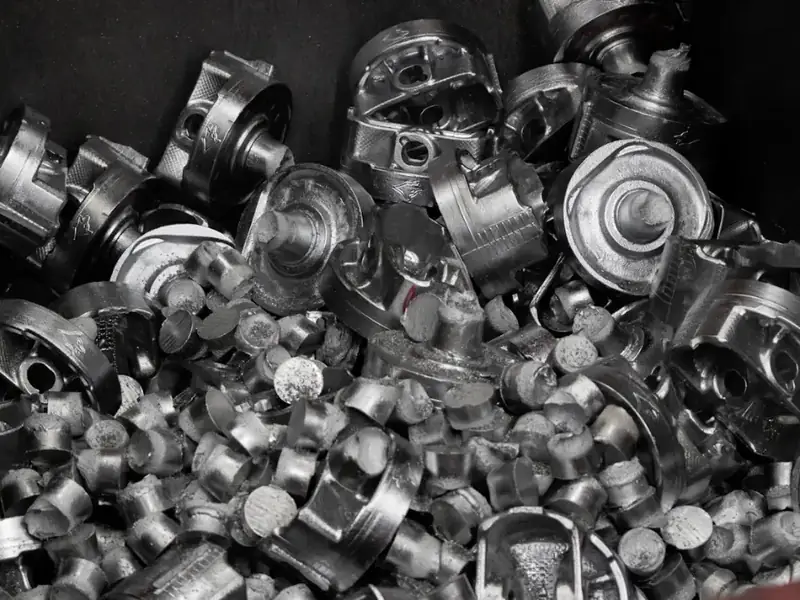
- Ferro tungsten is an iron-tungsten alloy with no binder phase, broken into irregular lumps, and goes back to a steel plant.
The practical rule is simple. Shape tells you a lot: tool shapes are carbide, machined or drawn shapes are pure tungsten or heavy alloy, and angular broken lumps are ferro tungsten. XRF then confirms it, because carbide shows cobalt or nickel, heavy alloy shows nickel with iron or copper, and ferro tungsten shows a large iron balance.
Where Does Ferro Tungsten Scrap Come from?
Ferro tungsten scrap is mostly off-grade or surplus alloy, not used parts, because the tungsten it carries ends up dissolved in steel. The common sources are:
- fines and undersize from crushing and screening;
- melts or lots outside a buyer's tungsten, carbon or residual limits;
- surplus stock at plants that have stopped making tungsten-bearing steels;
- part-used drums, sometimes repacked without a clear label.
Worn high-speed steel tools and tool steel offcuts are a separate stream. They are remelted as alloy steel scrap and return their tungsten to the next heat directly, so they are sorted by steel grade rather than sold as ferro tungsten. Mixing either of these with tungsten carbide tools in one bin is a common and costly mistake: high-speed steel is strongly magnetic and around 8 g/cm³, carbide is only weakly magnetic and nearly twice as heavy, and each goes to a different buyer.
How Do You Check a Ferro Tungsten Scrap Lot?
Check tungsten first, then carbon class and residuals, then sampling, size and paperwork. Because the alloy can be segregated and is very heavy, a fair sample matters more than for most ferro alloys.
- Tungsten contentXRF on several pieces gives a reliable first figure
- Carbon classlow-carbon and higher-carbon grades suit different steels, and carbon needs a laboratory
- Residual metalscopper, tin, arsenic, antimony and bismuth are limited in the grade tables
- Molybdenumreported because some grades limit it closely
- Samplingtake increments across the lot, since one lump may not represent a segregated melt
- Size and finesstate the size range and the share of fines
- Paperworkproducer certificate where one exists, and the HS subheading 7202.80
Our guide to choosing XRF, OES or a laboratory explains why tungsten can be read on a handheld analyser while carbon cannot. A short weight check also helps: ferro tungsten is noticeably heavier for its size than ferro chrome or ferro vanadium, so a lump that feels light deserves a reading before it goes into the bag.
How Should Ferro Tungsten Be Packed and Stored?
Pack ferro tungsten in strong, small units and keep it dry and labelled by grade and lot. Its density catches people out: a drum that would hold a modest weight of most materials becomes very heavy when filled with ferro tungsten, and over-filled bags split when lifted.
- 1Keep one grade per containernever top up a drum of one grade with another
- 2Label every drum or baggrade, lot number, net weight and date
- 3Separate finesstore fines in sealed drums so they stay dry and clean
- 4Store under coverrain and floor dirt add weight that is not tungsten
- 5Record the paperworkkeep the producer certificate with the lot it describes
Steel drums or heavy-duty bags of limited size are the usual choice. Mark the net weight clearly, because buyers and hauliers both need it, and note any repacking. The scrap preparation guide covers labelling and packing for other materials too.
What Sets the Ferro Tungsten Scrap Price per Kg?
The ferro tungsten scrap price per kg follows contained tungsten first, then how closely the lot meets a usable grade. No figure is given here, because the tungsten market moves and every lot differs.
- Tungsten content. Offers are usually built on the kilograms of tungsten in the lot.
- Carbon and residuals. High carbon, copper or tin limits which tool steel melters can use the material.
- Certainty. A fresh analysis of a properly drawn sample carries more weight than an old label.
- Form. Lumps in a standard size class are easier to charge than fines or sweepings.
- Quantity and mixing. Uniform lots of one grade are easier to place than drums of mixed origin.
The contained metal calculator shows how tungsten content and weight combine into the figure a buyer works from.
How Do You Buy or Sell Ferro Tungsten Scrap?
To buy or sell ferro tungsten scrap, send a lot description that answers the buyer's first questions before they are asked: grade, measured tungsten, carbon and residuals if known, size range, packing, quantity and location, with photographs of the material and of any drum markings.
Mipra Steel, based in Mumbai, buys and supplies ferro tungsten scrap and related tungsten materials described by grade, and handles import and export enquiries from India and abroad. Buyers in South Korea and Japan, both large tool and special steel producers, ask for the same evidence. The ferro tungsten scrap page lists the product details, the ferro alloy and metal scrap overview lists related materials, and you can send us the grade, form, quantity and photos when you are ready. We'll review your enquiry and come back with relevant next steps.
Submit a requirement with the grade, form, quantity and delivery location.
Source a GradeFAQ
Why is tungsten added to steel?
Tungsten forms hard, stable carbides and keeps steel hard and strong at high temperature, a property known as red hardness. That is why it is used in high-speed steels for cutting tools, in hot-work tool steels for forging and extrusion dies, and in some heat-resistant and hardfacing alloys.
Is ferro tungsten scrap the same as tungsten carbide scrap?
No. Ferro tungsten is an iron-tungsten alloy that goes back into steelmaking. Tungsten carbide is a cemented material of carbide grains and a cobalt or nickel binder, recycled by specialist processors who recover tungsten and cobalt. They should never be mixed in one lot. See tungsten carbide scrap.
What is FeW 80?
FeW 80 is the usual trade name for ferro tungsten with roughly 75–85% tungsten, the band most commercial material falls in. ISO 5450 covers ferro tungsten from 70% to 85% tungsten, and national standards add carbon classes and residual limits to the designation.
What is the HS code for ferro tungsten?
Ferro-tungsten and ferro-silico-tungsten fall under HS subheading 7202.80. Pure tungsten and tungsten carbide waste and scrap fall under 8101.97 instead. National tariff lines add further digits, so confirm the exact line with a customs broker before shipping.
Can XRF measure tungsten in ferro tungsten?
Yes. Handheld XRF gives a reliable tungsten reading and shows iron, copper and other metals, which is enough to separate ferro tungsten from pure tungsten, carbide and other ferro alloys. Carbon needs a laboratory combustion analysis, and a fair sample across the lot is needed for a figure the buyer will accept.
Is high-speed steel scrap the same as ferro tungsten scrap?
No. High-speed steel scrap is worn or offcut tool steel containing several per cent tungsten along with chromium, molybdenum and vanadium. It is remelted as alloy steel scrap. Ferro tungsten is a master alloy with 70–85% tungsten, added to steel in small amounts. The two are sorted and sold separately.
Why does ferro tungsten need careful sampling?
Ferro tungsten produced by thermite methods can be segregated, so tungsten content varies within a block, and crushed lots can separate by size during handling. A sample built from many increments across the lot gives a fair figure; a single lump can mislead both buyer and seller.